
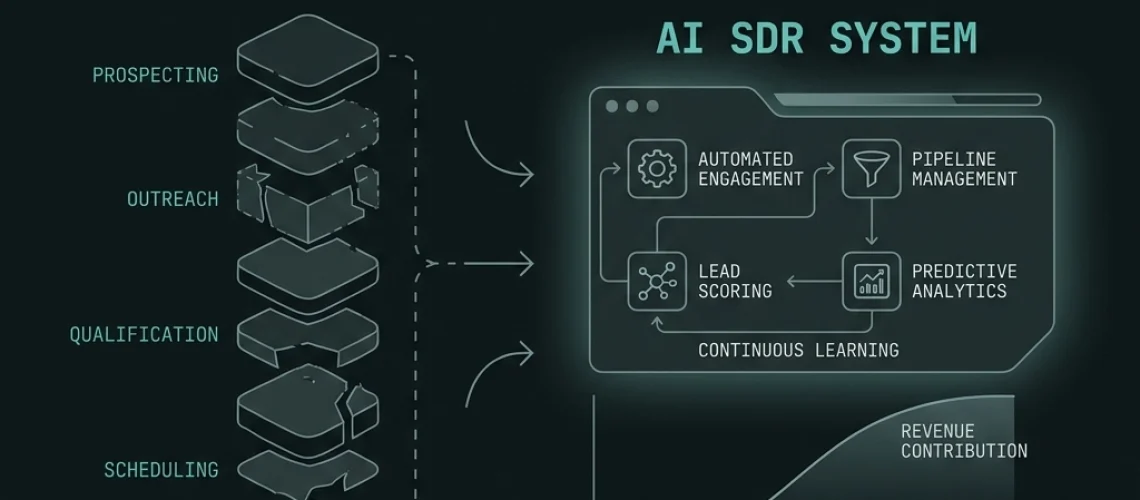
You’re staring at a stack of resumes for a sales development rep for your startup, realizing that even the "entry-level" candidates want a $60k base plus benefits for a role that has an average turnover of 14 months. It’s a Sunday night, and you’re trying to figure out how to scale your outbound without lighting $10,000 a month on fire. You need pipeline to raise your next round, but you can’t afford the overhead of a human sales team that takes three months just to ramp up.
Hiring a human SDR in 2026 is a 20th-century solution to a 21st-century problem. The math doesn't work for early-stage founders anymore. We’re going to show you why AI agents are now outperforming humans in nearly every metric that matters to a lean startup: from cost per lead to research depth: and how you can bridge the gap between "automation" and "authentic sales."
The SDR Turnover Crisis in Tech
The traditional SDR model is fundamentally broken. When you hire a human sales development rep for your startup, you aren’t just paying a salary. You’re paying for the recruiter, the laptop, the seat in the office (or the remote stipends), the Slack subscription, and the ZoomInfo license. By the time you’ve "fully loaded" that hire, you’re looking at a $100k+ annual commitment.
Here is the kicker: the average tenure for an SDR is now roughly 14 months. It takes four months for them to learn your product and your ICP (Ideal Customer Profile). They give you about eight months of "productivity": if you’re lucky: and then they either get promoted to Account Executive or they quit for a $10k raise at a Series B company down the street.
As a founder, you end up in a perpetual cycle of hiring and training. You spend more time managing "activity metrics" and checking if they actually sent their 50 emails a day than you do actually closing deals. You’re paying for human potential, but you’re mostly getting human error and burnout.
Efficiency and Scalability: The AI Advantage
An AI agent doesn't have a "bad Monday." It doesn't get discouraged after ten "unsubscribe" replies in a row. It doesn't need a 1:1 meeting to stay motivated.
When you look at the ai-sdr-vs-human-sdr-2025 comparison, the efficiency gap is staggering. A human SDR can effectively research and personalize about 20–30 high-quality emails per day. Any more than that, and the quality drops off a cliff. They start using templates. They start "spraying and praying."
An AI agent, specifically one built for research-first outbound, can ingest a prospect's LinkedIn profile, their recent podcast appearances, their company’s 10-K filing, and their latest tweet in seconds. It can do this for 500 prospects while you’re eating lunch.
This isn’t about just sending "more" email. It’s about doing more better work. Because the cost of compute is dropping while the cost of human labor is rising, the ai-sdr-pricing-breakdown-2025 shows that you can run a full-scale outbound engine for the price of a few Starbucks lattes a day.

Visual: A dark, minimal editorial graphic showing a comparison chart between a Human SDR (High Cost, Low Volume, High Turnover) and an AI SDR (Low Cost, High Volume, 24/7 Availability).
The "Spam" Objection: Can AI Handle Complex Nuance?
The biggest fear founders have is that an AI will burn their domain by sending robotic, "hope this finds you well" garbage to their best prospects. We’ve all seen the LinkedIn posts mocking AI-generated outreach.
The reason most AI outbound fails isn’t because it’s AI: it’s because the person setting it up treated it like a glorified mail merge. At Ramen, we approach this differently. We believe in a "Human-in-the-loop" system.
Instead of letting an agent run wild, you use AI to do the heavy lifting of research and drafting. The AI finds the "trigger": maybe a prospect just hired a new VP of Engineering or mentioned a specific pain point on a webinar. It drafts a message based on that specific data point.
Then, you (the founder) or a delegated reviewer can see those drafts. You see the research it found. You hit "approve." This prevents the ai-sdr-mistakes-kill-reply-rates that happen when you trust an unguided bot. You get the scale of a machine with the taste and judgment of a founder.
Deep Research vs. Template Blasting
Most SDRs use "snippets." They have a folder of templates where they swap out the [First_Name] and [Company_Name]. Prospects can smell this a mile away.
An AI agent doesn't need templates. It understands your value proposition and matches it against the prospect's actual problems. If you're using a research-first outbound AI SDR, the machine is looking for context. It’s looking for why you are reaching out today, not just because their name was on a list you bought from a database.
This level of research used to take a human 20 minutes per lead. For a startup, that’s 20 minutes of a $60k/year salary. It’s a luxury you can’t afford. AI makes deep research a commodity.
The BYOK Model: Control Your Own Tech Stack
One of the frustrations with "all-in-one" sales platforms is the "black box" pricing. You pay a massive monthly fee, and you have no idea how much of that is going to the AI and how much is just "platform tax."
We advocate for the ai-sdr-stack-own-api-keys approach. By bringing your own API keys (from OpenAI, Anthropic, or others), you only pay for what you actually use. You aren't subsidizing a sales team's fancy office in San Francisco. You’re paying for the raw intelligence used to book your demos.
This transparency is vital for seed-stage startups where every dollar needs to be accounted for. When you own the keys, you own the process.

Visual: A minimal, dark-themed diagram showing the "Ramen Flow": Data Source -> AI Research -> Founder Review -> Inbox. The style is clean and professional.
Why Founders Are the Best "SDRs" (With AI Help)
In the early days, you shouldn't be outsourcing the "learning" of your market to a 22-year-old who doesn't understand your product. You need to hear the objections. You need to see what resonates.
But you also don't have 4 hours a day to sit in sales tools.
The AI agent acts as your force multiplier. It does the "grunt work" of finding leads, verifying emails, and writing the first drafts. You do the "thinking" work of refining the ai-driven-outbound-playbook.
When a lead replies, it’s not a hand-off to a junior rep who might drop the ball. It’s a direct line to you, the founder. You are the one booking the demo. You are the one closing the deal. This is how you replace-sdr-with-ai-agent without losing the human touch that closes enterprise deals.
Scaling Without the Agency Overhead
Many founders, desperate for pipeline, turn to lead gen agencies. They pay a $5,000/month retainer for "qualified appointments."
The problem? Most agencies are just using the same tools you could buy yourself, but they’re adding a massive markup to cover their own staff. They often prioritize quantity over quality because their contract is tied to the number of "meetings," even if those meetings are with people who have zero intent to buy.
When you scale-outbound-without-agencies, you keep that $5,000 in your bank account. You keep the data. You keep the relationship. Most importantly, you keep the "signals" coming in from the market, rather than having them filtered through an agency account manager who just wants you to renew your contract.
Conclusion: The New Math of Sales
The math for hiring a human SDR simply doesn't add up for the modern startup. Between the ai-sdr-agents-booked-demos performance and the sheer cost savings, the choice is becoming binary.
You can either spend the next three months recruiting, onboarding, and managing a human who might quit in a year, or you can spend the next three hours setting up an AI agent that works for you forever.
If you want to stop staring at resumes and start staring at booked demos, it’s time to change your strategy. Use a tool that prioritizes research over volume and puts you in control of the process.
Scale smarter at Ramen.so. No more $60k bases. No more "hope this finds you well" templates. Just deep research and better pipeline.