
You're staring at a $120K loaded cost for your first SDR. Three months to ramp. No guarantee they'll hit quota. Your runway says you have eight months to prove product-market fit, but your investor deck promised aggressive growth. Sunday nights are spent crafting cold emails instead of building product. Sound familiar? Here's the truth most founders won't admit: you can't afford an SDR yet, but you can't afford not to have outbound running. Enter AI agents.
The Real Math Behind Your First Sales Hire
Before diving into AI solutions, let's get honest about what hiring an SDR actually costs. Base salary ranges from $45K-$65K depending on your market. Add 30-40% for benefits, payroll taxes, and equipment. Factor in management time (20% of your week minimum), tools ($200-$500/month), and the fact that 60% of SDR hires don't work out in the first six months.
You're looking at $80K-$120K annually, plus three months of negative ROI while they learn your product, ideal customer profile, and messaging. For a pre-seed founder burning $30K monthly, that SDR represents 25-40% of your annual burn rate.
Most founders I talk to know these numbers but hire anyway because the alternative feels like giving up on growth. That's where AI agents change the game, not by replacing humans entirely, but by giving you a viable path to consistent outbound while you prove you can afford dedicated sales headcount.
What AI Agents Actually Replace (And What They Don't)
An AI agent handles the grunt work that consumes 70% of an SDR's day: prospect research, list building, email sequencing, and follow-ups. It doesn't replace the relationship-building, objection handling, or complex deal navigation that separates great SDRs from order-takers.
Think of it this way: the AI agent gets prospects to raise their hand. You handle everything after "yes, I'm interested."
The research is compelling. Companies using AI for outbound prospecting see 2-3x higher response rates from timely engagement and can scale outreach 5-10x with the same headcount. But here's what the case studies don't tell you: this works because the AI handles volume and consistency while humans focus on conversations that actually close deals.

When AI Agents Make Sense for Founders
You're a good candidate for AI-first outbound if you're checking these boxes: pre-seed to Series A, doing founder-led sales, burning through weekends on manual outreach, can't justify $100K+ for unproven sales headcount, or have been burned by agencies that blast your domains into the spam folder.
AI agents excel in scenarios where you need consistent touchpoints across multiple prospects simultaneously. If your deal size is $10K-$50K annually and your sales cycle is 2-6 weeks, an AI agent can handle the top-of-funnel volume while you focus on demos and closing.
The sweet spot is B2B SaaS with clear buyer personas. If you're selling to "anyone who needs software," AI won't save you. But if you're targeting Series B marketing directors at fintech companies, or founders of bootstrapped agencies, AI agents can execute that precision at scale.
Implementation: Your First 30 Days
Week 1: Audit and Setup
Start by auditing your current outbound motion. What's your actual reply rate? How many prospects can you realistically contact manually per week? This baseline helps you measure AI impact later.
Define your Ideal Customer Profile obsessively. AI agents are only as good as the data you feed them. "Marketing directors" is too broad. "Marketing directors at B2B SaaS companies with 20-100 employees, recently funded Series A, using HubSpot" gives the AI something to work with.
Week 2: Message Framework and Voice
Create 3-5 message templates that sound like you, not a marketing agency. Include your actual pain points, specific use cases, and clear next steps. The AI will personalize around this framework, so make sure the bones are solid.
Set up your tech stack. You'll need email infrastructure (your own domain and SMTP), a CRM to track interactions, and the AI agent platform. Budget $200-$400 monthly for tools: still 90% less than an SDR.
Week 3: Test and Iterate
Start with 20-30 prospects daily. Monitor reply rates, bounce rates, and sentiment. Good AI outbound should hit 8-15% positive reply rates. If you're under 5%, your messaging needs work. Over 20%? Scale up gradually.
Week 4: Scale and Optimize
Increase volume based on results. Track leading indicators: emails sent, bounce rates, replies, and meetings booked. Optimize message templates based on what's generating responses.
Handling the Objections (Because You're Thinking Them)
"AI emails are obviously spam."
Bad AI emails are spam. Good AI emails research each prospect individually, reference specific company details, and offer genuine value. The difference is in the implementation, not the technology.
"This will ruin my domain reputation."
Only if you do it wrong. Proper AI outbound includes domain warm-up, authentication setup, and volume controls. Start with 20-30 emails daily and scale based on deliverability metrics.
"I need someone who can handle complex sales conversations."
You do. That's why the AI agent qualifies interest and you handle the actual selling. It's not replacing your sales process: it's feeding your sales process with qualified prospects.
"What about when I do hire an SDR?"
The AI agent becomes their research assistant. Instead of spending hours building lists, they focus on conversations. Your first SDR becomes 3x more productive because the AI handles prospecting and sequencing.
The Human-in-the-Loop Reality
Here's what separates effective AI outbound from spam: human oversight. You're not setting up a bot to blast emails while you sleep. You're creating a research and outreach assistant that drafts personalized emails for your approval.
This human-in-the-loop approach means you're still involved in every conversation, but you're not spending Sunday nights manually researching prospects on LinkedIn. The AI presents you with researched prospects and draft emails. You approve, edit, or reject before anything goes out.
It's the difference between having an assistant and having a replacement. The assistant handles the work you don't want to do. You handle the work only you can do.
When to Graduate to Human SDRs
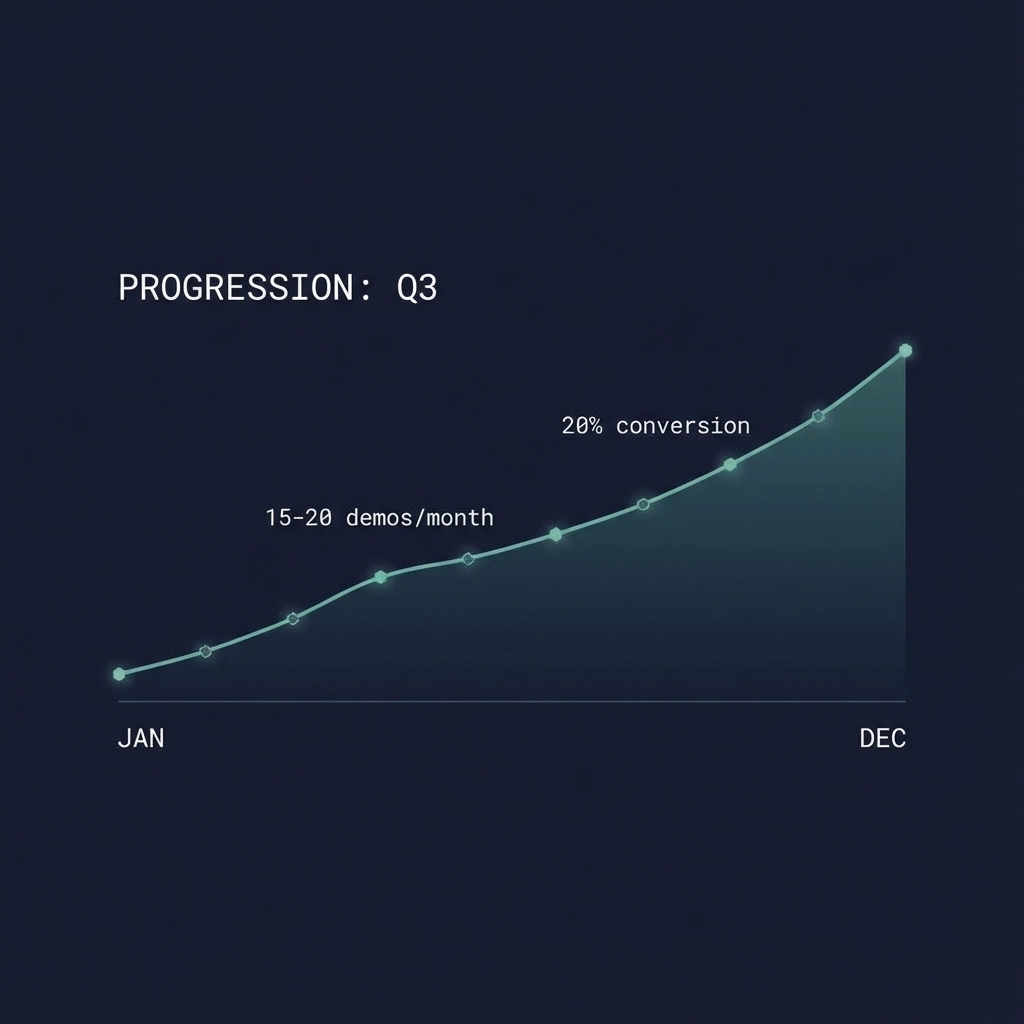
Once you're consistently booking 15-20 qualified demos monthly and converting 20%+ to trials or sales conversations, consider adding human SDR support. You've proven the demand exists and the unit economics work.
Your first SDR hire becomes much easier because you have data on what messaging works, which personas respond, and how long your actual sales cycle takes. Instead of guessing, you're hiring based on proven demand.
The AI agent doesn't disappear: it becomes your SDR's prospecting engine. They focus on relationship-building and deal advancement while the AI handles list building and initial outreach.
Making the Call
If you're spending 15+ hours weekly on manual outbound, burning weekends researching prospects, or watching your runway shrink while waiting to afford an SDR, an AI agent is worth testing. The setup cost is under $1,000 and monthly costs run $500-$1,500: roughly what you'd spend on an SDR's laptop.
The goal isn't to avoid hiring humans forever. It's to build sustainable pipeline while you prove your market and extend your runway. Think of it as bridge funding for your sales motion.
Ready to see how AI agents can transform your outbound without the enterprise software complexity? Book a demo and we'll walk through exactly how this works for early-stage founders who need results next week, not next quarter.