
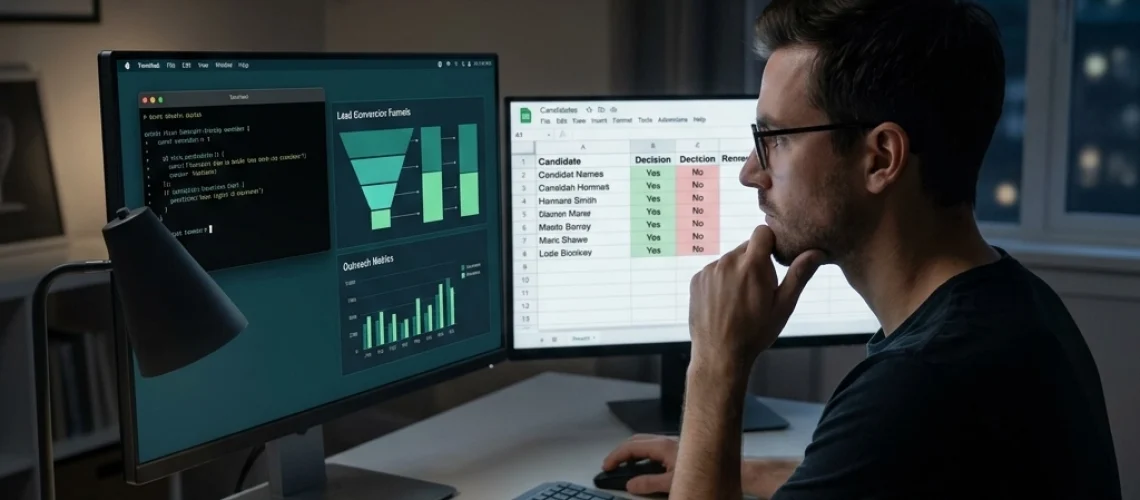
It’s Sunday night, 10:00 PM. You’ve spent the last three hours scanning LinkedIn profiles and trying to find something: anything: to mention in a cold email that doesn’t sound like it was written by a chatbot from 2021. Your product is great, but your pipeline is a desert. You’re the CEO, the lead engineer, and the support team. You can’t be the full-time SDR too.
The thought hits you: I’ll just hire a contract SDR.
It feels like a smart move. You don't want the $80,000–$120,000 loaded cost of a full-time hire, and you certainly don't want to deal with benefits or equity for a role that might not even work out. A freelancer or a boutique agency seems like the perfect "middle ground." You pay a few thousand a month, they send the emails, and you just show up to the meetings.
Except that’s almost never how it actually goes.
Instead of a pipeline full of qualified leads, you usually end up with a high-priced babysitting project. You’re tempted by the lack of commitment, but you end up with someone who is juggling four other clients and giving your brand exactly 20% of their attention.
The Multi-Client Trap of Contract Sales
When you hire a contract SDR, you aren't hiring a teammate; you're hiring a business owner. Their business model depends on volume: not your volume of leads, but their volume of clients.
If they’re charging you $2,000–$3,000 a month, they need at least four or five other "yous" just to keep their lights on. This creates a fundamental misalignment of incentives. You need deep, thoughtful research to break through the noise of a crowded inbox. They need to hit their activity metrics across five different dashboards so they don't get fired by any of their clients.
In this environment, your brand is the one that suffers. When an SDR is distracted, they default to templates. They start "spraying and praying." They misinterpret your ICP because they haven't spent 40 hours a week thinking about your problem space: they’ve spent eight.
The result? You aren't just losing money on the contract; you're burning your market. A bad first impression from a distracted contractor can take years to fix. Outbound isn’t hard because you’re bad at sales; it’s hard because you’re the bottleneck, and trying to solve that bottleneck with a part-time human usually just adds "manager" to your already overflowing list of titles.

The Management Tax You Didn't Account For
The biggest lie in the "hire SDR" playbook is that it saves you time.
If you hire a contractor, you still have to:
- Build the lead lists (or verify the ones they buy).
- Write the initial scripts (because they don't know your "why" like you do).
- Handle the technical setup of their inboxes so they don't tank your domain reputation.
- Hop on a weekly "sync" to hear why the open rates are down.
Suddenly, you're spending five to ten hours a week managing a person to do a job that they aren't even doing at a high level. You've traded your "doing" time for "managing" time, but the output hasn't actually improved. You’re still the one who has to fix the messaging when it fails.
For a solo founder, time is the only resource you can't get more of. Spending it managing a mediocre contractor is a fast way to kill your startup's momentum.
Automation vs. Distraction: The Case for AI
This is where the math shifts. In the past, your only options were "Do it yourself" or "Hire a human." But the landscape has changed. 2026 is the year startups go AI-first for a reason: AI doesn't have four other clients.
When we talk about an AI SDR, we aren't talking about a basic sequence tool. We’re talking about an agent that can do the one thing your distracted contractor refuses to do: research.
A contractor will look at a LinkedIn title and send a template. An AI agent can look at a prospect’s latest podcast appearance, read their company’s 10-K filing, and cross-reference their recent hires to find a genuine reason to reach out. It can do this for 500 prospects in the time it takes a human to finish their first cup of coffee.
The choice isn't between "Human" and "Bot." It's between "Distracted Human" and "Dedicated Intelligence."
Why Relevance Wins Every Time
You might think, "Isn't a person better for building relationships?"
It’s a fair question. But here’s the cold truth: Relationships start with relevance.
No one wants to build a relationship with someone who sent them a "quick bump" email. You build a relationship with someone who demonstrates that they understand your specific problem right now.
A distracted human contractor doesn't have the bandwidth to be relevant to 50 people a day. They barely have the bandwidth to be relevant to five. An AI SDR, however, can be hyper-relevant to every single person in your CRM. It doesn't get bored of researching. It doesn't skip the "About Us" page to save time. It treats every lead like it's the only one that matters.

The Real Math: SDR Costs vs. AI Efficiency
Let's look at the numbers. A decent contract SDR will cost you $2,500/month on the low end. Over six months, that’s $15,000.
In that time, you’ll likely spend 100+ hours of your own time managing them, reviewing their work, and fixing their mistakes. If your time as a founder is worth $200/hour (a conservative estimate), you’ve just spent another $20,000 in "founder tax."
Total cost: $35,000 for a part-time effort.
Compare that to an AI-driven approach. You can replace your SDR functions with an AI agent for a fraction of that cost. More importantly, the "management tax" drops to nearly zero once you’ve tuned the system. You aren't managing a person's motivation or their "other clients": you're simply approving high-quality drafts that already reflect your best thinking.
The $499 vs. $80k decision is a no-brainer for a solo founder. One option scales with your ambition; the other scales with your stress levels.
Objection: "But I want a human touch!"
We get it. You don't want to be "that guy" sending spam. You care about your brand.
But "human touch" is a buzzword that often masks inefficiency. If "human touch" means sending a template that says "I saw you work at [Company Name]," that's not human: that's a script.
The most effective way to maintain your brand's integrity is a Human-in-the-Loop model. You don't let the AI run wild. You use the AI to do the 95% of the work that is tedious (researching, drafting, lead sourcing) and you spend your 5% of the time as the editor-in-chief.
You read the draft, you see the deep research the AI pulled, you give it a thumbs up, and then it sends. You get the quality of a founder-led email with the scale of a machine. This is the safest way to automate outbound without ruining your brand.
Stop Being the Bottleneck
If you’re a solo founder, your job is to find product-market fit and close deals. It is not to spend your weekends writing cold emails or your Tuesday mornings arguing with a freelancer about why they shouldn't have emailed your current investors.
Hiring a contract SDR is a band-aid on a structural problem. The problem isn't that you need "a person" to do sales; the problem is that you need a scalable system to generate interest.
In 2026, building that system doesn't require a payroll or a management degree. It requires the right stack. You need a tool that lets you personalize at scale without templates and keeps you in control of the final send.
Skip the contract. Skip the "multi-client trap." Focus on building your company while your AI agent focuses on building your pipeline.
The era of the "distracted contractor" is over. It's time to scale your outbound without agencies and get back to the work that actually moves the needle.
If you're tired of the Sunday night spreadsheet grind, maybe it's time to stop looking for a freelancer and start looking for a better way to work. You can keep your "human touch" and your sanity at the same time.
Ready to scale without the headcount? Skip the contract and scale your pipeline with Ramen.so.