
You send 50 emails using your "personalized" template. You get 2 replies. Both prospects ask to be removed from your list.
The template mentioned their company name and recent funding round. It should have worked. But here's what actually happened: 47 other founders got the exact same email structure with different company names swapped in. Your "personalization" was just mail merge with extra steps.
Templates don't scale personalization. They scale sameness. And prospects can smell sameness from their inbox preview.
Why Templates Kill Real Personalization in Cold Email Outreach
Templates work backwards. You start with a structure, then try to fit prospects into that structure. This creates two problems:
First, you sound like everyone else using the same template framework. When every cold email starts with "I noticed you recently raised…" or "Love what you're doing with…", prospects stop reading after five words.
Second, you miss the unique context that actually matters to each prospect. Templates force you to pick generic talking points that work for anyone instead of specific insights that work for this one person.
The math is brutal: a 2% reply rate on 100 template emails gets you 2 conversations. A 20% reply rate on 10 researched emails gets you 2 conversations. But the researched approach takes one-tenth the volume and doesn't burn your domain reputation.
The Research-First Workflow for Personalized Email Outreach
Real personalization starts with research, not templates. This is how to run personalized email outreach without turning into a template factory. Cold email AI can help you gather inputs, but keep a human in the loop for the actual message.

Step 1: The 5-Minute Research Sprint
For each prospect, spend exactly 5 minutes gathering three types of intel:
Company context: Recent news, hiring patterns, product updates. Check their About page, recent blog posts, and press mentions from the last 90 days.
Personal context: LinkedIn activity, recent posts, speaking engagements. Look for opinions they've shared or problems they've mentioned.
Timing context: Funding announcements, leadership changes, product launches. Find the business events that create urgency.
Set a timer. Don't research for 20 minutes per prospect. Five minutes forces you to find what actually matters instead of collecting random facts.
Step 2: Find the One Thing
During your research sprint, identify the one insight that would make this person think "how did they know that matters to me?"
Not their company size. Not their industry. Not their job title. Find the specific challenge, opportunity, or context that's unique to their situation right now.
Examples of good "one things":
- They're hiring SDRs but posting about founder-led sales burnout
- Their product just launched but their LinkedIn shows they're still doing all the demos
- They raised money but their job posts suggest they can't find experienced sales talent
Examples of bad "one things":
- They're a SaaS company
- They recently got funding
- They're growing fast
Step 3: Write the Insight-First Email
Start with your insight, not your pitch. Lead with what you noticed that prompted you to reach out.
Bad opening: "I noticed you recently raised Series A funding. Congrats!"
Good opening: "Saw your LinkedIn post about doing 40 demos last month while trying to ship your new API. That founder-led sales grind hits different when you're trying to build product too."
The good version proves you actually read something specific they shared. The bad version could apply to 500 other companies that raised funding this quarter.
Step 4: Connect the Dots
After leading with your insight, make the connection to why this matters for their business right now. Don't jump straight to your solution.
Bad transition: "We help founders like you scale their outbound."
Good transition: "Most founders in your position try to hire an SDR at this stage, but that's $80K you probably can't spare while you're still pre-revenue."
Connect your insight to a business reality they're facing. This shows you understand their constraints, not just their goals.
Step 5: The Soft Introduction
Now introduce what you do, but position it as a specific solution to the specific problem you just identified.
Bad introduction: "Ramen is an AI SDR platform that helps startups scale their sales."
Good introduction: "We built something for founders stuck in your exact situation: an AI research assistant that handles the prospect digging and email writing, but you approve everything before it sends."
The difference: the good version connects directly to the insight and constraint you just mentioned. It feels like a logical next step, not a random sales pitch.
Where cold email AI fits (and where it doesn't)
Use AI to surface signals faster—company news, hiring patterns, LinkedIn activity. Keep the judgment call human: which insight matters, how to frame it, and whether to send now or later. That's how you protect deliverability and avoid generic AI-sounding emails.
(Related: See Ramen integrations for research sources you already use → https://ramen.so/integrations)
How to Scale Cold Email Personalization Without Losing Quality
You can't research every prospect forever. Here's how to scale this workflow without falling back into template mode:
Batch similar insights: After researching 20 prospects, you'll notice patterns. Founders struggling with founder-led sales. Companies hiring but posting about scaling challenges. Group prospects by insight type, not by industry or company size.
Create insight frameworks, not email templates: Instead of copying exact email language, create frameworks for each insight pattern. "When prospect shows X signal, lead with Y observation, connect to Z constraint."
Use tools for research, not writing: Tools can surface the insights faster: recent company news, hiring patterns, LinkedIn activity. But write the emails yourself based on what the research reveals.
The goal isn't outbound sales automation that writes everything for you. It's automation that gathers inputs while you control the message.
Real Example: Cold Email Personalization at Seed Stage
Here's a real example of research-first personalization:
Research findings: Prospect posted on LinkedIn about interviewing SDR candidates but getting "terrible answers to basic qualification questions." Their company just raised Series A but job posts show they're hiring junior sales roles.
Insight: They need sales capacity but can't find quality SDR talent.
Email approach: Lead with the observation about SDR interview quality, connect to the constraint of needing sales help while maintaining quality standards, position Ramen as the research and writing capability without the hiring risk.
Result: Not a template that could work for any growing startup. An email that could only work for someone in this exact situation.
(See more examples and breakdowns on our blog → https://ramen.so/blog)
Tradeoffs of Outbound Sales Automation vs Manual Personalization
This approach requires tradeoffs that most "scale at all costs" advice ignores:
Volume vs. quality: You'll send fewer emails. But you'll get more replies per email sent, and better-quality conversations.
Time vs. results: Five minutes per prospect feels slow compared to bulk template sends. But it's faster than hiring and training an SDR who takes three months to ramp.
Manual vs. automated: You can't completely automate research-first personalization. But you can automate the research gathering and keep the insight development human.
The math works when you factor in deliverability. Template blasting at high volume destroys your domain reputation. Research-first personalization protects it.
Glossary: Personalized Email Outreach, Cold Email AI, Outbound Sales Automation
- Personalized email outreach: Prospect-by-prospect messages based on real research and context, not variable-swapped templates.
- Cold email AI: Software that helps collect signals, draft options, and manage steps. Best used with human-in-the-loop review to avoid generic messages.
- Outbound sales automation: Automating the steps around outreach (research collection, sequencing, reminders) while keeping message quality and approval human.
- Human-in-the-loop: You approve every email before it sends. Guardrail for quality and deliverability.
- BYOK (bring your own API keys): You connect your own AI/provider keys so you control speed and cost. (Pricing details → https://ramen.so/pricing)
- Template blasting: High-volume sends using the same structure with minor token swaps. Fast to ship, fast to burn reputation.
FAQs: Email Personalization and Cold Email AI
Q: How do I personalize cold emails at scale without templates?
A: Run a 5-minute research sprint, find one insight that actually matters, write the email around that insight, and group prospects by repeating patterns. Automate the research collection, not the thinking.
Q: Do AI-written cold emails get flagged as spam?
A: Spam issues usually come from volume, low relevance, and poor domain setup—not just AI use. Keep human approval, send at realistic pacing, and focus on specific insights. Set up SPF/DKIM/DMARC and warm sensibly.
Q: When are templates okay?
A: Use internal frameworks, not prospect-facing templates. Define how you open, connect constraints, and close for each insight pattern. Don't reuse the same sentences; reuse the logic.
Q: What reply rate should I expect with research-first outreach?
A: It varies by segment and offer. The point is reply quality and fit. Research-first sends routinely outperform template blasts on both reply rate and meeting quality.
Q: How many minutes per prospect is enough?
A: Five minutes is the sweet spot. It forces focus. If you can’t find a meaningful insight in five, the prospect might not be a fit right now.
Q: What tools do I need to support this workflow?
A: Anything that pulls recent news, hiring signals, and social activity into one place helps. Start with the tools you already use. (Integrations we support → https://ramen.so/integrations)
Getting Your Sundays Back (Human-in-the-Loop, BYOK)
If you're spending Sunday nights writing cold emails instead of planning your week, you need a system that handles the research and drafting while keeping you in control of what actually gets sent.
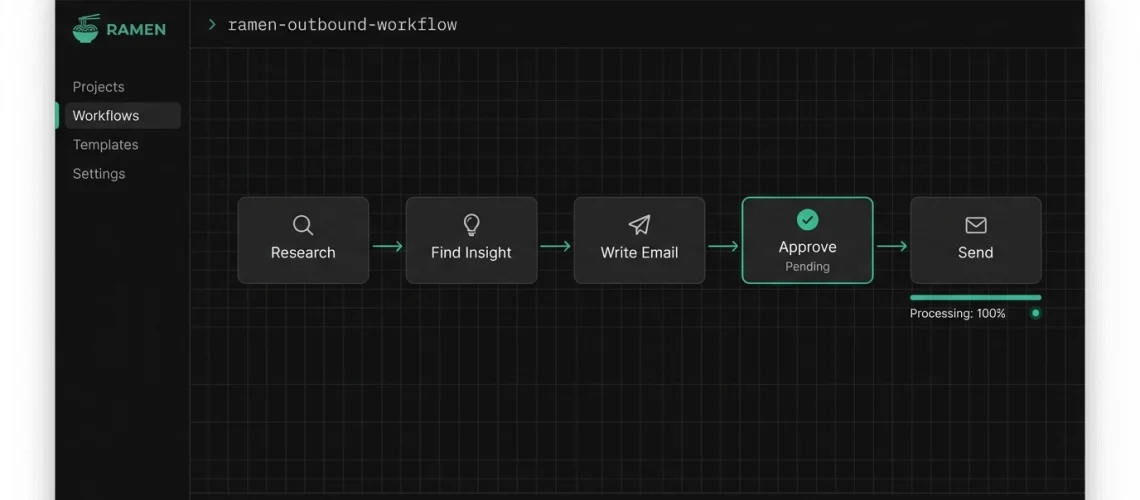
That's exactly what we built Ramen to do: research each prospect, draft personalized emails based on real insights, and queue everything for your approval. No templates. No auto-send. Just research-first personalization that gives you back your weekends.