

You're spending six hours every Sunday writing cold emails. You've burned through three domains this year. Your reply rate hovers around 2%. And everyone keeps telling you the same thing: "You need to get better at sales."
That's wrong. You're not bad at sales. You're just the bottleneck.
Jump to: Research Reality | Process Bottleneck | FAQs
Quick definitions
- Startup outbound prospecting: systematically identifying and researching likely buyers at early-stage companies so emails aren’t random.
- AI SDR: software agents that handle prospect research, drafting, and follow-ups. With Ramen, you approve every email before it sends. See AI SDR approach
- Outbound sales automation: the workflows that move leads from research to first touch to booked demo—sequencing, enrichment, deliverability, and follow-ups.
- Human-in-the-loop: you review and approve outputs to protect brand and domain.
- BYOK: bring your own AI API keys so you control model choice and cost.
You're Not Scaling : You're Context-Switching
Here's what your Monday looks like: Check Apollo for new leads. Export to a CSV. Upload to your cold email tool. Write personalized first lines for 50 prospects. Set up sequences. Check deliverability. Warm up your backup domain. Research prospects on LinkedIn. Update your CRM. Send follow-ups manually.
You just spent four hours before lunch, and you haven't built a single feature or talked to a single customer.
The problem isn't that you're bad at outbound. The problem is that you're trying to be a full-time SDR while running a company. Every minute you spend researching prospects is a minute you're not talking to users. Every hour you spend setting up sequences is an hour you're not building product.
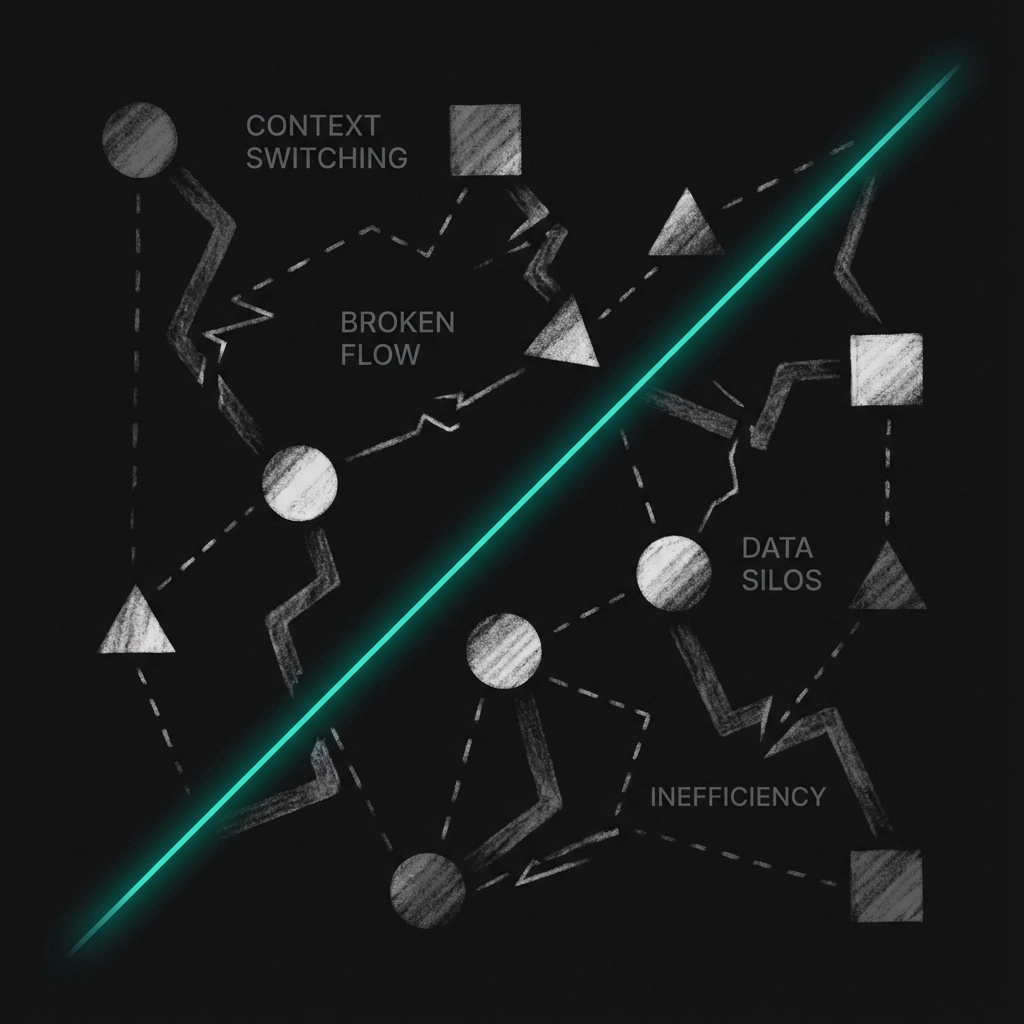
Your competitor with a $120K SDR isn't beating you because their founder is a better salesperson. They're beating you because their founder isn't spending 20 hours a week managing outbound infrastructure.
The Outbound Sales Automation Bottleneck
You've cobbled together Apollo for data, Instantly for sequences, Clay for enrichment, and some random Chrome extension for LinkedIn research. Now you're spending more time moving data between tools than actually reaching prospects.
Every platform has its own login, its own interface, its own way of handling duplicates. You're constantly exporting CSVs, cleaning data, and fixing sync errors. Your "streamlined" sales stack has 47 different tabs open, and you need a PhD in SaaS integrations just to send a cold email.
This isn't efficiency. This is digital quicksand.
Meanwhile, your SDR-equipped competitor is booking demos while you're troubleshooting why your enrichment tool thinks your prospect works at "null" company.
Startup Outbound Prospecting: Quality vs. Quantity
You're sending 100 emails a day because someone told you "it's a numbers game." But 90% of those prospects aren't actually a fit for what you're building.
You're blasting generic sequences to anyone with a Director title because you don't have time to research whether they actually have the problem you solve. You're prioritizing volume because research takes time, and time is the one resource you don't have.
Result: 2% reply rate, and half of those replies are unsubscribes.
The bottleneck isn't your closing ability. It's that you're trying to squeeze real research and personalization into the gaps between product meetings. You know good prospects when you see them, but you don't have the time to find them systematically.

The Process Bottleneck
You have no system for what happens after someone replies. Prospects slip through the cracks because you saw their email during a product sprint and forgot to follow up. You're managing leads in three different places: your email inbox, a Google Sheet, and that CRM you set up but never actually use.
When someone asks for a demo, you spend 15 minutes trying to remember what you wrote in your first email so you can reference it. Half your discovery calls start with "Sorry, remind me how you found us again?"
This isn't a sales skills problem. This is a bandwidth problem.
The Research Reality
Good outbound requires research. Not "I see you work at Acme Corp" research. Real research: understanding their tech stack, recent hiring, competitive landscape, and actual pain points.
That research takes time. For 50 prospects, you're looking at 4-5 hours of real work. Add email writing, sequence setup, and follow-up management, and you've just committed to a part-time job.
You know what good research looks like. You know how to write emails that get replies. But you can't do it at scale while also being a CEO.
What Changes When You Remove the Bottleneck
Companies with SDRs aren't more successful because they have better salespeople. They're more successful because their founders aren't doing SDR work.
When you're not spending Sundays writing cold emails, you're talking to users. When you're not managing sequences, you're building features. When you're not researching prospects, you're raising money or hiring team members or doing the hundred other things that only you can do.
The SDR advantage isn't about sales talent. It's about founder focus.
But here's the catch-22: you need pipeline to raise money, but you need money to hire an SDR. The math doesn't work. A good SDR costs $80-120K loaded, takes three months to ramp, and might quit after six months.

The Real Solution
What you need isn't sales training. You need to stop being the bottleneck without hiring someone you can't afford.
This means finding a way to get the research depth and personalization quality of a good SDR without the $120K commitment or three-month ramp time. It means having someone (or something) that can spend the time on proper prospect research while you spend time on things that actually move the business forward.
The best founders aren't better at cold email than you. They just found a way to get it done without doing it themselves.
FAQs
-
What is founder-led outbound?
Founder-led outbound is when you own startup outbound prospecting yourself—research, writing, and follow-ups—on top of product and fundraising. It works early, but it doesn’t scale without a workflow and some automation. -
How do I remove the outbound bottleneck without hiring?
Standardize research, use outbound sales automation for sequencing and follow-ups, and keep a human-in-the-loop for quality. If you use an AI SDR approach, approve every email before it sends and watch domain health. -
Aren’t AI SDR emails just spam?
Spam is volume without research. An AI SDR should do deep research per prospect and draft context-specific emails you review. If there’s no research or approval step, it’s a spam machine—don’t use that. -
Which cold outreach tool should a startup use first?
Pick what protects your domain and your time: a reliable sender, basic enrichment, and a workflow that ties research to messaging. Tools change; the workflow—research, write, send, follow up—doesn’t. If you want one place to run it with control, Ramen keeps you approving emails and lets you bring your own API keys. -
How does BYOK reduce costs?
You choose models via your own API keys, pay usage directly, and avoid vendor markups while keeping the workflow and visibility.
Ready to get your Sundays back? See how Ramen handles the research and writing while you stay focused on building. $499/month, human approval on every email, and you keep your API keys.