

You finally did it. You closed the seed round. The wire hit, the deck is filed away, and your VCs are already asking about your "go-to-market motion." The advice is always the same: "You need to scale. Hire an SDR."
So you do. You spend $10,000 on a recruiter to find a "hungry" 23-year-old with a year of experience at a big SaaS firm. You pay a $5,000 signing bonus. You spend weeks onboarding them, explaining the product, and setting up their seat in a CRM that costs another $300 a month.
Three months later, you’re sitting at your desk on a Sunday night, rewriting their cold emails because the reply rates are at zero. You realize you’re still the only one booking demos.
This is the Founder's Trap. It’s a $100,000 mistake that kills startups before they even find product-market fit. In this post, we’re going to look at why the traditional first sales hire is a relic of 2018 and how smart founders in 2026 are automating their pipeline instead.
The High Stakes of Your First Sales Hire
Most founders view hiring an SDR as a way to "buy back their time." They think if they throw money at the problem, the top of the funnel will magically fill up.
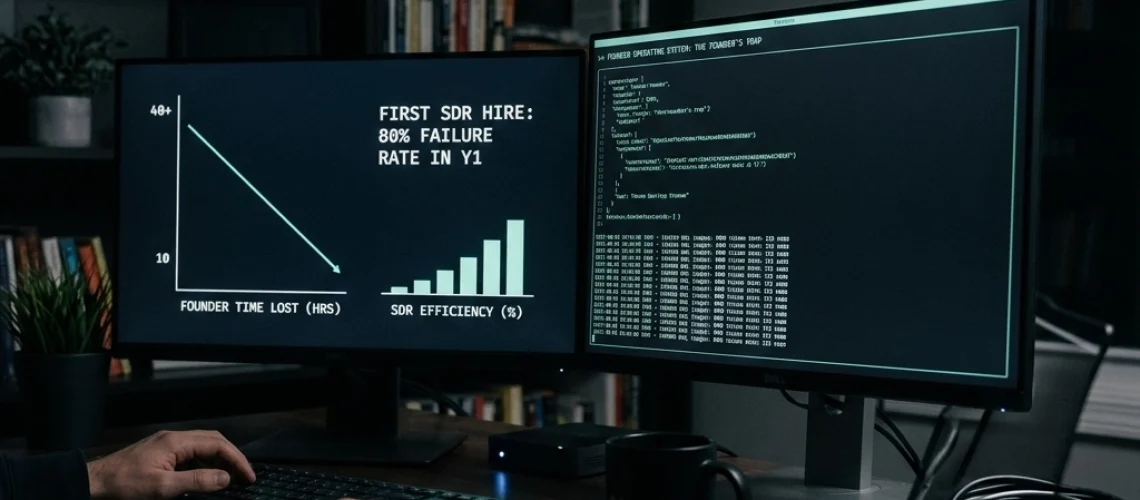
The reality is that hiring a human SDR is the highest-variance bet you can make in your first year. If it works, you’re a genius. If it fails, which happens more than 60% of the time for first sales hires, you haven’t just lost the salary. You’ve lost six months of runway and the momentum of your seed round.
The costs are more than just the base salary. When you factor in taxes, benefits, commissions, and the "tech stack" required to keep them productive, the real SDR costs usually land between $80,000 and $120,000 per year. For a startup with 18 months of runway, that’s a massive chunk of your lifeblood dedicated to a role that hasn't even proven it can generate a return yet.
Worse, when a human SDR fails, they don't fail quietly. They fail by burning your domain reputation with generic templates, misrepresenting your product to high-value prospects, and requiring three hours of your time every week for "coaching" that never seems to stick.
Why Founders Make the Best (and Worst) First Sales Reps
Every founder is told they need to get out of the way of sales. But at the early stage, your "Founder Magic" is actually your biggest asset. You know why you built the product. You understand the nuances of the pain points. When you hop on a call or write a personalized note, people listen because you have the authority of a creator.
This makes you the best sales rep you’ll ever have. You can pivot a conversation in real-time because you know the roadmap.
However, you are also the worst sales rep for one simple reason: you are the bottleneck.
You can’t spend eight hours a day researching prospects on LinkedIn. You can’t manually check 40 different news sources to see if a target account just hired a new VP of Engineering. You have a product to build and investors to manage.
The "trap" is thinking the only solution to this bottleneck is a human. Founders often hire an SDR because they want a "mini-me" who can do the research and the reaching out. But a junior hire will never have your context, and they’ll never care as much as you do. They’ll fall back on templates, and in 2026, templates are the fastest way to get marked as spam.

The "Culture" Myth: Why Process Trumps People Early On
When I tell founders they should automate their outbound before hiring a human, the most common objection I hear is: "But don't I need a human to build the sales culture?"
This is a fundamental misunderstanding of what culture is. Culture isn't two people high-fiving in a Slack channel because a lead opened an email. Culture is the set of repeatable processes and standards that define how your company interacts with the world.
If you hire a human to "figure it out," you aren't building culture, you're delegating your strategy to someone with the least experience in the company.
At Ramen, we believe you should build the process first. When you use an AI agent to handle the heavy lifting of research and initial outreach, you are forced to define your ICP (Ideal Customer Profile) and your messaging with mathematical precision. You learn what actually works because you’re looking at data, not just "vibes" from a weekly sales meeting.
By the time you actually need a human sales leader, you’ll be handing them a machine that already works. That is how you build a culture of winning.
The 2026 Reality: Human SDRs vs. AI Agents
The outbound landscape has changed. In 2021, you could win by being "loud", sending 100 emails a day and hoping for a 1% reply rate. In 2026, the filters are too good and prospects are too tired.
If your outreach doesn't show that you’ve done deep research on the prospect, it gets deleted. A human SDR can realistically do deep research on maybe 10-15 prospects a day if they’re being thorough. An AI agent can do it for 500.
Let’s look at the numbers. A typical human SDR hire:
- Cost: $8,000 – $10,000 per month (loaded).
- Ramp time: 3 months before they’re even "warm."
- Consistency: Variable. People get sick, they have bad weeks, they get bored of the grind.
- Output: ~50 personalized touchpoints per week.
Now look at an AI SDR agent:
- Cost: $499 per month.
- Ramp time: 24 hours.
- Consistency: 100% uptime. It doesn't get "bored" of researching 10-K filings.
- Output: Thousands of deeply researched, personalized emails that actually sound like they came from the founder.
When you see it laid out like that, the 499 vs 80k decision becomes a no-brainer for any founder who cares about their runway.
Handling the "AI sounds like a robot" Objection
"But Penny," you might say, "I’ve seen AI emails. They’re terrible. They all start with 'I hope this email finds you well' and use words like 'leverage' and 'synergy.'"
You’re right. Most "AI" tools are just wrappers around basic GPT prompts that use a generic template. That’s not what we’re talking about here.
The secret to personalizing at scale without templates is a human-in-the-loop system. You don't let the AI just blast emails into the void. The AI does the grunt work: reading the prospect's recent LinkedIn posts, finding their podcast appearances, and identifying a specific business pain: and then it drafts a high-quality email.
The founder (the "human in the loop") spends 15 minutes a day reviewing and approving those drafts. You keep the "Founder Magic" and the total control over your brand, but you lose the 40 hours a week of manual labor. This is why 2026 is the year startups go AI-first in their sales orgs.

Don't Hire Until It Hurts (And Even Then, Wait)
The most successful founders we work with at Ramen follow a simple rule: Automate until the volume of incoming leads is so high that you physically cannot handle the discovery calls yourself.
That is the only time you should hire. And even then, your first hire shouldn't be an SDR. It should be an Account Executive (AE) or a founding salesperson who can close the deals the AI is booking for you.
Hiring an SDR to book meetings for a founder who is already busy is just adding more noise to a system that needs a signal.
If you are currently:
- Spending your weekends writing cold emails.
- Feeling guilty that your outbound has "stalled" because you’re focused on product.
- Considering spending $15k on a recruiter to find a sales rep.
Stop. You don't need a hire. You need a system.
Automate Before You Hire
The "Founder's Trap" is easy to fall into because it feels like progress. Hiring people feels like "scaling up." But true scaling is about increasing output while keeping costs flat.
At Ramen, we built a platform specifically for the founder who is doing it all. We give you the tools to scale outbound without agencies or expensive hires. You bring your own API keys, you control your costs, and you approve every single word that goes out to your prospects.
It’s not magic. It’s just a better way to work. You can keep spending $80k on a gamble, or you can spend $499 on a system that works as hard as you do.
Before you sign that recruiter contract, see how Ramen can automate your pipeline. Give yourself the chance to be the founder who scales with code and intelligence, not just more headcount. Your runway (and your Sunday nights) will thank you.