
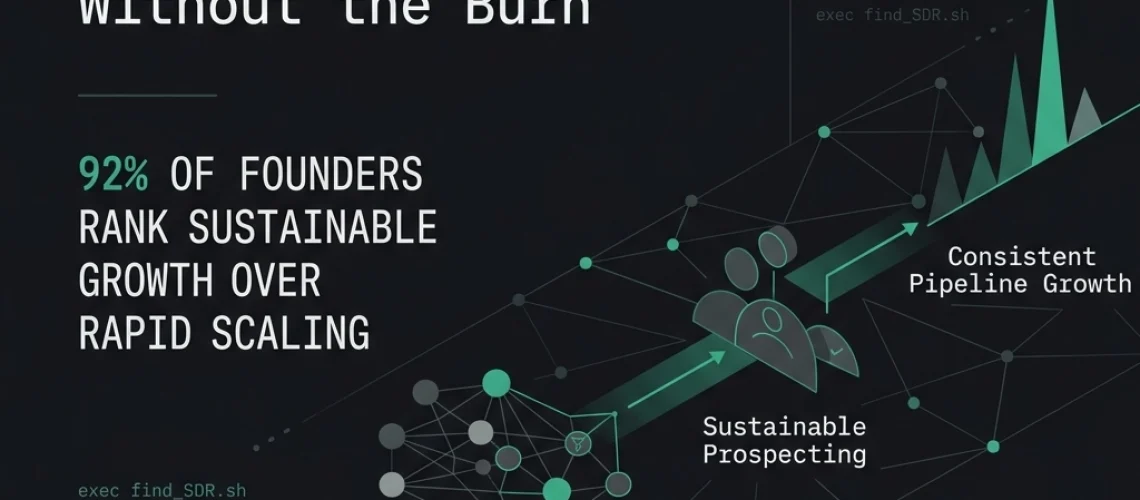
Most founders treat hiring a sales development rep for startup growth like buying a lottery ticket. You spend $8,000 to $10,000 a month on a salary plus commission, spend three months "ramping" them up, and then pray they don't quit the moment they actually start delivering results. Usually, they do. Or worse, they stay, but your calendar remains empty because they’re just "burning through the list" with templated garbage that makes your brand look like a spam factory.
It’s a gamble you can’t afford when you’re pre-seed or seed-stage. Every dollar is a day of runway. Every bad hire is a month of momentum lost.
If you’re feeling the pressure to scale your outbound but the thought of managing a 22-year-old who needs their hand held every Monday morning makes you want to close your laptop, you’re not alone. There is a repeatable, research-backed method to scale your outbound without the traditional hiring risk. You just have to stop thinking about sales development as a "person problem" and start seeing it as a "process problem."
Why Traditional Hiring is Broken for Startups
The standard advice is: "Hire an SDR so you can focus on building." This is the fastest way to burn $100k of VC money with zero ROI.
The typical sales development rep for startup growth stays in their role for less than 14 months. For a startup, that timeline is brutal. You spend 3-4 months training them on your niche, your product, and your tone. You spend another 2 months watching them fail to book meetings. By the time they’re finally hitting their stride, they’re looking for an Account Executive role elsewhere or they’ve burned out from the rejection.
Here is the truth: An SDR is a scaling function, not a creation function.
If you haven't closed 20+ deals yourself, you don't have a sales process. You have a series of experiments. Hiring a human SDR to "figure out sales" for you is a recipe for disaster. They don't have the context of why you built the product. They don't have the "founder magic" that closes early deals.
When you hire a traditional SDR, you’re also paying for more than just a salary. You’re paying for the "loaded cost": healthcare, taxes, a seat in a CRM, LinkedIn Sales Navigator, ZoomInfo, and a cold email tool. Suddenly, that $60k base salary looks a lot more like $120k. If they don't book enough meetings to cover that cost in the first six months, you're underwater. You can see the full AI SDR vs hiring an SDR cost breakdown here.

The "Ramping" Trap
The "ramp-up period" is a corporate myth that startups have adopted to justify inefficiency. In a big company, a 3-month ramp makes sense. In a startup, a 3-month ramp is 25% of your year.
Founders often find themselves becoming the bottleneck. You end up spending your weekends writing the scripts for the SDR you hired to save you time. You’re the one cleaning the leads. You’re the one fixing the deliverability issues. Outbound isn't hard because you're bad at sales; it's hard because you’ve become the manager of a process you were trying to offload.
Research as a Competitive Advantage
The reason most outbound fails in 2026 isn’t a lack of volume. It’s a lack of research.
The "spray and pray" era is dead. If your sales development rep for startup growth is sending 100 emails a day that all start with "I saw you were the CEO of [Company Name]," you are destroying your domain reputation. Everyone is using AI to write mediocre emails. To stand out, you have to use AI to do deep, human-level research.
In the past, you had two choices:
- The Human Way: A rep spends 20 minutes researching one person to write one great email. They send 15 emails a day. It’s high quality, but zero scale.
- The Agency Way: They use a template and swap out three variables. They send 500 emails a day. It’s high scale, but zero quality.
The modern way: the "Ramen way": is to use research-first outbound. This means your outbound engine doesn't just "write an email." It reads the prospect’s latest LinkedIn post, listens to their podcast appearances, scans their company’s 10-K filing, and checks their recent hiring trends.
When you lead with research, your reply rates don’t just move by a fraction of a percent; they jump. Because for the first time in a decade, the prospect feels like you actually know who they are.
Can an AI Agent Really Understand My Niche?
This is the number one objection we hear from founders: "My industry is too specific. My prospects are too sophisticated. An AI won't get the nuances of the supply chain/biotech/fintech world."
It’s a valid concern. Generic AI tools that just "rewrite an email to sound professional" will fail you. But an AI SDR agent is different.
Think about how a human SDR learns. They read your website. They look at your competitors. They read some industry blogs. An AI agent can do all of that, across 10,000 data points, in about four seconds.
At Ramen, our agents don't just guess. They perform deep prospect research. If you’re selling to CTOs at mid-market logistics companies, the agent will look for specific pain points like "legacy software migration" or "last-mile delivery inefficiencies" mentioned in their public profiles or news. It’s not about being "AI-driven"; it’s about being "intelligence-driven."
The agent doesn't need to be an expert in your niche to start: it uses your own knowledge as the base and then finds the specific hooks that make your value proposition relevant to each individual prospect.

The "Human-in-the-Loop" Safety Net
Automation without oversight is how you get banned from Google and Outlook. No matter how smart the AI is, you shouldn't let it talk to your future customers without a sanity check.
This is why we advocate for human-in-the-loop AI SDRs. You should be the one hitting "approve" on the first 50 or 100 emails. You should see exactly what the AI is saying. This gives you the control of a founder-led sales process with the efficiency of a machine.
If the AI makes a mistake, you catch it before it hits an inbox. If it hits a home run, you tell the AI to do more of that. You aren't managing a person; you're tuning a high-performance engine.
The Math of the $499 Decision
Let’s look at the actual numbers.
A human sales development rep for startup growth costs roughly $8,000/month.
An AI SDR, with your own API keys, might cost you $499/month.
For the price of one human hire, you could run 16 different AI-driven outbound experiments. You could test four different ICPs, three different messaging angles, and two different product offerings: all at the same time.
If a human hire fails, you’ve lost $30k and three months. If an AI experiment fails, you’ve lost $499 and a weekend. This is why smart founders are moving toward AI-first outbound playbooks. They realize that the "safe" choice (hiring a person) is actually the riskiest move they can make.
Stop Wasting Your Weekends
If you are still the one writing cold emails on Sunday night, you are the bottleneck. You aren't being "diligent"; you're being inefficient. You are doing $20/hour work while your company needs you to do $1,000/hour work.
There are clear signs you need an AI SDR right now. If your reply rates have dropped, if you’re tired of managing VAs who don’t get your product, or if you simply can't find the time to prospect consistently, it's time to change the model.
How to Get Started Without the Risk
You don't need to fire anyone or change your entire sales philosophy overnight. You just need to stop believing that a "person" is the only way to book a meeting.
The goal isn't to "replace" humans entirely; it's to replace the "burn": the wasted time, the high turnover, and the expensive mistakes. By using an AI agent that prioritizes deep research over volume, you can keep your brand's reputation intact while building a pipeline that actually scales.
Instead of hunting for the perfect hire, build the perfect process. An AI SDR doesn't get "burned out." It doesn't look for a new job after six months. And it doesn't forget to follow up because it had a long weekend.
It just works.
If you’re ready to stop gambling on sales development rep for startup growth and start building a predictable outbound machine, it’s time to look at what's possible with a research-first approach.
Scale your startup at Ramen.so.