
It’s 10:00 PM on a Sunday. You’ve spent the last four hours toggling between LinkedIn tabs, a half-baked spreadsheet of "leads," and your Gmail composer. You’re trying to write personalized cold emails because everyone tells you "founder-led sales" is the only way to get your first ten customers.
By the third email, you’re thoughtful. By the tenth, you’re copy-pasting. By the twentieth, you’re staring at the wall, wondering if you should just set $80,000 on fire and hire an SDR so you can finally go back to building your product.
This is the seed founder’s trap. You need a pipeline to raise your Series A, but you don't have the time to build it yourself, and you definitely don’t have the capital to hire a sales team that might fail.
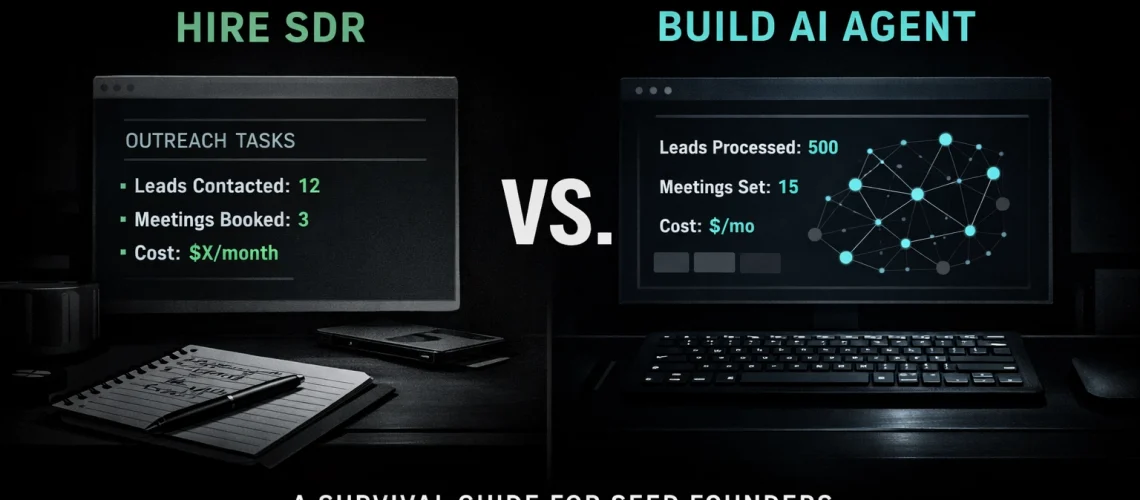
You’ve likely considered two options: hire a human SDR or try to automate the whole mess with an AI agent. Most founders get this choice wrong because they treat it like a binary decision about headcount. In reality, it’s a decision about your runway and your sanity.
The $80,000 Gamble
Let’s talk about the "traditional" path. You post a job for a hungry, entry-level SDR. You offer a $50k-$60k base, plus commission, plus benefits, plus the cost of their tech stack (Salesloft, ZoomInfo, LinkedIn Navigator). By the time they sit down at their desk, they’ve cost you $80,000 to $120,000 in loaded annual costs.
For a seed-stage startup, that isn't just a salary, it’s 4 to 6 months of total company runway.
The problem isn't just the money. It’s the "ramp." A human SDR takes three months to understand your product, your ICP, and your voice. During those three months, you are still the bottleneck. You have to train them, review their scripts, and keep them motivated when they get rejected for the hundredth time.
If they don't work out, and about 40% of SDR hires don't, you’ve lost a quarter of your funding and you’re back at square one. Outbound isn't hard because you're bad at sales; it’s hard because you’re trying to scale a human process that is inherently unscalable at your current stage.
The AI Agent Alternative: Build vs. Buy
The other side of the coin is the AI SDR. In 2026, the tech has moved past simple "if-this-then-that" sequences. We’re now in the era of autonomous agents. But there’s a massive divide in how founders approach this.
Some founders try to "build" their own stack using a mess of Python scripts, Zapier loops, and raw OpenAI API calls. They spend three weeks playing engineer instead of talking to customers.
Others look to "buy" an AI SDR that can handle the research, the writing, and the sending. But if you buy a tool that just blasts templates with a "Hi {{first_name}}" tag, you’re going to burn your domain and your reputation.

Why Most AI Outreach Fails (and Why Templates are Dead)
If your inbox looks anything like mine, you get twenty emails a day that say: "I saw you are the CEO at Ramen and thought you'd be interested in [Generic Service]."
That isn't personalization. That’s a mail merge. Prospects can smell it a mile away, and their "Report Spam" finger is itchy.
The reason most founders are seeing their reply rates drop isn't because outbound is dead; it's because their "AI" is just a faster way to be annoying.
To win in 2026, your AI agent can't just know the prospect’s name. It has to do what a high-performing human would do:
- Read their latest LinkedIn post.
- Look at their company’s recent funding news or 10-K filing.
- Listen to a podcast they were a guest on.
- Connect those dots to your specific value prop.
This is the "Research-First" model. Instead of sending 1,000 templated emails, you send 100 emails that are so deeply researched the prospect wonders if you spent an hour writing it just for them.
The Math: $499 vs. $80,000
If you’re a seed founder, your most important metric is "Demos Booked per Dollar Spent."
A human SDR might book you 10 meetings a month. At a $6,500 monthly burn (salary + tech), each meeting costs you $650.
An AI agent like Ramen costs significantly less. Even when you factor in your own API keys, which we recommend so you keep full control over your costs, you’re looking at a total cost that is a fraction of a human hire.
More importantly, the AI agent doesn't take lunch breaks, it doesn't get "prospecting fatigue," and it doesn't need a 1-on-1 meeting every Tuesday to stay "aligned." It scales horizontally. If you need more leads, you don't hire another person; you just give the agent more data.
Objection: "But Won't AI Ruin My Brand?"
This is the biggest fear founders have. They don't want a "rogue bot" hallucinating features or getting into an argument with a Tier-1 prospect.
This is where the "Human-in-the-loop" model becomes a feature, not a bug.
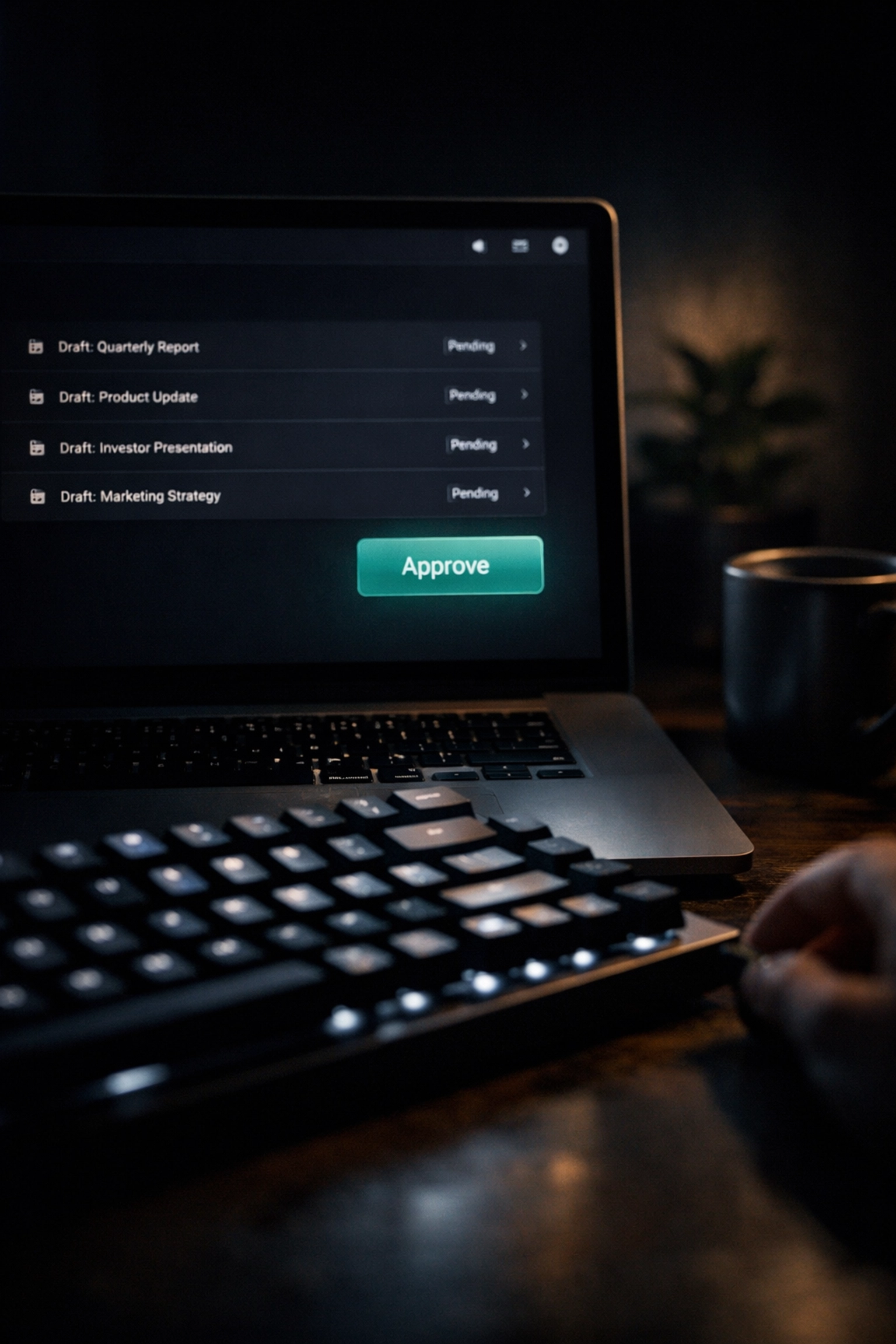
You shouldn't let an AI agent send emails autonomously on day one. You use the AI to do the 90% of the heavy lifting, finding the leads, doing the research, drafting the message, and then you, the founder, spend 20 minutes a day clicking "Approve."
This gives you the scale of an AI with the quality control of a founder. It’s the safest way to automate outbound without worrying about your domain reputation or your brand's dignity.
How to Choose: The "SDR Readiness" Checklist
Before you post that job description on LinkedIn, ask yourself these three questions:
- Is my ICP (Ideal Customer Profile) actually proven? If you’re still tweaking who you sell to, a human SDR will struggle. They need a clear target. An AI agent allows you to test five different ICPs in a week without hurting anyone's feelings.
- Do I have a repeatable sales script? If you can't close a deal yourself, an SDR definitely can't. You need to be the one who defines the "magic words" first.
- Can I afford to lose $30k? Because that’s what it costs to hire, train, and fire an SDR who doesn't work out.
If the answer to any of these is "No," you aren't ready to hire an SDR. You’re ready for a system.
The Survival Guide: How to Start Without the Headache
If you’ve decided that a human SDR is a luxury your runway can't afford, here is how you build a scalable pipeline as a solo founder:
1. Own Your Data
Don't rely on "black box" tools. Use a stack where you bring your own API keys. This ensures you aren't paying a 500% markup on GPT-4 usage and that your data stays yours.
2. Focus on Research, Not Volume
Stop trying to "break" the inbox. The goal isn't to send 5,000 emails. The goal is to get 5 replies. A research-driven outbound playbook focuses on finding a specific trigger: a new hire, a product launch, a specific pain point mentioned in a tweet: and leading with that.
3. Keep the "Human" in the Loop
Until you are booking 5+ demos a week consistently, review every single draft. The AI is your intern, not your replacement. Use it to eliminate the blank page syndrome, not to eliminate your brain from the process.
Why 2026 is the Year of the AI-First Startup
The reality of being a seed founder in 2026 is that the old playbooks are broken. The "spray and pray" method is dead. The "hire 10 SDRs and see who survives" model is only for companies with more VC money than sense.
Smart founders are building "lean" sales machines. They use AI to handle the grunt work of prospecting and research so they can spend their limited time doing what only they can do: closing deals and building product.
You don't need a "sales department." You need a pipeline that runs while you sleep. You need to stop wasting your weekends writing cold emails and start letting technology do what it was designed to do.
Stop the Sunday Night Struggle
You didn't start a company to become a manual data-entry clerk for LinkedIn.
At Ramen, we built a platform for the founders who are currently the bottleneck in their own sales process. We don't believe in magic buttons or spam bots. We believe in 100% research-based personalization that sounds like it came from you: because it did, just with a little help.
If you’re ready to scale your outbound without the $80k hiring headache, see how Ramen works. We’ll help you get your Sundays back and keep your runway where it belongs( in your product.)