
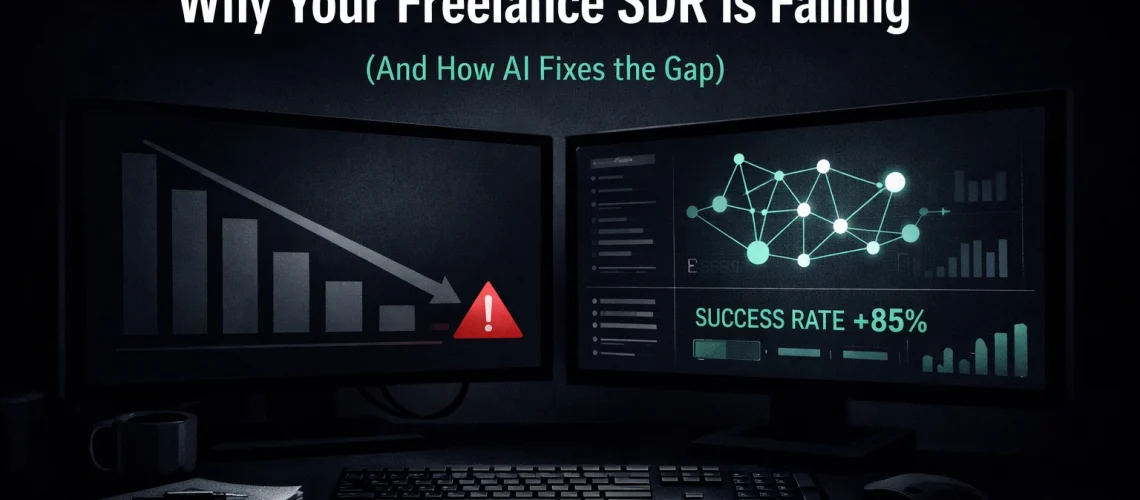
It’s 9 PM on a Sunday. You’re staring at a spreadsheet of "leads" your freelance SDR sent over. Half aren't in your ICP. The other half have "First Name" as their company. You realize you’ve spent more time managing them than you would have spent just doing the work yourself.
This is the freelance SDR trap: you pay for their time, but you still spend yours. Here is why the model is fundamentally broken for solo founders and seed-stage companies: and how to fix it without hiring an $80k rep.
The Management Tax You Didn’t Sign Up For
Most founders hire a freelance SDR because they are drowning. They think, "If I can just pay someone $2,000 a month to handle the top of the funnel, I can focus on the product."
But hiring a freelancer doesn't actually remove you from the process. It just changes your job title from "SDR" to "SDR Manager."
You have to write the scripts. You have to clean the lists. You have to check their work every morning to make sure they aren't burning your domain by sending 500 unpersonalized emails to CEOs of Fortune 500 companies who would never buy your product.
When you factor in the time spent on Slack, the weekly "alignment" calls, and the time spent fixing their mistakes, that $2,000/month freelancer is actually costing you $5,000 in your own hourly opportunity cost. You’re still the bottleneck.
Divided Attention: Why You’re Not Their Priority
Let’s be honest about how the freelance economy works. Your SDR isn't just working for you. They likely have three or four other clients.
When a freelancer manages multiple accounts, their attention is naturally divided. They aren't thinking about your product in the shower. They aren't deeply researching your industry trends. They are doing the bare minimum to hit their "activity" metrics so they can collect their retainer.
If another client offers a higher commission for a closed deal, where do you think their best energy goes? It’s not a knock on the freelancer; it’s just the reality of the business model. But as a seed-stage founder, you need someone who knows your ICP as well as you do. A part-timer with one foot out the door will never give you that.
The Variable Output Problem
In the early stages, consistency is everything. You need a steady stream of meetings to test your messaging and find product-market fit.
Freelance performance is notoriously volatile. They get sick. They have "personal issues." They decide to pivot their own business. Every time a freelancer leaves or checks out, your pipeline goes to zero. Then you’re back to square one: hiring, onboarding, and hoping the next one is better.

This cycle is why many startups never get off the ground. They spend six months rotating through three different freelancers, burning through $15,000, and end up with two demos and a damaged domain reputation.
AI is Not Just a Better Template: It’s a Better Researcher
The common objection to AI in sales is that it’s "spammy." People think AI outbound means blasting 10,000 generic emails.
Actually, that’s what bad freelance SDRs do.
True AI-driven outbound is about research-first outreach. A human SDR can spend 15 minutes researching one prospect: looking at their LinkedIn, reading their recent interviews, checking their company’s latest funding round: and then write one email. That’s great, but it doesn't scale. Most freelancers skip the research and go straight to the template.
AI can do that same 15 minutes of research in 15 seconds. It can scrape a prospect's profile, understand their role, and reference a specific pain point they’ve mentioned publicly. It’s not about sending more mail; it’s about sending better mail.
When you use a tool like Ramen, you’re not just automating the sending. You’re automating the research-first outbound that usually takes a human hours to complete.
The Numbers: Why $499 Beats a $3,000 Freelancer
Let’s look at the math. A decent freelance SDR will cost you anywhere from $2,000 to $4,000 per month as a retainer.
On the other hand, a full-time human SDR hire is closer to $80,000 to $120,000 when you factor in salary, benefits, and taxes. For a seed-stage company, that’s a massive portion of your runway.
Ramen costs $499/mo.
For that price, you get:
- 100% consistency (AI doesn't take sick days).
- Deep research on every single lead.
- The ability to scale up or down instantly.
If you’re comparing remote SDR vs. freelance SDR vs. AI SDR, the AI model is the only one that allows a solo founder to maintain a "big company" pipeline without a big company budget. You aren’t just saving money; you’re buying back the 90% of your time currently spent on manual outbound tasks.
Maintaining Your Brand with Human-in-the-Loop
The biggest fear founders have about AI is losing control. You’ve worked hard to build your brand. You don't want a bot hallucinating and promising a feature you don't have to a Tier 1 prospect.
This is why we built Ramen with a human-in-the-loop philosophy.
The AI does the heavy lifting: it finds the leads, does the research, and drafts the personalized message. But nothing goes out the door without your thumb on the button. You spend 20 minutes a day reviewing and approving drafts.
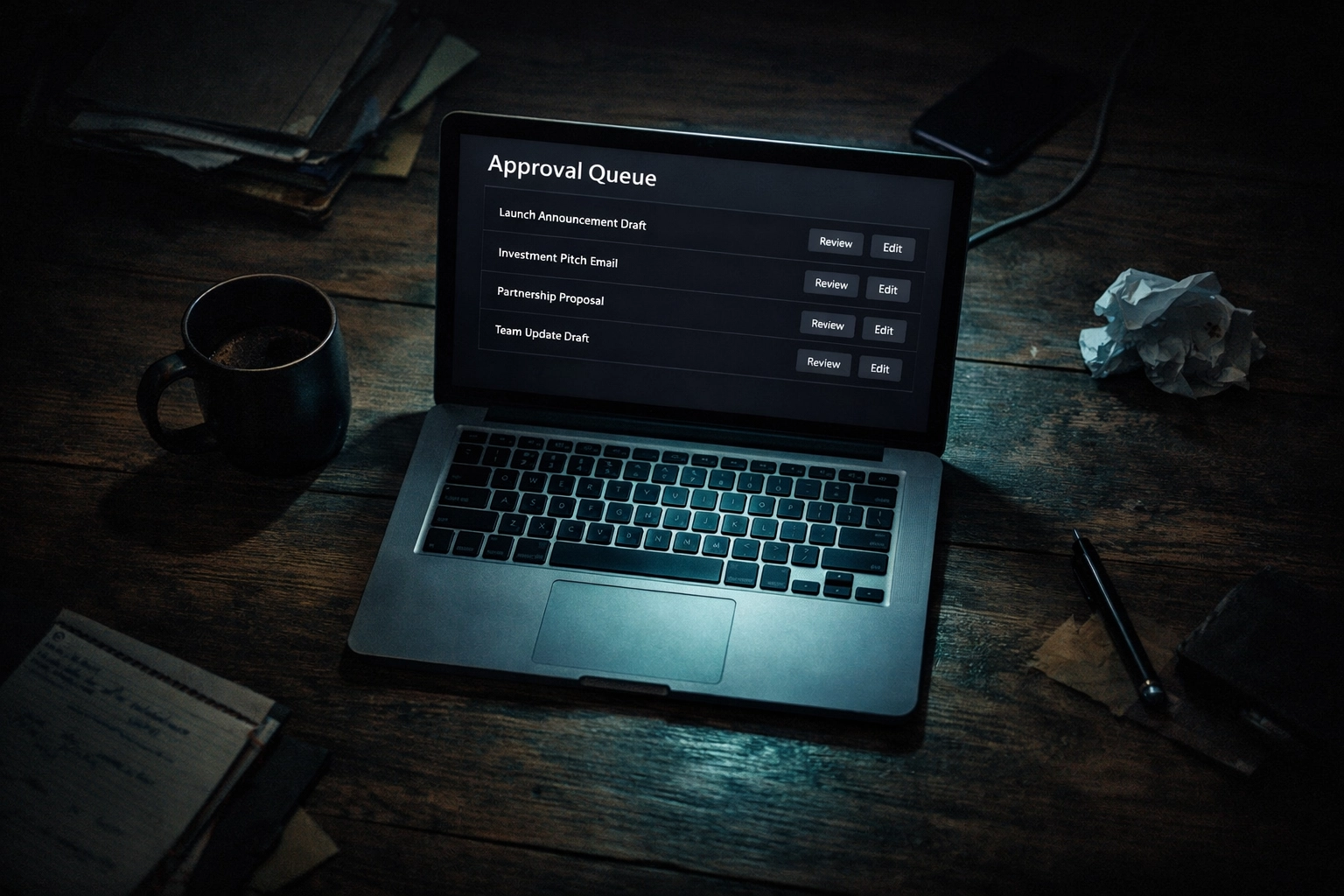
It’s the best of both worlds. You get the scale of AI with the quality control of a founder. You are still the brain behind the operation, but you’ve offloaded the manual labor. This is the safest way to automate outbound without risking your professional reputation.
The "Bring Your Own Key" Advantage
Most lead gen agencies and AI tools hide their costs. They upcharge you for every email sent or every lead found.
We believe in transparency. Ramen uses a BYOK (Bring Your Own API Key) model. You connect your own OpenAI or Claude keys. You pay the raw cost of the AI. There’s no "middleman" tax on your growth.
This also means you own your data and your stack. If you decide to change your strategy, you aren't locked into a proprietary black box.
Addressing the "AI is Spam" Objection
Is AI-written mail sometimes bad? Yes. If you give a bot a bad prompt and tell it to "sell my product," it will produce garbage.
But the "spam" problem isn't an AI problem; it’s a strategy problem. Most people fail at outbound because they treat it like a numbers game rather than a relevance game.
Why your cold email replies dropped usually has nothing to do with the tool and everything to do with the fact that you’re sending messages people don't care about. AI allows you to be more relevant to more people simultaneously. It allows you to personalize at scale in a way that is physically impossible for a human freelancer to match.
Making the Shift
If you are a solo founder or a seed-stage CEO, your time is your most valuable asset. Every hour you spend arguing with a freelancer about lead quality is an hour you aren't talking to customers or building product.
The freelance SDR model was a great bridge in 2018. In 2026, it’s a liability. It’s too slow, too expensive, and too inconsistent for the speed at which startups need to move.
You don't need a part-time human to click "send" for you. You need a system that does the research, handles the drafting, and lets you play the role of the closer.
Outbound isn't hard because you're bad at sales. It’s hard because you’re the bottleneck. It’s time to remove yourself from the manual work and start focusing on the conversations that actually move the needle.
Stop wasting your weekends writing cold emails and managing freelancers who don't care about your company as much as you do.
If you’re ready to see how an AI SDR can handle your outbound in 30 minutes a day, take a look at how Ramen works. You focus on the demos; we’ll handle the research.