
You're doing 47 discovery calls a week, building product, and somehow supposed to keep your pipeline full. Your runway's burning and you need predictable demos, but hiring a full-time SDR means $80-120K loaded cost plus 3-month ramp time you don't have. You've looked at remote SDRs, freelance contractors, and keep hearing about AI: but which one actually gets you from 2 demos per week to 20?
Here's the honest breakdown of what each option delivers, what they cost, and which one scales without breaking your bank account or your Sundays.
Remote SDR: The $80K Question Mark
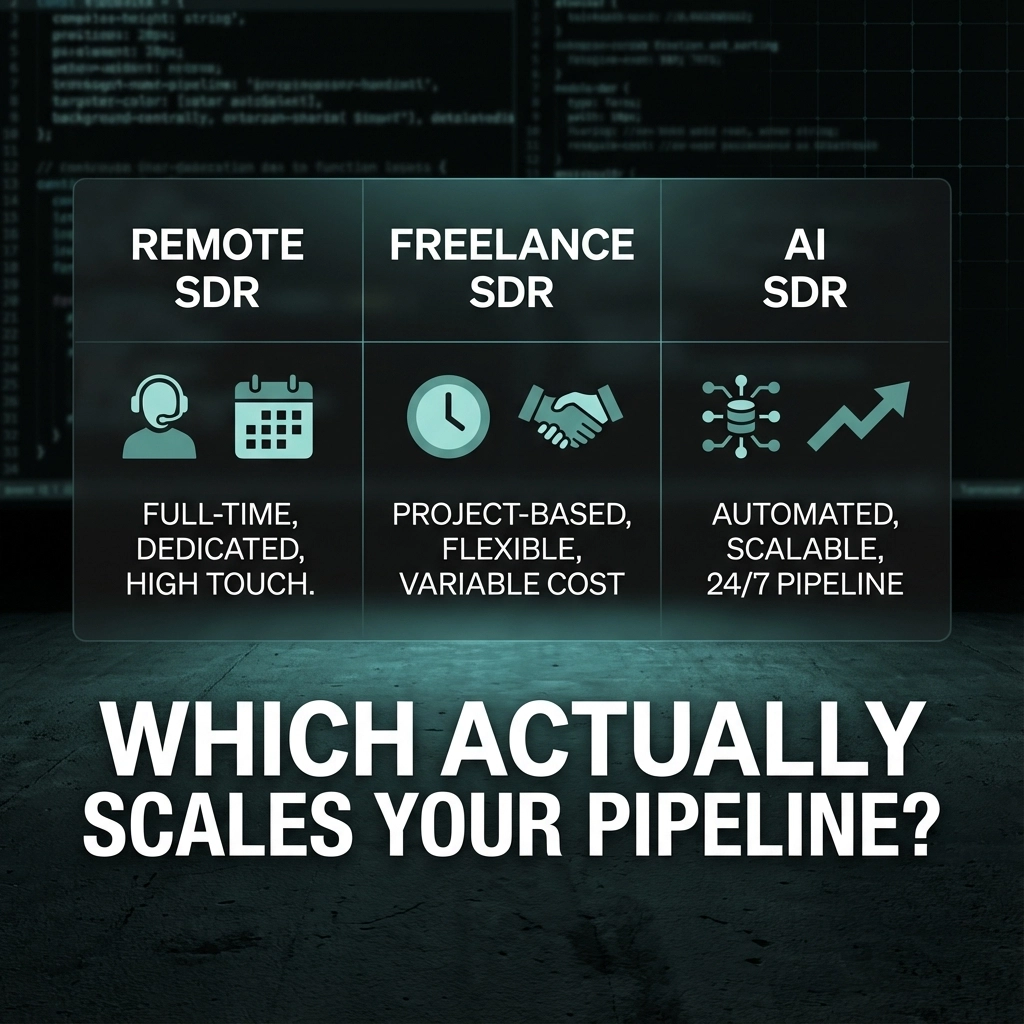
Remote SDRs solve the office overhead problem but not the fundamental math. A good remote SDR costs $60-80K base plus benefits, tools, and management overhead. You're looking at $100-120K loaded cost before they send their first email.
The scaling reality hits fast. One SDR maxes out at 50-80 quality outbound touches per day. Even if they're crushing it at 3% reply rates, you're looking at 1-2 qualified conversations per day. To double your pipeline, you need another $120K hire.
Most founders discover the ramp problem too late. Remote SDRs need 2-3 months to understand your ICP, nail the messaging, and build momentum. During ramp, you're paying full salary for maybe 20% productivity. If they don't work out, you've burned $30K and 6 months.
The management tax is real. Remote SDRs need daily check-ins, CRM training, message reviews, and constant pipeline coaching. You end up spending 10-15 hours per week managing someone who's supposed to give you time back.
Freelance SDR: The Reliability Gamble
Freelance SDRs seem like the obvious middle ground. Lower cost ($3-6K monthly), less commitment, and you can test multiple people. The reality is messier.
Most contract SDRs juggle 3-5 clients simultaneously. Your startup gets 20-30% of their attention, maybe less during busy periods. They're optimizing for volume across accounts, not quality for yours. Expect generic messaging and minimal account research.
The turnover rate kills consistency. Freelance SDRs disappear when they land bigger contracts or full-time offers. You lose all the ramp investment and start over with someone new every 3-6 months. Each transition costs 2-4 weeks of lost momentum.
Quality control becomes your full-time job. Most freelance SDRs blast templates with minimal personalization. You spend hours reviewing emails, fixing mistakes, and managing deliverability issues they create. The "time savings" evaporate quickly.

Contract SDRs also create brand risk you can't afford. When they burn through your domain sending bad emails, you inherit the damage. Most don't understand deliverability basics or care about long-term sender reputation.
AI SDR: The Scale Solution (With Honest Limitations)
AI SDRs flip the economics completely. Instead of $120K per year, you're looking at $500-2K monthly tools plus your time investment. One AI system handles the research, personalization, and initial outreach that would require 3-4 human SDRs.
The scaling math actually works. AI processes hundreds of accounts simultaneously, researches each prospect individually, and generates personalized messages at 10x human speed. To double your pipeline, you add more AI credits, not another salary.
The volume capability is legitimate. AI SDRs handle 500-1000 outbound touches daily while maintaining personalization quality. They don't get tired, take sick days, or need motivation. Your pipeline stays consistent regardless of your other priorities.
But here's what AI vendors don't tell you upfront. AI SDRs amplify whatever strategy you give them. Bad ICP definition means 1000 bad emails per day instead of 50. You need solid fundamentals before AI helps: it's not a strategy replacement.
The human oversight requirement is real. Every AI email should get reviewed before sending. You're trading SDR salary for daily email review time. But 30 minutes reviewing AI output beats 3 hours writing emails from scratch.
The Real Scaling Test: Month 6 Math
Here's where the differences become obvious:
Remote SDR at month 6: $60K spent, finally hitting stride, maybe 8-10 qualified conversations monthly. To double output, you need SDR #2 and can't afford it yet.
Freelance SDR at month 6: On your second contractor after the first disappeared. $18K spent, dealing with deliverability issues from sloppy email practices, getting 4-6 qualified conversations monthly.
AI SDR at month 6: $3-6K spent, handling volume that would require 3 human SDRs, generating 15-25 qualified conversations monthly. Scaling up means adding AI credits, not hiring.
The compound effect matters most. AI learns your patterns, improves messaging based on response data, and scales without human limitations. Human SDRs hit natural productivity ceilings you can't overcome with more coaching.
Addressing the AI Objections (Because You're Thinking Them)
"But doesn't AI just spam people?" Only if you let it. Good AI SDRs research each prospect individually and generate relevant messages. The spam reputation comes from founders blasting generic templates through AI tools: exactly what bad human SDRs do.
"What about domain health and deliverability?" This matters with any outbound approach. AI doesn't automatically burn domains: bad practices do. Whether it's a freelance SDR sending 500 template emails or AI doing the same, the outcome is identical. The difference is AI forces you to think about volume and deliverability upfront.
"Can AI actually book qualified demos?" The research and personalization quality often exceeds human SDRs. AI reads LinkedIn posts, company news, and job descriptions for every prospect. Most human SDRs skim profiles and copy-paste templates.
The Bottom Line: What Actually Scales
If you have $120K and 6 months to burn, remote SDRs eventually scale. But most early-stage founders need pipeline now, not after Q2 runway is gone.
Freelance SDRs work for specific projects or testing messaging, but they don't scale systems. You're buying temporary capacity, not building repeatable growth.
AI SDRs scale because they remove human bottlenecks while keeping you in control. You approve messaging, review emails, and maintain quality standards. But instead of writing every email, you're directing a system that handles the research and repetition.
The key difference: AI scales your effort instead of replacing your judgment. You still need strategy, ICP clarity, and message-market fit. But once you have those pieces, AI amplifies them 10x faster than hiring.
Ready to see what AI-powered outbound looks like when you maintain control? Ramen lets you review every email before it sends, uses your own API keys for cost control, and handles the deep research that makes outbound actually work. Book a demo and skip the $80K hiring experiment.