
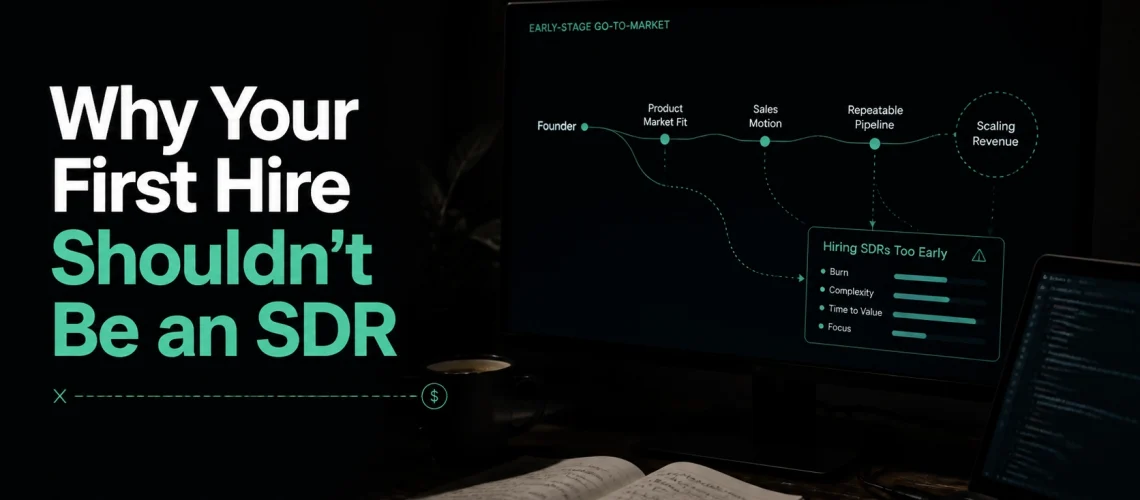
It’s 10 PM on a Sunday night. You’re sitting in your home office, the blue light of the monitor reflecting off a cold cup of coffee. You’ve spent the last three hours scraping LinkedIn profiles and trying to draft "personalized" emails that don’t sound like they were written by a robot.
You think to yourself: "If I just hire an SDR, all of this goes away. I can finally focus on the product and let someone else handle the grind."
It feels like the logical next step. You’ve raised a bit of seed money, or maybe you’ve hit that first $10k in MRR. You need a pipeline, and a Sales Development Representative (SDR) is the person who builds it. Right?
Wrong.
For most early-stage founders, hiring an SDR as the first hire is a trap. You think you’re buying a silver bullet for growth, but you’re actually inheriting a full-time management job with a 50% turnover rate. You’re about to spend $8,000 to $10,000 a month: fully loaded cost: on a person who will likely quit or be fired before they ever book a demo that actually closes.
I’m going to show you why that first hire shouldn't be a human, and how you can build a predictable pipeline without the overhead, the drama, and the massive hit to your burn rate.
The Hidden Risks of Your First Sales Hire
When you hire your first SDR, you aren’t just adding a line item to your payroll. You are fundamentally changing your daily routine as a founder, and usually not for the better.
The first risk is Management Debt. Most SDRs are early in their careers. They require constant coaching, scripts, list-building guidance, and emotional support when they get told to "unsubscribe" for the twentieth time that day. If you don't have five to ten hours a week to sit with them, review their calls, and fix their emails, they will fail. And if you do have those ten hours, you’re no longer building your company; you’re a sales manager.
Then there’s the Ramp-Up Tax. A typical SDR takes three months to reach "productivity." In those three months, you are paying full salary plus benefits for zero results. If your runway is short, that’s a $30,000 gamble that they’ll figure it out before you run out of cash.
Finally, there’s the Turnover Reality. The average tenure for an SDR in 2026 is hovering around 12 to 14 months. If it takes them three months to ramp up, you only get nine months of actual work before they either get promoted or leave for a higher salary elsewhere. You’re essentially paying a massive "education fee" for a different company to benefit from later.

Why Headcount Doesn't Equal Revenue
Founders often fall into the "linear growth" trap. They think: "If one SDR gets me 10 meetings a month, two SDRs will get me 20."
But headcount is a scaling function, not a creation function. If you haven't established a repeatable sales process yourself, hiring an SDR is like pouring gasoline on a fire that hasn't been lit yet. You just end up with a lot of expensive, wet wood.
An SDR cannot tell you why your product-market fit is slightly off. They cannot pivot your messaging on the fly because they noticed a nuance in a prospect's objection. They follow the script you give them. If that script doesn't work, they can't fix it. They’ll just keep sending it until your domain is burned and your reputation in the industry is "that company that spams everyone."
According to recent data, 49% of companies saw their customer acquisition cost (CAC) go up this year because they threw bodies at a problem that required a better system. You can’t hire your way out of a bad outbound strategy.
The "Human Touch" Fallacy
"But Mudassar," you might say, "I sell a complex product. I need a human to navigate the nuances of the enterprise."
This is the most common objection I hear. The truth is, most "human" SDRs are actually acting like bad bots. They use templates, they half-heartedly change the first name and company name, and they hit send.
In 2026, prospects are smarter than ever. They can smell a template from a mile away. If your "human" SDR is sending generic outreach, they aren't providing a "human touch." They’re providing noise.
The "complex sales" argument only works if the person doing the outreach has done deep, meaningful research on the prospect. They need to know what the prospect said in their last podcast appearance, what their company's Q3 earnings report looked like, and what their specific pain points are likely to be based on their job title change.
Most SDRs simply don't have the time or the patience to do this for 50 leads a day. They take shortcuts. They blast. And your brand pays the price.

Scaling Smarter Without the Overhead
So, if you shouldn't hire an SDR, what should you do? You still need meetings. You still need a pipeline.
The answer is to build a system that acts like a 10x SDR but doesn't require a desk, a health insurance plan, or a "sync" every Monday morning. You need to automate the parts of the job that humans are traditionally bad at: consistency and deep research: while keeping your "Founder Brain" in the loop for the parts that matter.
This is where the AI-driven outbound playbook comes in. Instead of hiring a person to manually scrape leads and guess at personalization, you use tools that can do deep research on every prospect simultaneously.
The Deep Research Advantage
Imagine an outbound system that doesn't just know a prospect's name, but understands their entire professional history. It looks at their LinkedIn, their company's "About" page, recent news articles, and even their Twitter feed to find a genuine hook.
When you use an AI SDR agent like Ramen, you're not sending templates. You're sending messages that are so specific the prospect assumes you spent twenty minutes researching them personally.
The best part? You don't have to trust the AI blindly. You can maintain a "human-in-the-loop" workflow. You approve the research and the draft before it ever hits their inbox. You get the quality of a top-tier SDR with the speed of an automated system.
The Math of an AI SDR vs. a Human SDR
Let's look at the numbers.
A human SDR:
- Salary + Commission: $80k – $120k/year (loaded)
- Management Time: 5-10 hours/week
- Ramp Time: 3 months
- Output: ~50-100 emails/day (often templated)
An AI SDR stack with Ramen:
- Cost: A fraction of a salary (see our pricing breakdown)
- Management Time: 15 minutes a day to approve drafts
- Ramp Time: 1 day
- Output: As many as your domain health allows, with 10x the personalization depth.
If you are a pre-seed or seed-stage founder, that $100k difference isn't just "savings." It's six months of extra runway. It's the ability to hire an extra engineer to actually build the product your customers are asking for.

When Should You Actually Hire a Salesperson?
I’m not saying you should never hire a salesperson. I’m saying don't hire an SDR as your first hire.
Wait until you have a repeatable process. Wait until you know exactly which hooks get a 2-4% reply rate. Wait until you have so many demos booked through your automated systems that you literally don't have time to take the calls yourself.
At that point, your first hire shouldn't be an SDR: it should be an Account Executive (AE). Someone who can take the qualified leads your system is generating and close them.
Scaling a company is about removing yourself from the "grind" work so you can focus on the "leverage" work. Manual outbound is the ultimate grind. Hiring a person to do that grind for you is an expensive, old-school solution to a problem that technology has already solved.
Don't Inherit a Management Job
You started your company to build something great, not to spend your Sundays coaching a 22-year-old on how to handle a "not interested" email.
If you’re currently doing founder-led sales and feeling the burn, don't rush to post a job listing on LinkedIn. You’ll just be trading one type of exhaustion for another.
Instead, look at how you can replace your SDR with an AI agent. Build a system that does the research, finds the leads, and drafts the emails while you sleep. Keep your API keys, keep your data, and most importantly, keep your runway.
Your first hire should be someone who adds a new dimension to your product or your operations: not someone you have to manage just to keep the lights on in your inbox.
Scale smarter. Keep your Sundays. If you want to see how to build a research-first outbound motion without the $100k price tag, see how we do it at Ramen.so.