
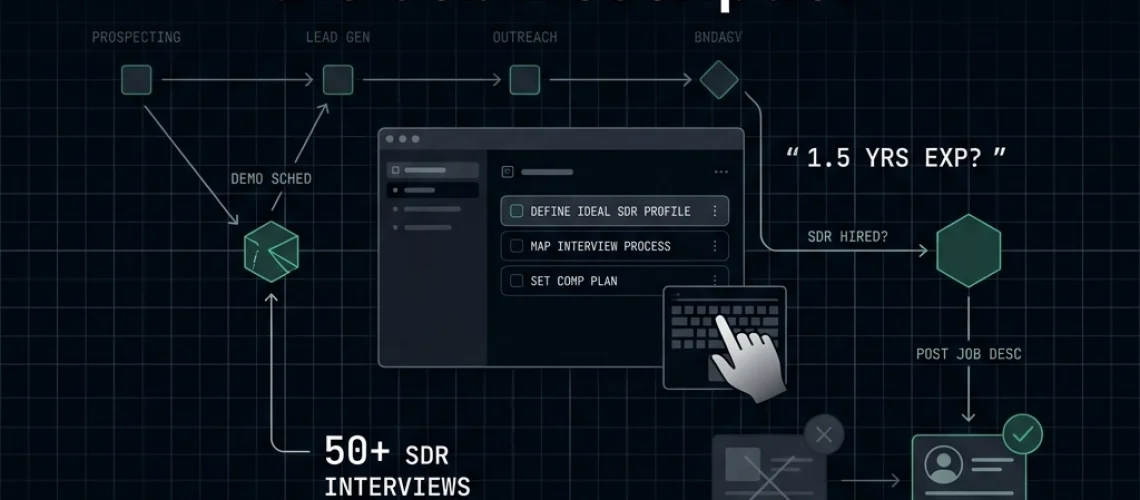
You’re sitting there, looking at a blank LinkedIn job post, about to click "Publish." You need pipeline. You’re tired of being the only person in the company sending outbound emails, and frankly, you’re not even doing it that well because you’re also trying to close deals, manage the product, and maybe squeeze in a few hours of sleep.
But as you hover over that button, you’re probably feeling that familiar knot in your stomach. You know exactly what happens next. You’ll spend three weeks interviewing. You’ll pick someone who seems hungry. And then you’ll spend the next three months paying a full salary: plus benefits, plus a $1,000/month tech stack: while they "ramp up."
That’s ninety days of burning cash for zero results. You’re paying to be a teacher, not a founder. By the time they actually book their first meeting, you’ve already spent $25k. If they quit in month four? You’re back at zero, and your runway is shorter.
There is a way to get "fully ramped" output on day one. But before we get to that, let's talk about why the traditional path is breaking early-stage startups.
The High Cost of the SDR Learning Curve
When you hire a Sales Development Representative (SDR), you aren't just paying a salary. In the current market, a decent SDR costs between $60k and $80k base. Add in taxes, health insurance, and the "tech tax" (LinkedIn Sales Navigator, ZoomInfo, Outreach, etc.), and you’re looking at a $100k-$120k loaded cost.
If you want to see the brutal breakdown of these numbers, you should look at the real SDR costs with simple math. It’s usually double what you think it is.
The problem is that a human SDR is a depreciating asset for the first quarter. They don’t know your product. They don’t know your ICP (Ideal Customer Profile). They definitely don’t know the nuance of why a VP of Engineering at a Series B startup cares about your specific API latency.
They spend month one "learning." They spend month two "building lists" and "practicing pitches." They spend month three finally sending emails: most of which will be slightly off-brand and might even burn through your best leads before they find their rhythm.
For a seed-stage founder, this is a luxury you can’t afford. You don’t have a "training department." You are the training department. Every hour you spend teaching an entry-level hire how to use a CRM is an hour you aren’t talking to customers or building the product.
Why Traditional Onboarding is a Growth Bottleneck
Traditional onboarding is designed for big companies with established playbooks. In those environments, an SDR is a cog in a machine. But in a startup, the playbook is still being written.
When you hire a human SDR, you are effectively asking them to help you find product-market fit. That is a founder’s job. By delegating it to someone with two years of experience, you create a massive bottleneck. Information gets lost in translation. They tell you "people aren't interested," but they can't tell you why because they don't have the context to ask the right follow-up questions.
Furthermore, the "ramp-up" period is a static cost in a dynamic environment. Your product might change in six weeks. When it does, the human SDR has to "unlearn" and "re-learn."

The "Burnt Lead" Risk
One of the biggest fears founders have: and they’re right to have it: is that a new SDR will ruin their reputation.
You’ve spent years building your network and your brand. Then, a new hire eager to hit their "activity metrics" sends a generic, templated email to your dream client. The client sees the "Sent from my iPhone" fluff or the poorly researched "I saw you went to [University Name]" intro and marks it as spam.
Once that domain is burned, it stays burned. Once that prospect thinks you’re just another spammy SaaS company, they stop taking your calls.
This is why many founders end up wasting weekends writing cold emails themselves. They don’t trust anyone else to do it. But you can't scale yourself. You are the bottleneck, and that's exactly why outbound feels so hard.
"But Can AI Really Handle My Complex Product?"
This is the most common objection we hear. Founders say, "My product isn't a simple $20/month seat-based tool. It requires deep technical understanding. An AI can't possibly understand the nuances of SOC2 compliance for fintech infrastructure."
Five years ago, you’d be right. But the world has changed.
The "AI" people are used to is the "template-blaster": tools that just swap out names and company titles. That’s not what we’re talking about here.
At Ramen, we built a research-first outbound AI SDR. It doesn't just "write an email." It acts like a high-level researcher. It goes to a prospect’s LinkedIn, reads their recent posts, checks their company’s recent funding news, and looks at their job descriptions to see what tech stack they use.
If your product is complex, the AI actually has an advantage. It can process your entire documentation, your past successful sales decks, and your case studies in seconds. It uses that "knowledge base" to find the exact hook that connects your complex solution to the prospect’s specific pain point.
It doesn’t get tired. It doesn’t forget the "nuance" on the 50th email of the day. And most importantly, it doesn’t send anything until you’ve looked at it.

The Human-in-the-Loop Advantage
The biggest mistake founders make when looking at AI tools is thinking it’s an "all or nothing" decision. They think they either have to hire a human or let a "bot" run wild and potentially ruin their brand.
The smart middle ground is human-in-the-loop automation.
Imagine having an SDR that does 95% of the work: the prospecting, the deep research, the drafting of a highly personalized message: and then puts it on your desk. You spend 10 minutes a morning clicking "Approve" or making one small tweak.
You get the quality of founder-led sales with the scale of a full sales team.
This is the "day one" ramp-up we promised. You don't have to wait three months for the AI to "get it." You give it your best case studies, tell it who you want to talk to, and it starts producing high-quality drafts immediately.
The Math of the Pivot
Let’s look at the numbers one more time.
A human SDR:
- $8k+ per month (loaded)
- 3-month ramp-up ($24k spent before ROI)
- Variable quality
- Management overhead (1-on-1s, training, motivation)
An AI SDR (like Ramen):
- A fraction of the cost (pricing breakdown here)
- Zero ramp-up
- Consistent, research-backed quality
- You only spend time on "Approve" or "Reject"
For a founder, the choice between the $499 vs $80k decision isn't just about money. It’s about speed. In a startup, speed is the only thing that matters. If you can start booking demos tomorrow instead of three months from now, you’ve just bought yourself a quarter of runway.
Stop Hiring for the Wrong Reasons
Most founders hire an SDR because they think they should. They see it as a milestone of "scaling." But hiring a human to do a job that can be automated is just adding weight to your ship while you’re trying to reach plane speed.
If you are a pre-seed or seed founder, your goal is to talk to as many qualified prospects as possible to refine your message. You don't need a "team." You need a pipeline.
Before you post that job description and commit to a $100k liability, ask yourself: Do I need a person in a chair, or do I need 10 qualified meetings a month?
If it’s the latter, you might want to rethink the hire. The "year of the AI SDR" isn't a future prediction: it's already here. Startups that go AI-first in 2026 are going to out-pace and out-outbound everyone else simply because they don't have the "ramp-up" anchor holding them back.
Skip the ramp-up at Ramen.so
If you're ready to stop being the bottleneck and start building pipeline without the 3-month waiting period, come see how we do things. We’ll show you how to automate the research and the outreach while keeping you in total control. No "template blasting," just pure, high-quality outbound that sounds like you: because it's backed by your own expertise.
Take your Sundays back. Build your pipeline. Let’s get to work.