
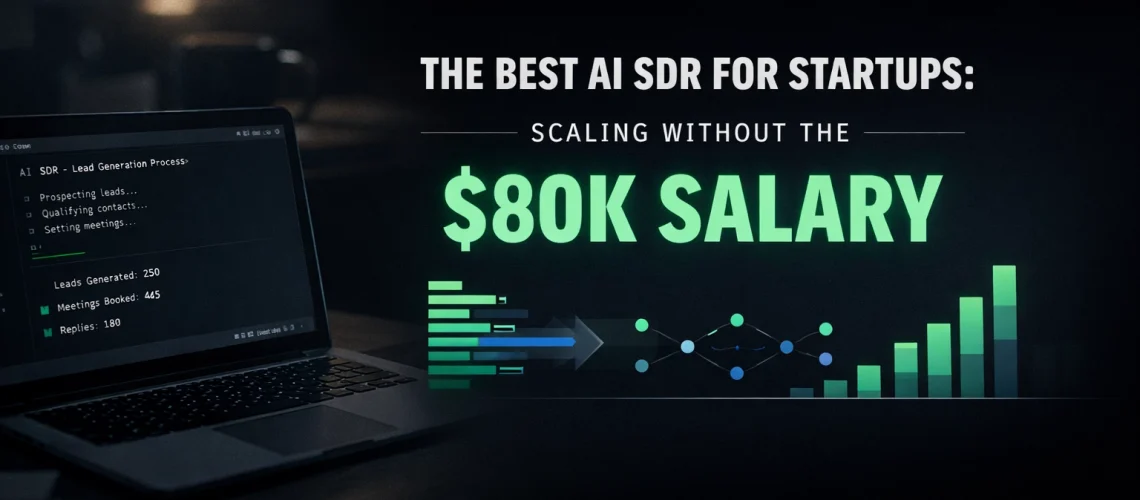
You’re a founder. It’s 10:00 PM on a Tuesday. You’ve spent the last three hours digging through LinkedIn, trying to find fifty people who might actually care about your product. You know you need a pipeline to survive, but you’re also the person building the product, managing the one engineer you hired, and trying to figure out why your AWS bill just doubled.
You know the "traditional" advice: "Just hire an SDR."
Then you look at the math. A decent SDR in 2026 costs about $80,000 in base salary. Add in benefits, taxes, a seat on Salesforce, a LinkedIn Sales Navigator subscription, and some data tool like Apollo, and you’re looking at over $100,000. And that’s before they’ve booked a single meeting. Most SDRs take three months to "ramp," which is startup-speak for "burning $25k while they learn how to spell your prospects' names correctly."
For most startups, that model is dead. It’s too slow, too expensive, and the risk of a bad hire is a literal company-killer.
The alternative isn't just "more automation." We’ve all seen what happens when you turn on a mindless bot: your domain gets blacklisted, and you end up in the spam folder of every CTO in the country. The real alternative is the AI SDR, a system that does the research of a human but at the speed and cost of software.
The Landscape: Finding the Best AI SDR for Your Stage
If you’re looking for the "best" AI SDR, you have to understand that the market has split. There isn’t a one-size-fits-all tool anymore. You have to choose based on your specific pain point.
Some platforms, like Warmly, are built for people who already have decent website traffic and want to catch "warm" leads the second they land on your pricing page. Others, like 11x.ai (with their agents Alice and Jordan), focus on high-volume outbound and rapid inbound follow-ups. Then you have Artisan, which tries to be an all-in-one platform for the entire sales cycle.
But for an early-stage founder, many of these tools feel like "Salesforce 2.0", overly complex, expensive, and requiring a full-time operator just to keep them running.
When we talk about the best AI SDR for a startup, we’re talking about a tool that:
- Doesn’t require a $20k annual contract upfront.
- Performs deep, human-level research so you don't look like a spammer.
- Lets you keep control over your costs (the "Bring Your Own Key" model).
Why Personalization is the Only Way to Avoid the Spam Filter
In 2024, Google and Yahoo changed the rules. If more than 0.3% of your emails get marked as spam, you’re done. Your emails stop landing in the primary inbox, and your outbound strategy becomes a very expensive way to talk to yourself.
The "spray and pray" era is over. You cannot send 1,000 generic emails and hope for a 1% reply rate. Those 1,000 emails will kill your domain reputation before you get your fifth reply.
The only way to survive now is through hyper-personalization. But I’m not talking about "I see you went to [University Name]" personalization. Prospects can smell that a mile away. I’m talking about "I saw your recent post about the challenges of scaling your Postgres database, and I noticed your company just hired three new data engineers" personalization.
This is where an AI SDR wins. A human SDR spending 15 minutes researching a single prospect can only send about 30-40 emails a day. An AI agent can scan a prospect’s LinkedIn, their company’s recent news, their 10-K filings, and their latest podcast appearance in roughly three seconds.
By leading with research, you aren't just sending an email; you're starting a relevant conversation. This isn't just about being "nice", it's a technical requirement. High relevance leads to high open rates, which tells Google you’re a legitimate sender, which keeps you out of the spam folder.
Unlimited Agents vs. One Human Head
One of the biggest traps founders fall into is thinking of an AI SDR as a replacement for one person. It’s not. It’s an infrastructure.
When you hire a human SDR, you are capped by their 40-hour work week. They get tired. They have bad Mondays. They get bored of prospecting and start "optimizing" their LinkedIn profile instead of sending emails.
With AI agents, you can scale horizontally. You can have one agent focusing entirely on your "Seed-funded Fintech" segment and another agent focusing on "Series B Healthcare" companies. They don't get tired, they don't ask for a raise, and they don't quit after six months to become an Account Executive somewhere else.
This allows you to test multiple AI-driven outbound playbooks simultaneously. You can find out within 48 hours if a specific angle is working, rather than waiting three weeks for a human to finish their first batch of outreach.
Objection: "Is this just another template tool?"
I hear this from founders every day: "I tried AI writers. They sound like robots. 'I hope this email finds you well!' No thanks."
You’re right to be skeptical. Most "AI" tools in the sales space are just fancy mail-merges. They take a template and swap out {{first_name}} and {{company_name}}. That is not an AI SDR.
A true AI SDR uses an LLM (like GPT-4o or Claude 3.5) to synthesize information. It doesn’t just "fill in the blanks." It reads the context. It understands that if a company just laid off 10% of its staff, sending a "hey, I can help you hire faster" email is a bad move.
At Ramen, we believe in a research-first approach. The AI’s job isn't to write the "perfect" email, it’s to find the perfect reason to reach out. If the reason is weak, the email will be weak, no matter how good the AI is. That’s why the best tools allow for a human-in-the-loop workflow. You see what the AI found, you see the draft it wrote, and you give it a thumbs up before it hits the "send" button.
The Cost Reality: $80,000 vs. The "BYOK" Model
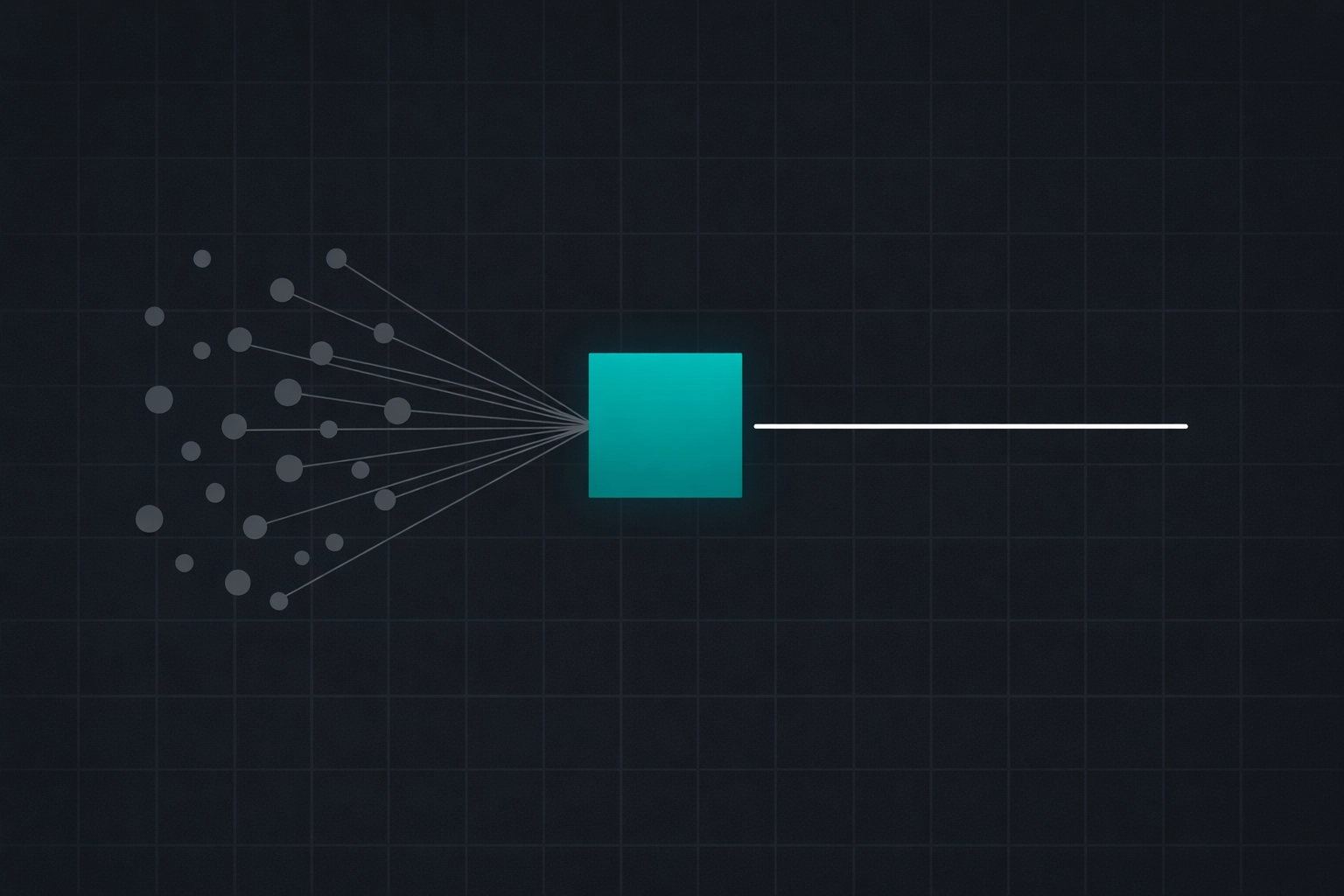
Let’s talk about money. Most AI SDR platforms want to charge you like a human employee, $500 to $2,000 per month, paid annually. For a pre-seed or seed-stage startup, that’s a lot of equity and cash to gamble on a tool.
The "Best AI SDR" for a startup is one that scales with your budget. This is why we advocate for the BYOK (Bring Your Own Key) model.
When you use your own OpenAI or Anthropic API keys, you pay exactly what the AI costs to run. If you send 100 emails this month, you pay a few cents. If you send 10,000, you pay for that. You aren't paying a massive markup to a software vendor who is just "leveraging" (sorry, Mudassar, I know we hate that word) the same APIs you could access yourself.
When you combine the cost of the AI with the cost of your domain infrastructure, you can run a world-class outbound program for about 10% of what an SDR's salary would cost. That 90% savings goes back into your product, your runway, or your actual marketing budget.
Why Founders Are Burned by Agencies
A lot of you reading this have already tried to solve this problem by hiring a lead gen agency. You paid them a $3,000/month retainer, they promised you "15 qualified meetings," and three months later, you had zero meetings and a burned domain.
The problem with agencies is the "incentive gap." They need to show activity to justify their retainer, so they blast your list. They don't care about your long-term domain health because they aren't the ones who have to deal with it when it breaks.
By using an AI SDR in-house, you own the process. You own the data. You own the reputation. You can replace your SDR or agency with an AI agent and actually see what is happening under the hood. No more "trust us, the replies are coming." You see the research, you see the drafts, and you see the results in real-time.
The Founder-Led Sales Reality
If you’re a founder, you are your best salesperson. You know the pain points better than anyone you could hire. The problem is that you don't have time to do the "grunt work" of prospecting.
The AI SDR isn't here to take over your job as the closer. It’s here to do the 90% of the work that keeps you from actually talking to customers. It handles the research, the initial outreach, and the follow-ups. Your job is to step in when a human says, "This looks interesting, can we chat?"
This is how you scale. You don't scale by throwing more bodies at a broken process. You scale by automating the research and the outreach while keeping the "humanity" in the final conversation.
Taking Back Your Sundays
Outbound shouldn't be a Sunday night chore. It shouldn't be something you "get around to" when you aren't busy. It should be a machine that runs in the background while you sleep.
If you’re tired of the $80k salary gamble, or the "template blasting" that gets you nowhere, it’s time to look at a research-first approach.
At Ramen, we built the platform we wanted as founders. We don't believe in $20k contracts or black-box automation. We believe in deep research, bringing your own API keys, and keeping you in control of every single email that leaves your inbox.
You don't need a bigger team. You need a better system.
Ready to see how AI can handle your outreach? See how it works at Ramen.