
It’s 10:00 PM on a Sunday. You’re sitting at your kitchen table with twenty browser tabs open. You’re jumping between LinkedIn profiles, company “About Us” pages, and a spreadsheet that’s starting to look like a blur of blue links. You’re trying to find just one specific nugget of information: a recent pivot, a new hire, a specific pain point mentioned in an interview: to make your cold email sound like it was written by a person, not a bot.
You know the "Best AI SDR" isn't the one that sends the most emails; it's the one that actually gets a response from your high-value prospects because it did the work to understand them.
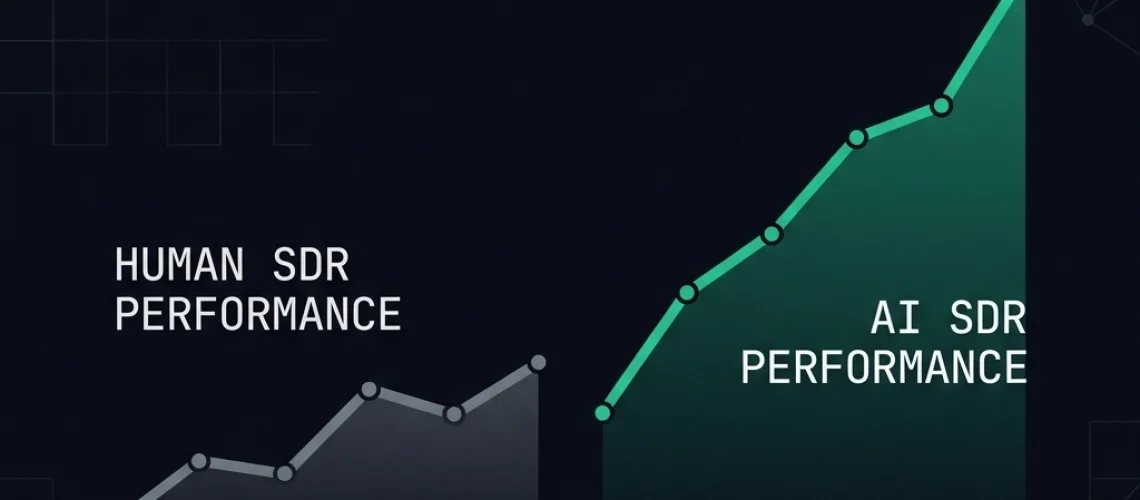
Most founders think the choice is between a $100/month spam machine and an $80,000/year human SDR. But the performance data from early 2026 is telling a different story. The gap between manual outreach and AI-powered research isn't just closing; it’s shifting entirely in favor of the machines: at least for the parts of the job that usually lead to founder burnout.
The Cost Reality of the "Human" SDR
Let’s be honest about what a human SDR actually costs a seed-stage startup. It’s not just the base salary. It’s the $80,000 to $120,000 loaded cost including benefits, the three months it takes for them to ramp up and actually understand your product, and the management overhead that eats into your own time as a founder.
In 2025 and 2026, data showed that human SDRs spend only about 30% of their time actually selling. The other 70%? It's spent on data entry, cleaning up lead lists, and basic account research. You are effectively paying a premium for someone to do administrative work that they probably hate doing.
Compare that to the emerging performance data. AI SDRs are currently showing 35% higher conversion rates and 60% lower cost-per-lead compared to traditional human-only teams. Why? Because the AI doesn’t get tired of researching. It doesn't skip the "deep dive" on the 40th lead of the day.

The Scalability of Personalized Research
The old school of thought was that you had to choose between volume and personalization. You could either send 1,000 generic emails (spam) or 10 highly researched ones (manual).
That trade-off no longer exists.
The real performance shift in favor of AI-powered research over manual outreach comes down to the ability to process unstructured data at scale. A human SDR can effectively research maybe 50 prospects a day if they are being truly thorough. An AI SDR can do 500.
But it’s not just about doing more; it’s about the quality of the "hook." When we talk about personalized research, we aren't talking about "I saw you went to [University Name]." That’s been dead since 2022. We’re talking about finding a specific quote from a prospect’s recent podcast appearance or identifying a technographic shift: like the fact that they just installed a competitor's software: and using that as the "why now" for the reach out.
This level of research-first outbound is what keeps your domain health high and your reply rates above 5%. If you want to dive deeper into how this works, you can check out how we handle research-first outbound AI SDR strategies.
Why Human SDRs Burn Out (and AI Doesn't)
Outbound is a grind. There is no other way to put it.
Even the most motivated human SDR will experience a dip in quality by Thursday afternoon. They start taking shortcuts. They stop checking if the "VP of Sales" they are emailing is still actually at the company. They start copy-pasting more than they should.
This is where the burnout happens. A human SDR's capacity is capped at 50-100 touchpoints per day before quality falls off a cliff. AI SDRs can handle 200-500 personalized touchpoints daily with 100% consistency.
The AI doesn't have "bad days." It doesn't get discouraged by a "not interested" reply. It doesn't forget to follow up on the fourth email in a sequence: a task where humans typically drop the ball 25-35% of the time.

Is AI Outbound Just More Spam?
This is the biggest objection we hear from founders: "I don't want to burn my market with AI-generated spam."
It's a valid concern. Most "AI" tools on the market are just GPT wrappers that take a name and a company and hallucinate a generic compliment. That is spam. It's annoying, it's obvious, and it gets your domain blacklisted.
At Ramen, we tackle this with a "human-in-the-loop" philosophy. We believe the AI should do the heavy lifting: the hours of research, the drafting, the data enrichment: but the founder (or a trusted team member) should have the final say.
You approve every email before it goes out. You can see the logic the AI used to find that specific "hook." This isn't about letting a bot run wild on your reputation; it's about giving you a research assistant that works 24/7 so you can spend your Sunday nights actually resting, rather than staring at LinkedIn.
The Critical Factor: The Data Layer
If you’re evaluating the Best AI SDR for your stack, you need to look at the data layer.
The reason human SDRs often outperform basic AI tools is that humans can cross-reference information. If a tool only uses one data source (like just Apollo or just LinkedIn), it’s going to have a match rate of about 50%. This means half your emails are going to the wrong person or a dead inbox.
Modern AI SDR setups use what we call "waterfall enrichment." This means the system checks 10+ data providers in a row until it finds a verified, high-confidence email address. This lifts match rates to ~85%. When your data is that much better, even a "basic" email will outperform a "highly personalized" one sent to a dead address.
A Founder’s Guide to Choosing an AI SDR
If you are looking to scale your outbound without hiring a full agency or an $80k rep, here is what you should look for in your tech stack:
- Deep Research Capabilities: Does the tool actually browse the live web, or is it just pulling from a stale database?
- Human-in-the-Loop: Can you review and edit drafts before they send? If not, you're playing Russian roulette with your domain.
- BYOK (Bring Your Own Key): High-quality AI SDR platforms like Ramen use a "Bring Your Own API Key" model. This means you control your costs and you aren't paying a massive markup on OpenAI or Claude tokens. You can see the ai-sdr-stack-own-api-keys breakdown to see why this matters for your margins.
- Transparent Pricing: Avoid the "contact us for enterprise pricing" trap. You're a founder; you need to know your burn. Check out AI SDR pricing breakdown for a reality check on what you should be paying.

The Verdict: Who Wins?
The data is clear: AI SDRs win on volume, research depth, and cost-efficiency. Humans still win on live calls, complex objection handling, and closing the actual deal.
The most successful founders in 2026 aren't choosing one or the other. They are using AI to handle the entire top-of-funnel process: from list building to personalized first touches: and only stepping in when a prospect replies and wants to talk.
You shouldn't be spending your time finding email addresses and writing "I saw you recently raised a Series A" drafts. You should be talking to customers who already know who you are because an AI did the work to introduce you properly.
If you’re ready to stop the Sunday night spreadsheet grind and see how the data-driven approach to outbound actually performs, see the data and how we've helped others replace SDR with AI agent workflows at Ramen.so.