
You thought you were being smart. By hiring a remote SDR in a lower-cost region, you saved $60,000 a year on a base salary and avoided the overhead of a fancy office. On paper, the math is flawless. In reality, it’s 9:00 PM on a Tuesday, and you’re recording your fifth Loom video of the day, explaining for the third time why we don’t send "I hope this email finds you well" to a Series B founder who just lost their lead investor.
You traded a high salary for a massive management tax. You’re no longer a founder building a product; you’re a full-time babysitter, losing 10+ hours a week in Zoom calls and "quick check-ins" just to make sure your remote hire is actually hitting "send" on emails that don’t embarrass your brand.
In 2026, the gap between the "sticker price" of a remote SDR and their "fully loaded cost" has never been wider. If you're a pre-seed or seed-stage founder trying to scale outbound, you need to look past the monthly invoice and see the invisible numbers that are draining your runway.
The Invisible Management Tax of Remote Sales
The biggest lie in the remote hiring world is that you can "set it and forget it." Many founders hire a remote SDR thinking they’ve bought back their time. What they’ve actually bought is a second job.
When you hire a remote SDR, especially one from an agency or a region with a significant time zone gap, you inherit a massive communication overhead. Every nuances of your product, every shift in your ICP (Ideal Customer Profile), and every tweak to your messaging requires a synchronous meeting.
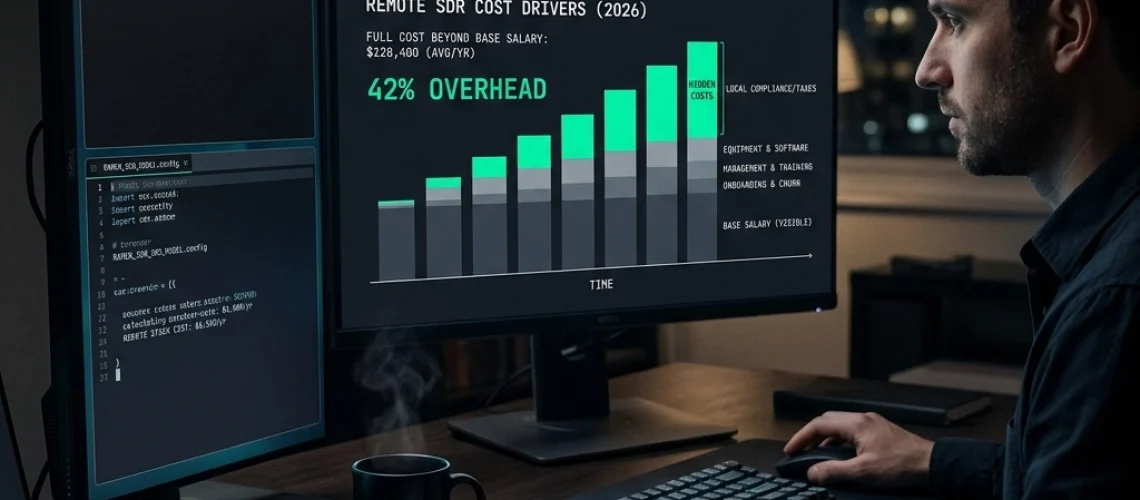
If you spend just 90 minutes a day managing a remote SDR: reviewing their drafts, checking their activity logs, and correcting their mistakes: that’s 7.5 hours a week. For a founder, that’s nearly 20% of your productive capacity. If your time is worth $200 an hour to your company, you’ve just added an invisible $1,500/week ($6,000/month) to the cost of that SDR. Suddenly, that "affordable" $2,500/month hire is costing you $8,500.
The management tax shows up in:
- The Context Gap: A remote hire doesn't sit in your Slack channels or hear your customer calls. They lack the "osmosis" of an in-house team, meaning you have to manually transfer every piece of institutional knowledge.
- The Quality Audit: You can't trust that the "50 emails sent today" were actually good. You end up spot-checking sent folders at midnight because one bad email to a key prospect can burn a bridge forever.
- The Motivation Loop: Keeping a remote contractor engaged when they are 12 time zones away requires constant emotional labor.

The Ramp Time Trap
Most founders overlook the cost of the "Zero-ROI Period." In 2026, it takes an average of 3 to 4 months for a human SDR to become fully productive. During those first 90 days, you are paying 100% of the salary and getting maybe 20% of the output.
When you factor in the recruiting fees (often 15-20% of the first-year salary) and the cost of the tech stack they need (LinkedIn Sales Navigator, Apollo, a CRM seat, and a cold email tool), the true cost of a human SDR in their first year is staggering. If they quit or you have to fire them at the six-month mark: which happens more often than most agencies admit: you’ve essentially lit $30,000 on fire with zero booked meetings to show for it.
Automation vs. Activity: What Really Drives Demos
There is a fundamental misunderstanding in outbound sales: the belief that more activity leads to more demos. This "volume-first" mindset is exactly what remote SDR agencies sell. They promise 100 emails a day, 50 LinkedIn requests, and 30 cold calls.
But in 2026, volume is cheap. Everyone has access to basic automation. Your prospects are drowning in "personalized" emails that use the same generic variables. What drives demos isn't activity; it's deep research and relevance.
A human SDR: especially one managed remotely: will naturally gravitate toward the path of least resistance. They will use templates. They will scrape a list and blast it. Why? Because you’re measuring them on activity. If they don't hit their "100 emails" mark, they feel they aren't doing their job.
However, one highly researched email that references a prospect's recent podcast appearance, their specific technical debt, or a challenge their industry is facing is worth 500 template blasts. The problem is that doing this level of research takes time: time that a remote SDR focused on "activity" doesn't have.
This is where the shift to AI-driven outbound becomes a survival necessity for founders. An AI agent doesn't get tired of doing research. It doesn't skip the "About Us" page because it's five minutes before the end of its shift. It can perform deep research on every single prospect at a scale no human can match.
Objection Handling: "Can't I Just Use Tracking Software?"
When I talk to founders about the management headache of remote teams, the first response is often: "I'll just use Hubstaff or Time Doctor. I'll see their screen and know they're working."
This is a trap. Better tracking is not the same as a better system. In fact, micromanagement via tracking software often makes the problem worse.
- Activity vs. Value: Tracking software shows you that a person is at their computer. It doesn't tell you if the email they are writing is actually going to convert. You're measuring presence, not performance.
- The "Cat and Mouse" Game: High-quality talent hates being tracked. You end up hiring people who are good at "looking busy" rather than people who are good at selling.
- The Cognitive Load: You now have to spend time reviewing the tracking logs. You've added another layer of management to your already overflowing plate.
Better systems beat better tracking every time. Instead of trying to monitor every keystroke of a remote hire, founders are moving toward systems where the "labor" is handled by AI, and the human's role is strictly to provide high-level strategy and final approval. This "Human-in-the-loop" model ensures quality without the need for digital surveillance.

The Domain Health Crisis
There’s a hidden cost that can kill your startup before you even find Product-Market Fit: domain reputation.
A remote SDR who is pressured to hit high activity numbers will eventually cut corners. They’ll use poor-quality leads or aggressive subject lines. When those emails get marked as spam, your company’s domain health takes a hit.
I’ve seen founders lose their primary business email functionality because a remote SDR burned their domain. Fixing a blacklisted domain can take months of "warming" and thousands of dollars in consulting fees. If your SDR isn't an expert in the technical nuances of deliverability: SPF, DKIM, DMARC, and inbox rotation: they are a liability to your company’s infrastructure.
The Opportunity Cost of Founder-Led Management
As an early-stage founder, your most valuable asset is your focus. Every hour you spend debating a subject line with an SDR is an hour you aren't talking to customers, refining your product, or closing deals.
The "hidden cost" of a remote SDR isn't just the money; it's the lost momentum.
Imagine if you could get the efficiency of a world-class remote team: the research, the outbound, the follow-ups: without the micromanagement. Imagine if your "SDR" never needed a 1-on-1, never got sick, and performed deep research on every lead before you even saw the draft.
This is why we built Ramen. We realized that for most founders, replacing an SDR with an AI agent isn't about saving a few thousand dollars on salary. It’s about saving their sanity. It’s about moving from a "babysitter" role back to a "founder" role.
Getting the Output Without the Headache
If you are currently managing a remote SDR and feeling the weight of the "Management Tax," it’s time to audit your process. Ask yourself:
- How many hours a week do I spend reviewing work?
- What is the cost of my time versus the "savings" of the hire?
- If I stopped managing them today, would the quality of our outbound stay the same?
The goal of outbound shouldn't be to build a large team. The goal is to build a predictable pipeline. In 2026, the leanest startups are the ones that win. They don't hire for the sake of hiring; they scale outbound without agencies or bloated remote teams. They use systems that leverage AI for the heavy lifting and keep themselves in the loop only where it matters: the final strategy and the closed deal.
Don't let the "sticker price" of a remote hire fool you. The most expensive SDR is the one who requires your constant attention.
If you're ready to stop the Zoom-call cycle and actually start booking demos while you sleep, it might be time to look at a different way to do outbound. Automate your remote outbound at Ramen.so and get back to building what actually matters.