
You’re sitting there on a Sunday night, looking at your bank statement and your empty calendar. You know you need more demos. You also know you can’t afford to drop $80k, plus benefits and a hefty tech stack, on a full-time Sales Development Representative (SDR) who might take three months just to learn how to pronounce your product’s name.
So, you do what many founders do: you go to Upwork or a "boutique" lead gen agency. You find a freelance SDR who promises the world for $2,000 a month. You think you’ve found a loophole. You think you’re being "scrappy."
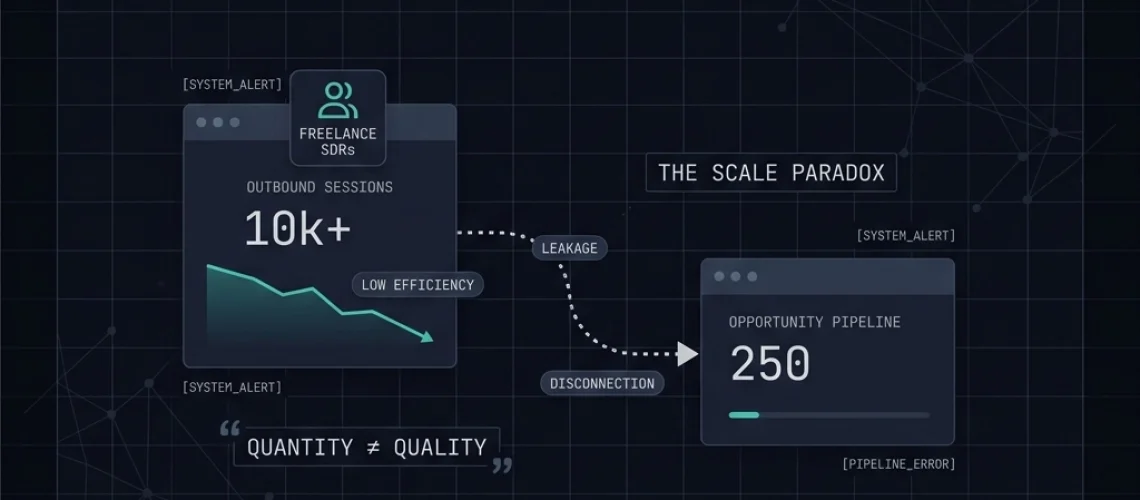
But here’s the reality you’ll face in about six weeks: that freelancer just sent you a "Hey, sorry, I took a full-time gig" email, or worse, they’ve been "working" for a month and haven’t booked a single qualified meeting because they’re simultaneously juggling four other clients who pay more than you.
Hiring a freelance SDR isn't a shortcut to growth. It’s a revolving door of contractors who don't understand your product, won't learn your market, and will leave the moment a better offer hits their inbox. You aren't building a sales engine; you’re renting a broken one.
We’re going to show you why the freelance SDR model is fundamentally flawed and how you can actually build a permanent outbound infrastructure that doesn’t quit on you when things get difficult.
The Flaw in the Contract SDR Model
The biggest lie in the sales world is that you can outsource the "boring" part of sales to someone who isn't invested in your company. Outbound isn't just a numbers game; it’s a feedback loop. When you hire a freelancer, you’re severing that loop.
Freelance SDRs operate on a transactional basis. Their incentive structure is almost always misaligned with yours. If you pay them per meeting, they’ll book meetings with anyone who has a pulse, regardless of whether they fit your Ideal Customer Profile (ICP). If you pay them an hourly rate, they’ll spend hours "researching" without actually hitting the send button.
The most dangerous part? The lack of tribal knowledge.
When a full-time employee fails, you at least own the lessons they learned. When a freelancer fails, they take those lessons with them. They learned which subject lines didn't work, which personas were hostile, and which objections kept coming up, and then they disappeared. You’re left back at square one, having to pay the next freelancer to make the exact same mistakes.

The Talent Ceiling
Let’s be honest about the talent pool. Sales is a high-turnover, high-stress career. The SDRs who are truly elite, the ones who can navigate a complex enterprise sale or find a creative angle into a competitive market, don't stay freelancers for long. They get snatched up by Series B startups or big tech companies that offer six-figure base salaries and equity.
By opting for the freelance route, you are often choosing from a pool of people who are either:
- Transitioning: They are between "real" jobs and will leave the second they get a LinkedIn message from a recruiter.
- Over-leveraged: They are "white-labeling" their services, meaning you think you hired "Alex," but "Alex" actually hired a team of VAs in a different time zone to send templated spam.
- Inexperienced: They are learning the ropes on your dime, using your domain reputation as a laboratory for their mistakes.
If you’re a founder doing your own outbound, you’re likely already feeling the "chicken-and-egg" problem: you can't raise money without a pipeline, but you can't build a pipeline without the time or money to hire a pro. A freelancer feels like a bridge, but it’s more like a treadmill. You’re running hard and spending money, but you’re not actually moving forward.
Building Equity in Your Sales Process
Instead of hiring a person to do a job, you should be building a system that performs a function. This is the difference between "renting" a salesperson and "owning" your outbound infrastructure.
When we talk about sales equity, we’re talking about your playbook. This includes your validated messaging, your verified lead lists, your technical domain setup, and your response handling logic. If this lives in a freelancer’s head (or their personal Google Drive), you have zero equity.
To build a permanent outbound engine, you need three things:
1. Deep Research as a Standard, Not an Extra
Most freelance SDRs use a "spray and pray" approach because deep research takes time, and time is money they’d rather spend on their other clients. Your sales engine should be built on deep research on every prospect. It shouldn't just be "Hey {{first_name}}, I saw you work at {{company}}." It should be "I saw your recent post about the challenges of scaling a remote team, specifically regarding X…"
2. Technical Control (BYOK)
You should never let a contractor "handle" your email infrastructure entirely. You need to control your own API keys and your own domains. This is what we call the BYOK (Bring Your Own Key) model. It ensures that if you stop working with a specific tool or person, you still own the technical foundation. You aren't starting from scratch with "burned" domains that land every email in the spam folder.
3. Human-in-the-Loop Oversight
The mistake many founders make when moving away from freelancers is thinking they can just turn on an "AI bot" and walk away. AI SDRs require human oversight, that’s a feature, not a limitation. You, the founder, are the only one who truly understands the nuance of your product. You should be the one approving the final drafts, at least until the system is dialed in.

"Isn't a freelancer easier to fire?"
This is the number one objection founders have. "I don't want the commitment of a full-time hire. If the freelancer sucks, I just stop paying them."
This is a "cope" for a broken strategy. Yes, a freelancer is easier to fire, but they are also significantly easier to lose. You might feel in control because you can cut the cord, but you aren't in control of when they decide to cut the cord.
The "flexibility" of a freelancer is a double-edged sword that usually cuts the founder. Every time you "fire" a freelancer and hire a new one, you lose at least 2-4 weeks of momentum. In the world of early-stage startups, four weeks of zero pipeline is a catastrophe.
The real goal shouldn't be "easy to fire." The goal should be "predictable and persistent." You want a system that stays running whether it’s a holiday, whether someone gets sick, or whether a contractor finds a better-paying gig. This is where the AI SDR agents come in. They don't get bored, they don't take other jobs, and they don't forget the lessons learned from the last 1,000 emails sent.
The Reality of Founder-Led Sales
If you're at the pre-seed or seed stage, you are the best salesperson your company will ever have. No freelance SDR will ever match your passion or your depth of knowledge. The problem isn't that you shouldn't be doing sales; it's that you don't have the time to do the manual labor of sales.
The manual labor: finding emails, verifying data, writing the first draft, following up: is what kills founders. It’s what leads to those "Sunday night email sessions" where you try to blast out 50 messages before Monday morning.
Instead of hiring a person to do that manual labor poorly, you should replace the SDR role with an AI agent that works under your direction. This allows you to scale your own expertise. You provide the strategy, the AI provides the labor, and you only step in to handle the actual conversations with interested prospects.
Moving Beyond the "Cheap" Fix
The freelance SDR is a band-aid on a gunshot wound. It might stop the bleeding for a week, but it won't fix the underlying problem: you lack a scalable, repeatable way to generate interest in your product.
Stop looking for a person to save you and start looking for a process. A process doesn't quit. A process doesn't ask for a raise. A process doesn't get "distracted" by other clients.
At Ramen, we built a platform for the founders who are tired of the agency games and the freelancer churn. We believe outbound should be high-quality, research-backed, and entirely under your control. You shouldn't have to choose between a $100k hire and a $2k-a-month "lead gen" bot that burns your domain.
Build a stable pipeline that doesn't quit on you. If you’re ready to stop the revolving door of contractors and start building real sales equity, come see how we do things.
Build a stable pipeline at Ramen.so.