
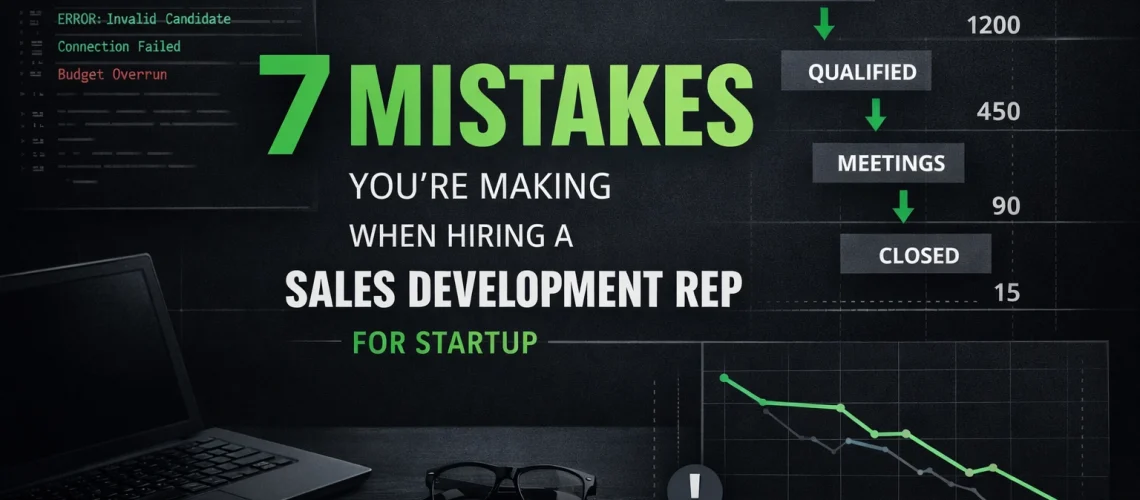
It’s 11 PM on a Sunday. You’re staring at a spreadsheet of LinkedIn profiles, trying to figure out which of these "VP of Engineering" types might actually reply to a cold email. You’ve been building product for 10 hours, and now you’re doing the one thing you hate most: manual prospecting.
The thought hits you: I just need to hire an SDR.
You imagine a hungry 23-year-old taking this off your plate, booking five demos a week while you focus on the roadmap. You picture the pipeline growing while you sleep. You think a $60,000 base salary is a small price to pay for your sanity.
But here is the cold, hard reality: most first SDR hires at seed-stage startups fail within six months. They burn through your precious runway, send generic sequences that torch your domain reputation, and eventually quit because "the leads weren't good enough."
If you’re about to post that job description, stop. Most founders treat hiring a sales development rep for a startup like buying a plug-and-play solution. It’s not. It’s a complex, high-risk experiment that usually fails because of these seven common mistakes.
1. Hiring Before You’ve Proven the Motion
This is the "founder's trap." You’re tired of doing outbound, so you hire someone to figure it out for you. You expect a junior SDR to define your Ideal Customer Profile (ICP), craft the messaging, and find the right channels.
That is not an SDR's job. That is a founder's job.
If you haven’t personally booked at least 10–20 demos using a specific script or strategy, an SDR will fail. They don’t have your "founder magic." They don’t understand the nuances of the "why" behind your product. When you hire an SDR before you have a repeatable process, you aren't hiring a salesperson, you're hiring a very expensive researcher who is going to guess at your market.
2. Over-Indexing on "Big Tech" Resumes
It looks great on LinkedIn. "Former SDR at Salesforce" or "Top Performer at HubSpot." You think they’ll bring that "world-class" training to your three-person startup.
It almost never works.
Reps from giant companies are used to having a massive brand behind them. When they call a prospect, the prospect knows the company. They have dedicated sales engineers, pre-vetted lead lists, and a tech stack that costs $2,000 per month per user. At your startup, nobody knows who you are. The SDR has to build the plane while flying it. A rep who is used to a "mature process" will crumble when they have to find their own leads and deal with a 99% rejection rate for a brand-new product.

3. Ignoring the "Fully Loaded" Cost
Founders often look at an SDR salary, say $60,000, and think, I can swing that.
But the real cost of a human sales development rep for a startup is significantly higher. You have to account for:
- Payroll taxes and benefits: Usually 20–30% on top of base.
- Commission: Another $15k–$25k for hitting targets.
- The Tech Stack: LinkedIn Sales Navigator ($100/mo), a CRM ($100/mo), data providers like Apollo or ZoomInfo ($200/mo), and sending tools.
- Management Time: Your time is the most expensive resource. You will spend at least 5–10 hours a week training, coaching, and reviewing their work.
When you do the math, that "entry-level" hire is costing you closer to $100,000 a year. If they don't produce for three months while they "ramp up," you’ve just lit $25,000 on fire. You can see a more detailed breakdown of these costs here.
4. Falling for the "Volume over Value" Math
You’ve probably seen the spreadsheets. "If the SDR sends 500 emails a week, and we get a 2% reply rate, that’s 10 leads…"
In 2026, those numbers are a fantasy. The "spray and pray" method is dead. Inboxes are more crowded than ever, and AI filters are getting smarter. If your SDR is just blasting templates, your reply rate won't be 2%, it will be 0.1%.
The mistake is incentivizing the SDR on activity (number of calls/emails) rather than quality. When you push for volume, the quality of research drops. They start reaching out to "close enough" prospects with "good enough" messages. This doesn't just fail to book meetings; it kills your reply rates and can get your domain blacklisted.
5. The "Set It and Forget It" Delusion
Many solo founders hire an SDR because they want to "get sales off their plate." They hand over the keys and go back to coding.
Three weeks later, they check the CRM and realize the SDR has been messaging the wrong department or using an old version of the pitch. An SDR, especially in a startup, needs constant feedback loops. They are your eyes and ears on the market. If you aren't reviewing their "no's" to understand why the market is rejecting you, you're losing the most valuable data a startup has.
You can't outsource the "brain" of your sales process; you can only outsource the "legs."
6. Hiring a "Body" Instead of a System
Hiring one SDR is a single point of failure. If they get sick, leave for a better offer, or just turn out to be a "bad hire," your entire outbound motion stops.
Smart founders focus on building a system first. This might involve a research-first outbound approach where the data is the priority. When you hire a person before you have the infrastructure (the lists, the tools, the messaging), you are paying a premium for them to sit around and wait for you to give them directions.
7. Sticking to the Human-Only Status Quo
This is the biggest mistake founders make today. They assume that because outbound is "personal," it must be done entirely by a human.
They spend $80k–$100k on a person to do tasks that are 80% administrative.
- Finding emails.
- Checking LinkedIn profiles.
- Reading 10-K reports to find a "trigger event."
- Managing follow-ups.
If a human does this, they get tired. They take shortcuts. They miss details.
The alternative isn't "spammy AI." The alternative is an AI-driven system that does the heavy lifting with a human in the loop to ensure quality.
The Chicken-and-Egg Problem
As a founder, you’re in a tough spot. You need a pipeline to raise your next round or hit cash-flow positivity. But you can't afford a $100k sales hire until you have that money.
This is where the industry is shifting. You don’t need an $80,000 human to do research that an AI can do better for $499 a month.
At Ramen, we see founders making these mistakes every day. They think their only options are:
- Do it themselves and never sleep.
- Hire an expensive SDR and pray it works.
- Hire a cheap agency that sends junk and ruins their brand.
None of those are great.
Is AI Outbound Actually Better?
The biggest objection we hear is: "But won't AI emails look like spam?"
If you use a generic tool to blast 10,000 people, yes. It will be spam.
But the mistake is thinking that humans are naturally more "personal." Most human SDRs are just copy-pasting templates anyway. They don't have the time to read every prospect's recent blog post or listen to their latest podcast appearance.
An AI SDR, like Ramen, actually does more research than a human. It scans the web, understands the prospect's current challenges, and drafts a message that actually makes sense.
The key: and the reason we built Ramen the way we did: is the Human-in-the-Loop model.
You don't just "turn it on" and let it run wild. You see every email before it goes out. You approve the research. You keep the "founder's touch" without the "founder's manual labor." It's about replacing the SDR role with an AI agent while you stay in control of the strategy.
What Should You Do Instead?
If you're a solo founder or a seed-stage company, stop looking for a "perfect" SDR hire to save you.
Start by automating the parts of the job that a human shouldn't be doing anyway. Spend $499/mo instead of $8,000/mo. Use that saved $7,500 to extend your runway or hire another engineer.
Control your own costs by using your own API keys. Keep your "founder-led sales" approach, but give yourself the tools to scale it.
You don't need another person to manage. You need more booked demos.
If you're ready to stop wasting your weekends on spreadsheets and want to see how an AI agent can handle your outbound while you keep 100% control, see how Ramen works. We’ll show you how to build a pipeline without the $80k mistake.