
It’s Sunday night. You’re staring at a spreadsheet of 200 prospects. You know that if you don't get these emails out by Monday morning, your pipeline for the month is dead. You also know that if you do send them, you’re spending four hours on manual research instead of fixing that bug or talking to your existing customers.
At this point, every founder has the same thought: "I just need to hire an SDR."
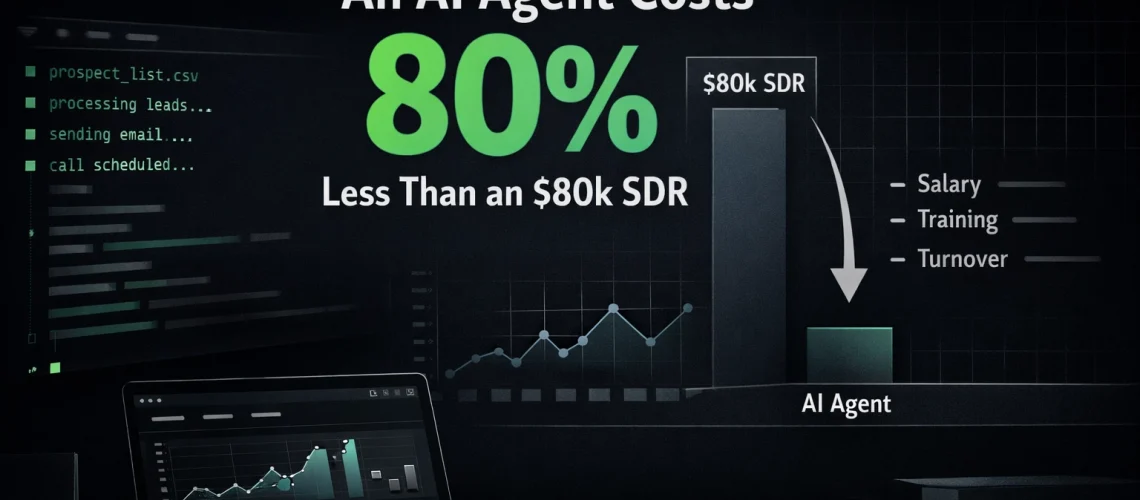
You tell yourself that an $80,000 salary is a small price to pay for a full calendar. You think that once you bring someone on board, your outbound problems will vanish. But for most early-stage startups, hiring a human SDR is the most expensive mistake you can make. It’s not just the salary that kills you, it’s the math you didn't see coming.
The $80,000 Mirage
When you look at a job offer for an SDR, you see the base salary. Let's say it's $60k plus $20k in commissions. $80k. Seems manageable, right?
Wrong. In the SaaS world, the "fully loaded" cost of an employee is usually 1.25x to 1.4x their base salary. Once you add in payroll taxes, health insurance, 401k matching, and office overhead, that $80,000 hire is actually costing your company closer to $105,000 per year.
And that’s before they’ve sent a single email.
Before they can even start, you have to buy their "toolbox." You’re looking at $150/month for LinkedIn Sales Navigator, $300/month for a lead database like ZoomInfo or Apollo, $100/month for a CRM seat, and another $100/month for email sequencing tools. Suddenly, you’re spending an extra $7,000 to $10,000 a year just to give them the equipment to do the job.
The Management Tax: Your Most Expensive Asset
The biggest hidden cost isn't money, it's your time.
A junior SDR doesn't just show up and start booking demos with Fortune 500 CEOs. They need training. They need scripts. They need you to sit with them and explain why "Value Prop A" works better than "Value Prop B."
Most human SDRs take about 3.1 months to reach full productivity. During those 90 days, you are paying full price for zero results. You are essentially subsidizing their education on your dime.
Even after they’re ramped, you’re stuck in the "management loop." Weekly 1-on-1s, pipeline reviews, and the inevitable "motivation" talks when they hit a dry spell. As a founder, your time is worth hundreds of dollars an hour. If you’re spending five hours a week managing a single SDR, that’s another $50,000+ in "opportunity cost" annually.
The SDR Churn Cycle
Here is the cynical truth about the SDR role: nobody wants to be an SDR for long.
The average tenure for an SDR is about 14 months. If they’re good, they want to be promoted to an Account Executive (AE) within a year. If they’re bad, you have to fire them after six months.
Either way, you are back at square one every year. You have to recruit, interview, hire, and train all over again. You lose the momentum, the data, and the institutional knowledge. You spend $10k on a recruiter fee, another $20k in ramp-up time, and the cycle repeats. You aren't building a sales machine; you're running a revolving door.

Why AI Agents Are Winning the Math War
This is where the math shifts. An AI SDR agent doesn't need health insurance. It doesn't get "burnt out" by rejection. It doesn't ask for a promotion to AE after ten months of sending emails.
At Ramen, we see founders making the switch every day. Instead of an $8k monthly burn for a human hire, they’re spending $499 a month for unlimited AI agents.
Let's look at the direct comparison:
| Feature | Human SDR | Ramen AI Agent |
|---|---|---|
| Annual Cost | $98,000 – $120,000 | $5,988 |
| Ramp-up Time | 3 Months | 30 Minutes |
| Daily Output | 50 – 100 emails | 1,000+ (if needed) |
| Research Quality | Varies by mood | Consistently deep |
| Management | Daily/Weekly | Set and forget |
| Availability | 40 hours/week | 168 hours/week |
The cost difference isn't just a "discount." It's a fundamental shift in how you can run your business. That $80k you save can be spent on an engineer, an extra six months of runway, or your own salary.
The "Spam" Objection: Addressing AI Quality
The most common pushback I hear is: "But won't AI just send generic spam? I need someone who can actually research my prospects."
Ten years ago, that was true. But the "template blasting" era is over, and human SDRs are often the biggest offenders. When a human has a quota of 100 emails a day, they take shortcuts. They use a generic template and swap out the first name.
A research-first AI agent like Ramen actually does more work than a human. It scans the prospect’s LinkedIn, reads their recent tweets, looks at their company’s latest news, and finds a specific reason to reach out. It does this for every single lead, every single time.
The result? Better reply rates. Because the AI isn't rushing to finish its shift; it's just following the logic you gave it.
Human-in-the-Loop: The Best of Both Worlds
We aren't suggesting you remove humans from the sales process entirely. Sales is still about relationships. But you shouldn't be paying a human to do the "grunt work" of prospecting and initial outreach.
The smartest founders use a human-in-the-loop workflow. The AI does the heavy lifting: it finds the leads, does the research, and drafts the personalized email. You, the founder, simply hit "approve."
This takes 15 minutes of your morning instead of four hours of your Sunday night. You keep total control over your brand voice without the $80k price tag.
The "Bring Your Own Key" (BYOK) Advantage
One of the ways "traditional" sales tools trap you is by marking up data and AI costs. They charge you a premium for every lead and every AI credit.
At Ramen, we use a BYOK model. You bring your own API keys for OpenAI and your lead data providers. This means you pay the raw cost for what you use. No markups. No hidden "platform taxes."
This level of transparency is exactly why smart founders are moving away from the old-school SDR model. Why pay a middleman when you can own your infrastructure?
Can You Really Replace a Human?
If you are a Series C company with a $10M marketing budget, sure, hire a team of 20 SDRs. You have the cash to burn on management and turnover.
But if you are a seed-stage founder, or a solo-founder trying to get your first 50 customers, hiring a human SDR is a luxury you can't afford. You need pipeline, but you also need to protect your equity and your cash.
The "real" cost of an SDR isn't just the money out of your bank account: it's the risk. If a human hire fails, you've lost $30k in three months and have zero pipeline to show for it. If an AI agent doesn't work out, you’ve lost a few hundred bucks and can pivot your strategy in an afternoon.
Stop Paying for the 2015 Playbook
The world has changed. The "predictable revenue" model of hiring rooms full of 22-year-olds to hammer the phones is dying. It’s inefficient, it’s expensive, and it’s annoying for the prospects receiving those generic calls.
Modern outbound is about personalizing at scale. It’s about being relevant, not just loud.
For $499 a month, you can have a fleet of configurable AI agents that work harder than any $80k hire ever could. They don't need coffee breaks, they don't get discouraged, and they don't leave for a better offer after six months.
Your job as a founder is to be the bottleneck of your company’s growth for as short a time as possible. You need to scale yourself. And the fastest way to do that isn't by adding more people: it's by adding better systems.
If you’re ready to get your Sundays back and build a pipeline that doesn't eat your entire seed round, it’s time to stop hiring and start automating.