
You finally hit that milestone. Maybe you just closed a small round, or maybe your founder-led sales have reached a point where you simply can’t keep up with the manual outreach anymore. You look at the market rate for a junior Sales Development Representative (SDR). $5,000 a month in base salary.
"I can afford that," you tell yourself. "If they book just two or three solid demos a month, they’ve paid for themselves."
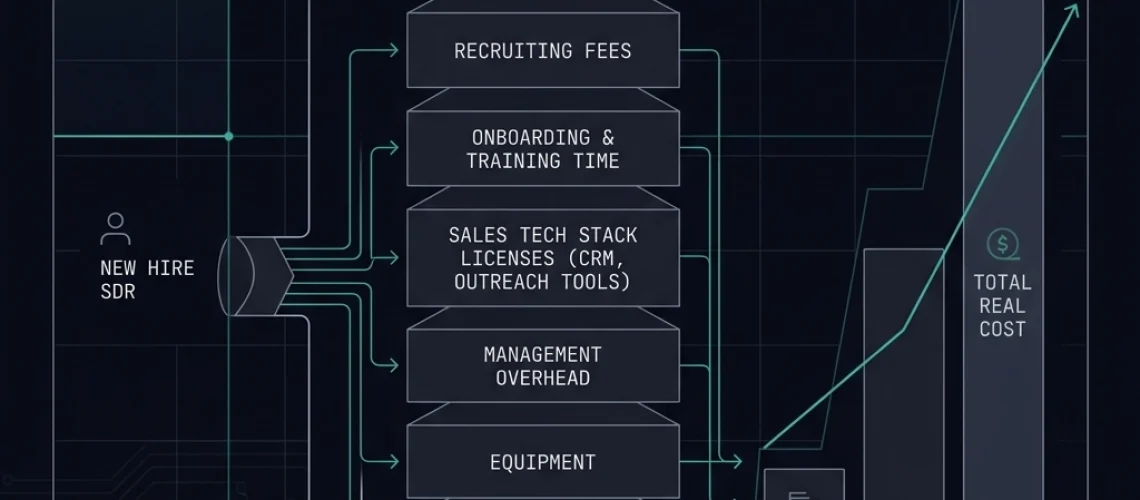
But then the "New Hire Tax" starts to kick in. It’s not a line item on your P&L, but it’s real. It’s the $2,000 a month in data tools they need to actually do the job. It’s the 10 hours a week you lose in management time because they don't know your ICP as well as you do. It’s the four-month ramp-up period where you are effectively burning cash while they "learn the market."
By the time your "affordable" $60k/year hire is actually productive, you’ve likely spent closer to $100k in actual out-of-pocket costs and lost opportunity.
We’re going to break down the real "New Hire" tax and show you how to bypass it entirely.
Beyond the Base Salary: The True Cost of Outbound
When you hire a human SDR, the salary is just the entry fee. In the world of modern outbound, a salesperson is only as good as the tech stack you give them. You can't just hand them a phone book and a desk.
To be competitive in 2026, your SDR needs a specific arsenal. At a minimum, you're looking at:
- Data & Intent Tools: $400 – $800/mo (Apollo, ZoomInfo, or specialized scrapers).
- LinkedIn Sales Navigator: $100/mo.
- Email Sending Platforms: $100 – $300/mo (Instantly, Smartlead, etc.).
- Domain & Inbox Management: $50 – $150/mo (Buying and warming up secondary domains).
- Research & Enrichment: $500 – $1,000/mo (Clay or similar tools to ensure they aren't sending generic garbage).
Suddenly, that $5,000 base salary has ballooned to $7,000 or $8,000. And we haven't even touched on payroll taxes, health insurance, or the hardware they need. This is the AI SDR pricing breakdown reality that most founders ignore until the first month's expenses hit the dashboard.

The Management Overhead No One Talks About
This is the hidden tax that hurts early-stage founders the most: your time.
Most founders hire an SDR to save time. They want to get "out of the weeds." But for the first three to six months, you’ll find yourself deeper in the weeds than ever before.
A junior SDR doesn't know why your product matters. They don't understand the nuance of why a VP of Engineering at a Series B startup cares about "latency" while a CTO at a seed-stage company cares about "speed to market." You have to teach them.
That’s 10 hours a week of your time. You’re reviewing their lead lists. You’re editing their scripts. You’re sitting in on their "shadowing" sessions. If your time is worth $150/hour (which is a conservative estimate for a founder), that’s another $6,000 a month in "Management Tax."
You aren’t just paying for an SDR; you’re paying for a part-time job as a Sales Manager.
The Ramp-Up Sinkhole
The industry average for an SDR to become fully productive is between three and four months. During month one, they are learning the tools. Month two, they are building lists. Month three, they are finally starting to get some replies.
During this window, you are paying 100% of the costs for roughly 20% of the output. In the venture-backed world, this is just "the cost of doing business." For a bootstrapped or early-stage founder, this is a dangerous burn of precious runway.
If it takes four months to ramp, and you’re spending $8,000 a month (fully loaded), you’ve spent $32,000 before you’ve seen a single qualified demo. If they quit in month six: which happens more often than anyone likes to admit: you’ve essentially lit that money on fire.
This is why many are looking to replace SDRs with AI agents. An AI doesn't need to "learn the market" for four months. It doesn't have a ramp-up period. It just needs the right data and the right guardrails.
"Can't I Just Use a Cheaper Tool?"
The common rebuttal from founders is to try and cut corners. "I’ll hire a VA from overseas for $1,500 a month and give them a basic Apollo account."
Here is what actually happens:
- The Quality Problem: Without deep research, your outbound becomes "template blasting." Your domain reputation tanks because you’re sending 200 generic emails a day.
- The Hidden Tool Costs: You still need the data. You still need the sending platform. You still need the LinkedIn Premium.
- The Management Headache: Managing a remote, low-cost worker often requires more of your time, not less, to ensure they aren't burning your brand's reputation with low-quality outreach.
The "cheap" route often ends up being the most expensive because it fails to generate any pipeline. The cheapest outbound is the outbound that actually books meetings.

Consolidating the Stack with Ramen
This is where the math starts to shift. The reason we built Ramen was to solve this specific "New Hire" tax.
Instead of paying for five different tools and a junior salary, you consolidate. Ramen acts as the research layer, the data layer, and the execution layer. It doesn't just send emails; it performs research-first outbound. It looks at a prospect's LinkedIn, their recent news, and their company's tech stack before it ever drafts a word.
One of the biggest pain points for founders is the "Black Box" of most AI tools. You worry that an AI will go rogue and send something stupid to your dream prospect.
We solve this with a Human-in-the-Loop model. The AI does the heavy lifting: the 10 hours of research and drafting: but you (or someone on your team) gets the final "Approve" button. You maintain the quality of a founder-led sales process with the scale of an enterprise team.
By using the AI SDR stack with your own API keys, you keep your costs transparent. You aren't paying a massive markup on data; you’re paying for the work done.
The Opportunity Cost of Staying Manual
While you're debating whether to hire an SDR or keep doing it yourself on Sunday nights, your competitors are likely scaling.
The real tax isn't just the money you spend: it's the demos you aren't booking while you're busy formatting Excel sheets. Every day you spend without an automated outbound motion is a day you aren't building a predictable pipeline.
If you're a pre-seed or seed founder, your job is to find Product-Market Fit and build a repeatable sales engine. Hiring a human SDR before you have that engine is putting the cart before the horse. You're asking a junior hire to solve a strategic problem they aren't equipped for.
How to Bypass the Tax
If you want to skip the $100k "New Hire" tax, the playbook is simple:
- Automate the Research: Don't pay a human to copy-paste from LinkedIn. Use an agent that can read and synthesize information.
- Consolidate the Tools: Stop paying for a "stack" and start paying for a solution.
- Keep the Quality: Never sacrifice the "human" element of your brand. AI should be used to enhance your voice, not replace it with generic noise.
- Control Your Costs: Use models like Ramen where you can scale outbound without agencies or bloated payrolls.
The era of the "Entry Level SDR" is ending. The role is being split into two: strategic sales leaders who handle the closing, and AI agents that handle the prospecting. For a founder, that's the best news you've had all year. It means you can build a $10M pipeline without the $100k headcount.
If you’re tired of the Sunday night email sessions and the constant "New Hire" tax, it’s time to change how you think about outbound. You don’t need more employees; you need a better system.
Cut your costs and start booking more demos at Ramen.so.