
It’s 9:00 PM on a Sunday. You’re three tabs deep into a LinkedIn Sales Navigator search, manually copy-pasting names into a spreadsheet. You’ve got a product to build, a pitch deck to refine, and a team to lead, yet here you are: playing data entry clerk for your own outbound.
You know you need a pipeline to raise your next round, but you’re out of hours in the day. So, you do what every "scale-up" podcast tells you to do: you hire a freelance SDR.
They seem like the perfect low-risk solution. They’re "experts." You pay them a small base plus a commission for every meeting booked. You think you’ve just bought back your weekends.
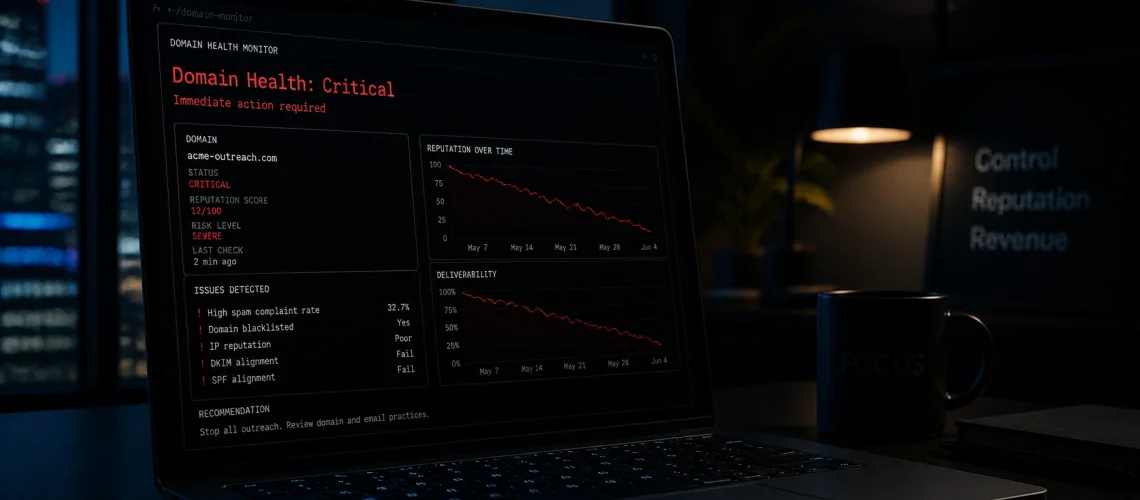
But three months in, the meetings stop. Then your internal team starts complaining that their calendar invites are going to spam. You check your domain health and realize your primary URL: the one you use to talk to investors, customers, and partners: is on three different blacklists.
Your "expert" wasn't doing deep research. They were running a high-volume numbers game with your brand's reputation as the collateral.
In this post, I’m going to pull back the curtain on why the freelance SDR model is fundamentally misaligned with your long-term success, and how you can scale your outreach without burning your most valuable digital asset.
The Misalignment of Freelance Incentives
The core problem with hiring a freelance SDR isn't necessarily the person; it’s the math.
Most freelancers or small agencies work on a performance-based model. They want to show you "traction" quickly so you keep paying their retainer. In their world, traction equals volume. If they send 50 emails and get zero replies, they haven't made any money. If they send 5,000 emails and get five replies, they’ve justified their existence for another month.
This creates a dangerous incentive to cut corners.
When an SDR is incentivized by the number of meetings booked, they aren't incentivized to care about your domain’s long-term health. They don't care if 20% of the list they scraped from a budget database bounces. They don't care if their "personalization" is just a {{first_name}} tag followed by a generic pitch.
They need hits, and they need them now.

This "spray and pray" approach is the fastest way to get flagged by Google and Microsoft. Modern spam filters don't just look for keywords like "Viagra" or "Wire Transfer." They look for patterns:
- High bounce rates (sending to unverified emails).
- Low engagement rates (no one opens or replies).
- High "Mark as Spam" rates (from people who are annoyed by your irrelevant pitch).
A freelancer might book you two meetings this week, but if they trigger 50 spam reports in the process, they’ve done $10,000 worth of damage to your domain for a $500 commission. For a solo founder, that trade-off is a death sentence. You can scale outbound without agencies, but you have to do it by changing the incentive structure, not just the person in the seat.
Protecting Your Most Valuable Asset: Your Domain
As a founder, your domain is your identity. If your primary domain (e.g., yourcompany.com) gets blacklisted, it doesn't just affect your sales emails. It affects your ability to send invoices, communicate with your existing customers, and even email your own mom.
Recovering from a trashed domain reputation is a nightmare. It involves "warming up" new domains for months, pleading with IT departments to whitelist you, and potentially losing months of communication with prospects who simply never see your messages.
Freelancers often ignore the technical guardrails required for safe outbound. They rarely check if SPF, DKIM, and DMARC are configured correctly. They don't monitor your daily send limits. They just want to hit "send" on the next batch of 500 prospects.
When you use AI SDR agents for booked demos, the technical setup is baked into the process. But more importantly, the "agent" doesn't have a mortgage to pay based on how many emails it blasts today. You can set strict caps on volume because the "cost" of the agent isn't tied to the sheer quantity of activity.
The "Guideline" Fallacy: Why You Can’t Manage Your Way Out of This
I hear this from founders all the time: "I’ll just give them strict guidelines. I’ll tell them they can only send 50 emails a day and every single one must be personalized."
It sounds good in theory. In practice, it fails for two reasons:
- Monitoring is a full-time job. If you have to spend two hours a day auditing your freelancer’s sent folder to make sure they’re actually doing the research they promised, you haven't saved any time. You’ve just traded one manual task (writing emails) for another (micromanaging someone else's bad writing).
- The "Efficiency Gap." A human SDR, even a good one, takes 15–20 minutes to do "deep research" on a single prospect. To send 50 high-quality, research-backed emails, they need 12.5 hours of pure focus. At $30–$50 an hour, that’s $625 per day just for outreach. Most freelancers aren't doing that. They’re spending 30 seconds looking at a LinkedIn profile and calling it "research."
Guidelines don't fix the fact that humans are expensive and slow, while the "commission-only" model demands they be fast and cheap.
Why Research-First Outbound Wins
The only way to stay out of the spam folder in 2026 is to be relevant. Relevance is the ultimate deliverability hack. If a prospect sees an email that mentions a specific podcast they were on last week, or a specific problem their company is currently facing, they won't mark it as spam. They might even reply.
This is where the research-first outbound AI SDR model changes the game.
Instead of a human skimming a profile for 30 seconds, an AI agent can scan a prospect’s entire digital footprint: their LinkedIn posts, company news, 10-K filings, and blog posts: in seconds. It can then synthesize that information into a personalized message that actually adds value.

But here is the kicker: You shouldn't let an AI send those emails autonomously either.
The "trap" isn't just freelancers; it's any system that lacks human oversight. At Ramen, we believe in a human-in-the-loop approach. The AI does the 90% of the heavy lifting: the research, the drafting, the data cleaning: but you (the founder) spend 10 minutes a morning hitting "Approve" or making a quick tweak.
This ensures that:
- Your brand voice is never compromised.
- The "personalization" isn't hallucinated or creepy.
- You have 100% visibility into exactly what is being sent from your domain.
Compare this to the AI SDR vs. Human SDR reality. A human SDR costs $80k-$120k a year (including benefits and management overhead) and takes months to ramp. A freelance SDR is a domain-health gamble. An AI agent is $499/month, does more research than a human ever could, and never sends a single word without your sign-off.
Controlling Your Costs (The BYOK Model)
Another part of the "Freelance Trap" is the hidden costs. Freelancers often want you to pay for their tools: Apollo seats, Sales Nav, CRM licenses. Before you know it, you’re out $1,500 a month before they’ve even sent an email.
We built Ramen on a "Bring Your Own Key" (BYOK) model. You use your own AI API keys (OpenAI, Anthropic, etc.). This means you aren't paying a massive markup on the "intelligence." You pay for the platform, and you control your own compute costs.
It’s the most transparent way to scale. If you want to pause for a week because you’re underwater with demos, you pause. You don't have to worry about a freelancer's "minimum hours" or a 30-day notice period.
The Founder’s Path to Sanity
If you’re a pre-seed or seed-stage founder, you are the best salesperson your company will ever have. No freelancer will ever care about your vision as much as you do.
But you cannot be the person doing the manual labor of prospecting. It’s a waste of your talent and your time.
The mistake is thinking the only alternative to "doing it yourself" is "hiring a human." In 2026, the alternative is building an automated research engine that acts as your virtual SDR team.

Don't let the "Freelance SDR Trap" burn your domain reputation before you’ve even had a chance to scale. Your domain is too valuable, and your time is too scarce.
Scale safely. Keep the human in the loop. And get your Sundays back.
Ready to stop gambling with your domain? See how Ramen.so gives you a research-first SDR team for $499/month.