
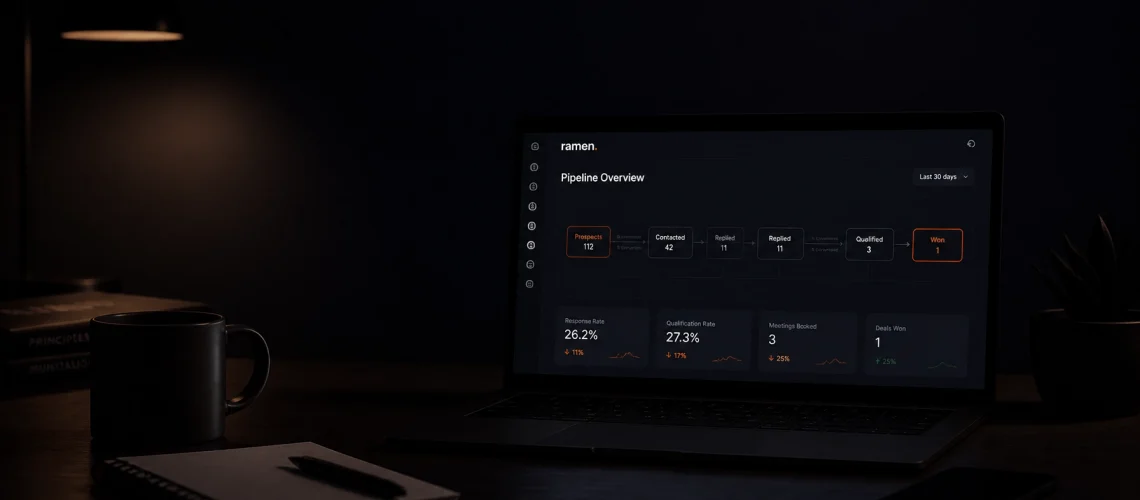
It’s Sunday night, and you’re staring at a spreadsheet of 200 leads that you haven’t emailed yet. You know you should be doing outbound. You know that without pipeline, your next round of funding is a fantasy. But you’re also the CEO, the product manager, and currently, the person fixing a bug in the billing code.
You think you’ve found the solution: a freelance SDR.
They’re "flexible." They’re cheaper than a full-time hire. You can find them on Upwork or through a LinkedIn referral, give them a list, and wait for the demos to roll in. It feels like a low-risk way to test the channel.
The reality? Within three weeks, you’re usually paying a monthly retainer for someone to spray-and-pray generic templates to your most valuable prospects. Your domain reputation is tanking, your reply rates are under 1%, and you’re spending more time managing the freelancer than you would have spent just writing the emails yourself.
The freelance SDR model is built on a fundamental misalignment of incentives. If you’re a solo founder or a seed-stage team, you can’t afford to burn your market with mediocre outreach. Here is why the "flexible" freelance route is often a dead end, and why AI-led agents are finally closing the gap.
The Multi-Client Conflict: Why Your Leads Aren't the Priority
When you hire a freelance SDR, you aren't hiring a dedicated team member. You’re hiring a service provider who is likely juggling four other clients. This isn't just a scheduling issue: it's a priority conflict.
Outbound sales in 2026 is harder than it’s ever been. Cold email reply rates have dropped to an average of 3.4%. To get a response, you need deep, obsessive research. You need to know why a prospect’s recent LinkedIn post relates to your product, what their company’s 10-K says about their goals, and exactly which competitor they are currently complaining about.

A freelancer billing you for 10 or 20 hours a week doesn't have the "cycles" for that level of depth. Their goal is to hit their activity metrics so they can justify their invoice. If they have five clients, they are looking for the shortest path to "sent." Usually, that path is a generic template with a {{first_name}} tag and a vague mention of their "impressive background."
Your prospects see right through it. They receive fifty of these emails a day. When your freelancer sends a shallow, templated message, they aren't just failing to book a meeting: they are actively signaling to a high-value prospect that your company doesn't care enough to do the homework.
Research vs. Templates: The Quality Gap
The biggest lie in the freelance SDR world is that "volume solves everything." It doesn't. In fact, volume without personalization is the fastest way to get your domain blacklisted by Google and Outlook.
Most freelancers rely on a "stack" they’ve used for every other client. They buy a list, plug it into a sequencer, and hit go. They might spend 30 seconds "personalizing" the first line, but the core of the message is a static pitch.
Contrast this with how an AI agent works. At Ramen, our agents don't just "fill in tags." They perform deep research on every single prospect. They scrape the prospect’s latest articles, their company’s recent news, and their specific job responsibilities.
Because an AI doesn't get bored and doesn't have "other clients" to worry about, it can spend the equivalent of an hour researching a single person before writing a single word. That is the difference between a 0.5% reply rate and a 5% reply rate.

When you look at the AI SDR vs. human SDR comparison, the quality gap is no longer about "human warmth." It’s about data density. A human freelancer simply cannot compete with the speed and depth of AI-led research at scale.
The Management Overhead Fallacy
"But Penny," you might say, "isn't an AI tool just another thing I have to manage? At least a freelancer is a person I can talk to."
This is the "Management Overhead Fallacy." Founders often hire freelancers to get a task off their plate, only to find that managing a freelancer is a full-time job in itself. You have to:
- Vet their scripts (which are often mediocre).
- Check their lead lists for quality.
- Monitor their activity to make sure they’re actually working.
- Handle the "ramp time": which usually takes 3 months for a human to even understand your product.
With Ramen, the workflow is designed for the "Sunday Night Founder." You set up your agent once, and it handles the prospecting and drafting. But: and this is the critical part: you stay in control.
We use a human-in-the-loop approach. The AI does 95% of the work, but you approve every email before it sends. It takes 10 minutes a morning to swipe through a queue of perfectly researched, highly personalized drafts. You get the scale of an automated system with the peace of mind that nothing "weird" is being sent on your behalf.

The Math of Scale: $499 vs. $80,000
Let’s talk about the money. A competent U.S.-based freelance SDR will cost you anywhere from $3,000 to $8,000 a month. Even an offshore freelancer is going to run you $1,500+ once you factor in their tools and your time spent managing them.
If you hire a full-time SDR, you’re looking at an all-in cost of $110k to $160k per year. That’s a massive bet for a seed-stage company that hasn't fully dialed in its outbound motion.
Ramen costs $499 a month.
Because we let you bring your own AI API keys (BYOK), you have total transparency and control over your costs. You aren't paying a "management fee" for someone to copy-paste templates. You’re paying for a sophisticated infrastructure that turns raw data into booked demos.
For the price of a few nice dinners, you get an unlimited number of AI agents that work 24/7, don't need health insurance, and don't quit after three months because they found a "better opportunity."
The Chicken-and-Egg Problem
As a founder, you're stuck in a loop. You need pipeline to raise your next round, but you need the money from that round to hire the sales team to build the pipeline.
The freelance SDR is the "band-aid" solution that usually ends up wasting three months of your runway and burning your most important leads. You don't need a freelancer who is doing the bare minimum for five different clients. You need a system that does the deep work you would do if you had 48 hours in a day.
Stop paying for templates and start building a research-first outbound engine. Your Sundays are too valuable to spend them on manual prospecting: and your company is too important to leave its growth in the hands of someone who doesn't have the time to care.
If you’re ready to see how AI agents can actually book demos without the freelance headache, see how Ramen works.