
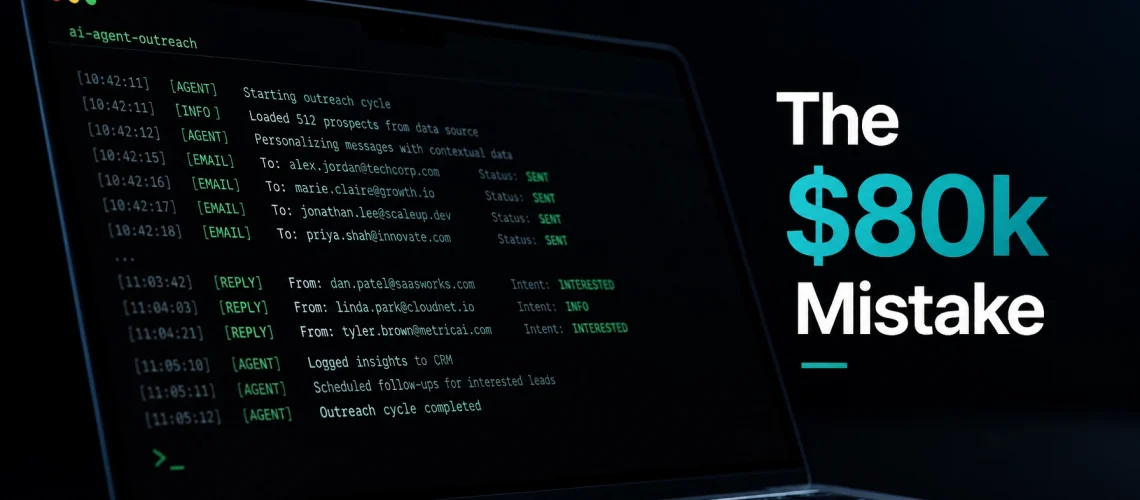
You finally got the budget. Maybe you just closed a small seed round, or perhaps your self-serve revenue finally hit the point where you can afford to offload the one thing you hate most: outbound prospecting.
You go out and find a hungry, entry-level Sales Development Representative (SDR). You offer a $55k base, a $80k OTE, and a small slice of equity. You buy them a seat in ZoomInfo, a LinkedIn Sales Navigator license, and a subscription to a fancy sequencing tool.
You spend your weekends training them. You walk them through your ICP (Ideal Customer Profile) for the tenth time. You explain why we don't use "hope this finds you well" in the subject line.
Three months later, they’ve booked two calls. One was a "no-show," and the other was with a student who wanted to pick your brain. By month six, they’re checking out, distracted by their next "career move" at a bigger firm.
It’s a startup rite of passage, but it’s one that’s quickly becoming obsolete. In 2026, hiring a human for your first outbound seat isn't just expensive: it's a fundamental misunderstanding of how modern sales works.
I’m going to show you why that $80k hire is usually a mistake, and how you can get better output for $499/month using AI agents.
The $80k Gamble vs. The $499 Guarantee
When you hire a human SDR, you aren't just paying a salary. You’re making a high-stakes bet with a massive "loaded cost."
According to market data for 2024–2025, a typical US-based SDR costs significantly more than their sticker price. Once you factor in payroll taxes, health insurance, benefits, and the $7,000+ per year in tech tools they require, a "cheap" SDR actually costs your company between $110k and $160k per year.

Compare that to an AI SDR platform like Ramen. For $499/month, you get unlimited agents that don't need health insurance, don't take lunch breaks, and: most importantly: don't need three months to "ramp up."
The Hidden Costs of Humanity
- The Ramp-Up Tax: It takes the average SDR 3.2 months to reach full productivity. That’s a quarter of a year where you are paying 100% of the cost for 20% of the output. In a pre-seed or seed-stage company, three months of "ramping" is three months of burn you can't get back.
- The Turnover Loop: The average SDR tenure is roughly 15 months, with an annual turnover rate of nearly 40%. Just as they finally start to understand your product and build a pipeline, they leave. You then spend another $10k+ on recruiting and start the ramp-up cycle all over again.
- The Management Burden: Your time is your most valuable asset. If you’re spending 10 hours a week managing an SDR, that’s 10 hours you aren't spending on product or closing deals. AI doesn't need "weekly 1-on-1s" or "motivational Slack messages."
Why Early-Stage Teams Can't Afford Human SDR Mistakes
For a solo founder or a small team, the margin for error is zero. You need a pipeline to raise your next round, but you can't afford to burn $100k on a failed experiment.
Most lead gen agencies and human SDRs run a playbook designed for 2018: template-based volume. They blast 500 emails a day and hope for a 1% reply rate. In today’s world of aggressive spam filters and "AI-fatigued" prospects, that strategy is a great way to get your domain blacklisted and your brand ignored.

This is where the AI-SDR vs. Human SDR debate becomes one-sided. A human SDR physically cannot research 100 prospects a day with the depth required to break through the noise. They’ll start cutting corners by noon on Tuesday.
An AI agent, however, can scan a prospect’s LinkedIn, read their recent blog posts, listen to a podcast they featured on, and cross-reference their company’s latest quarterly report: all in about 15 seconds. This research-first approach ensures that every email feels like it was written by a founder, not a bot or a bored 22-year-old.
"Doesn't a human have more grit?"
This is the most common objection I hear from founders. They think a human will "hustle" harder.
The reality? Humans get tired. Humans get discouraged after ten "unsubscribe" replies in a row. Humans forget to follow up on the fourth email because they’re busy researching a new list.
AI has 100% persistence and 0% burnout. It will follow up precisely at the cadence you set, every single time, without ever feeling "rejected."
But there’s a catch: pure AI automation can be dangerous. If you let an LLM loose on your entire TAM (Total Addressable Market) without oversight, you’re asking for trouble. That’s why we built Ramen with a human-in-the-loop philosophy.

You don't just "set it and forget it." You act as the editor-in-chief. The AI does 99% of the heavy lifting: the deep research, the drafting, the follow-up scheduling: and you just hit "approve" or "tweak" on the final version. It gives you the scale of a 10-person SDR team with the quality control of a founder.
The Cost of Control: The BYOK Advantage
Most AI tools on the market are "black boxes." They charge you a massive premium on top of the AI usage costs.
At Ramen, we believe founders should have full control over their expenses. That’s why we use a Bring Your Own Key (BYOK) model. You plug in your own OpenAI or Anthropic API keys. You pay the raw cost of the AI, and we provide the "brain" that coordinates the agents.
When you look at the pricing breakdown, the math is undeniable. For less than the cost of a single SDR's monthly health insurance premium, you get a system that out-works, out-researches, and out-performs a human team.
Stop Spending Your Weekends on Outbound
The "SDR trap" is real. You hire someone to save time, only to realize that managing them takes more energy than doing the work yourself.
If you're a founder who is currently spending your Sunday nights writing personalized outreach emails because you don't trust an agency or a junior hire to do it right, you’re exactly who we built Ramen for.
You don't need an $80k mistake. You need a system that gives you back your time while building a pipeline that actually converts.
Hire your first AI SDR at Ramen.so and stop gambling with your GTM.