
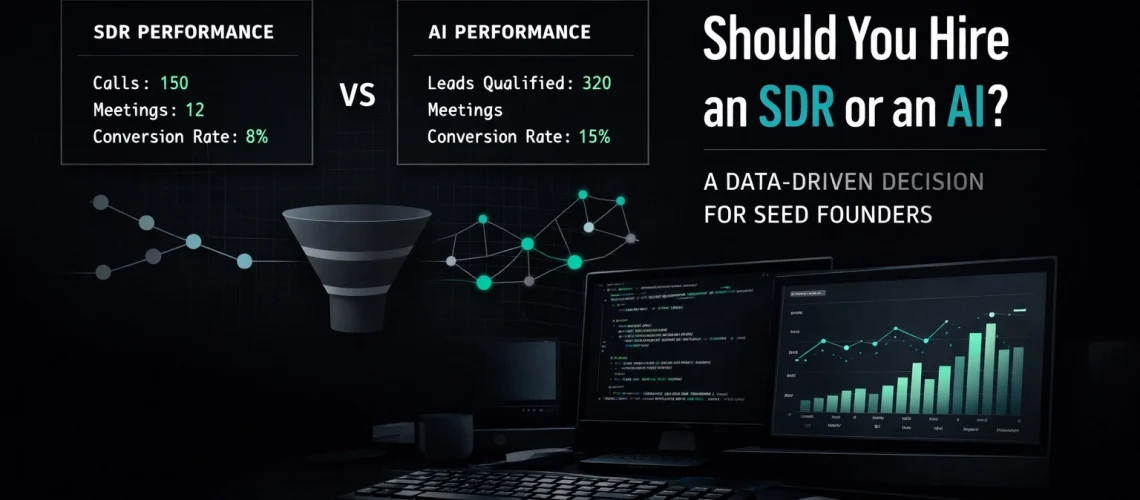
It’s 10 PM on a Sunday. You’re staring at a spreadsheet of 50 LinkedIn profiles, trying to find a "hook" for an outbound sequence. You know you need to send 200 emails this week to book the three demos required to hit your monthly target. But you also have a product roadmap to manage and a pitch deck to polish.
The thought hits you: "I just need to hire an SDR."
Before you post that job description, let’s look at the numbers. Hiring your first Sales Development Representative (SDR) is often the most expensive mistake a seed-stage founder can make.
The $100,000 Gamble
Most founders look at an SDR salary and think, "I can afford $50k-$60k." But that’s not the real cost. When you factor in payroll taxes, health insurance, a laptop, and a seat on Salesforce or HubSpot, the "fully loaded" cost of a human SDR usually lands between $80,000 and $120,000 per year.
And that’s just the base. You still have to pay commissions for every meeting booked.
Then there is the time cost. A new SDR takes, on average, three to four months to ramp up. That’s a full quarter where you are burning $8k–$10k a month with zero guaranteed pipeline. If they don't work out, and 40% of SDRs churn within their first year, you’ve just set $40,000 on fire and are back at square one.
For a seed-stage company, that’s not just "expensive." It’s a significant chunk of your remaining runway.
The Case for AI: Efficiency at Scale
This is where the AI SDR vs human SDR debate becomes a data-driven decision.
In 2026, the technology has moved past simple templates. An AI SDR doesn't just send emails; it researches prospects, monitors signals, and manages the back-and-forth of scheduling.
Setup Time: Hours vs. Weeks
Hiring a human involves sourcing, interviewing, and onboarding. You’re looking at a 60-day cycle before they send their first email. An AI agent can be configured in an afternoon. You connect your domain, define your ICP (Ideal Customer Profile), and it starts researching prospects immediately.
The Admin Burden
The average human SDR spends roughly 72% of their day on administrative tasks: cleaning data, updating the CRM, and digging through LinkedIn. They only spend about 28% of their time actually communicating with prospects. AI flips this. It handles the data mining and CRM logging in seconds, ensuring 100% of the "outbound time" is spent on high-quality outreach.
Cost-to-Meeting Ratio
If a human SDR costs $100k and books 10 meetings a month, your cost per meeting is $833. An AI SDR, even with high-end API costs and platform fees, typically brings that cost down by 80-90%.
Why Most Founders Are Scared of AI Outreach
Let’s address the elephant in the room: spam.
We’ve all received those "Hi {{First_Name}}, I noticed your company {{Company_Name}} is doing great things" emails. They are lazy, they are obvious, and they burn your domain reputation.
If your plan is to use AI to blast 5,000 people a day with generic garbage, don’t bother. You’ll be blacklisted within a week.
The objection that "AI emails sound like bots" is valid, but only if you use AI incorrectly. The reason human-led sales used to win was the "human touch." A human would look at a prospect’s recent podcast appearance or a blog post they wrote and mention it.
Modern AI agents can now do this same level of research-first outbound. They can read a prospect’s LinkedIn activity, summarize their latest interview, and weave those specific details into the email. When done correctly, the recipient can’t tell the difference between a research-backed AI email and a manual one.
The "Human-in-the-Loop" Oversight
The biggest mistake you can make is thinking you can set an AI on "autopilot" and walk away. This is where most AI tools fail founders. They promise a "hands-off" experience, but hands-off usually leads to brand damage.
At the seed stage, your reputation is everything. You cannot afford to have a bot hallucinate a feature you don’t have or promise a discount you didn't authorize.
This is why the most successful founders use a "Human-in-the-Loop" (HITL) model. The AI does the heavy lifting:
- It finds the leads.
- It researches their recent news.
- It drafts a hyper-personalized email.
- It waits for you to click "Approve."
By spending 15 minutes a morning reviewing and approving drafts, you get the scale of a full sales team without losing control over the message. You aren't replacing yourself; you're multiplying your output.
When Should You Still Hire a Human?
Despite the efficiency of AI, there are times when a human SDR is the right move.
1. High-Contract Value (ACV) Enterprise Sales
If you are selling $100k+ enterprise deals where you are targeting only 50 specific accounts globally, you don't need scale. You need deep, multi-threaded relationship building. A human SDR can navigate a complex corporate hierarchy, attend the same events, and build personal rapport over months.
2. Complex Objection Handling
While AI is getting better at answering "Does this integrate with X?", it still struggles with the subtle nuances of human emotion. If your sales process requires navigating intense political landscape within a client’s company, a human’s EQ (Emotional Intelligence) is still superior.
3. You Have the Cash to Burn
If you just closed a $10M Series A and your goal is aggressive headcount growth to satisfy VC expectations, hiring a team is the traditional path. But for seed founders, every dollar of burn should be scrutinized.

The Decision Matrix for Seed Founders
To help you decide, ask yourself these three questions:
- Is your ICP clearly defined? If you know exactly who you are selling to, AI can find them and reach out. If you are still "pivoting" every week, stay manual.
- What is your runway? If you have less than 18 months of cash, hiring a $100k human is a massive risk.
- How much time are you spending on outbound? If you are spending more than 10 hours a week on "grunt work" (finding emails, writing first drafts), you need automation.
Most founders find that an AI SDR is the perfect "bridge." It allows you to scale outbound without agencies or expensive hires, keeping your burn low while you find Product-Market Fit.

Transitioning from Founder-Led Sales
The goal of outbound in the seed stage isn't just to "book meetings." It's to gather data. You need to know which messaging resonates, which job titles reply, and what the common objections are.
When you hire an SDR, that data often stays in their head or gets lost in a messy CRM. When you use an AI-driven process, every interaction is logged and analyzed. You get a clear picture of your market without having to manage a person.
As you grow and your pipeline becomes predictable, that is the time to hire your first salesperson. Except now, you aren't hiring them to do the "grunt work" of prospecting. You’re hiring a high-level closer to handle the demos that your AI has already booked for them. This makes your first sales hire much more likely to succeed because they are walking into a calendar full of qualified leads.
Stop Burning Your Sundays
You started a company to build a product and solve a problem, not to become a full-time database researcher.
The "SDR vs. AI" debate isn't about replacing humans. It's about recognizing that for a seed-stage founder, time is the only resource you can't buy more of. Using AI to handle the 90% of outbound that is repetitive allows you to focus on the 10% that requires your unique expertise: closing deals and building the future.
If you’re ready to stop the Sunday night spreadsheet grind, it might be time to look at how AI SDR agents book demos for you.
Keep your burn low, keep your quality high, and keep your focus on the product. The outbound can handle itself.
About Ramen
Ramen is built for seed-stage founders who need a pipeline but can't justify the $100k cost of an SDR. We focus on deep research and human-in-the-loop oversight, ensuring your outbound feels personal, not automated. You bring your own API keys, stay in control of your costs, and get your Sundays back.