
You’ve seen the ads. Every tool on LinkedIn claims to be the "Best AI SDR." They promise you a calendar full of meetings while you sleep. But here is the reality: most of these tools are just glorified mail-merge templates. They take a static CSV, wrap it in a slightly better LLM, and blast it out until your domain reputation is in the gutter and your prospects have blocked you for life.
If you are an early-stage founder, you don't need more spam. You need more conversations. You’ve probably spent your Sunday nights manually researching prospects because you know that a "Hi [First_Name]" email doesn't work anymore. You’re looking for a tool that actually does the work you do, not just a tool that sends emails faster.
In this guide, we’re going to cut through the noise. We’ll look at what actually moves the needle in 2026 and why the "autonomous" dream is usually a nightmare for your brand.
The Buyer’s Guide: How to Actually Evaluate an AI SDR
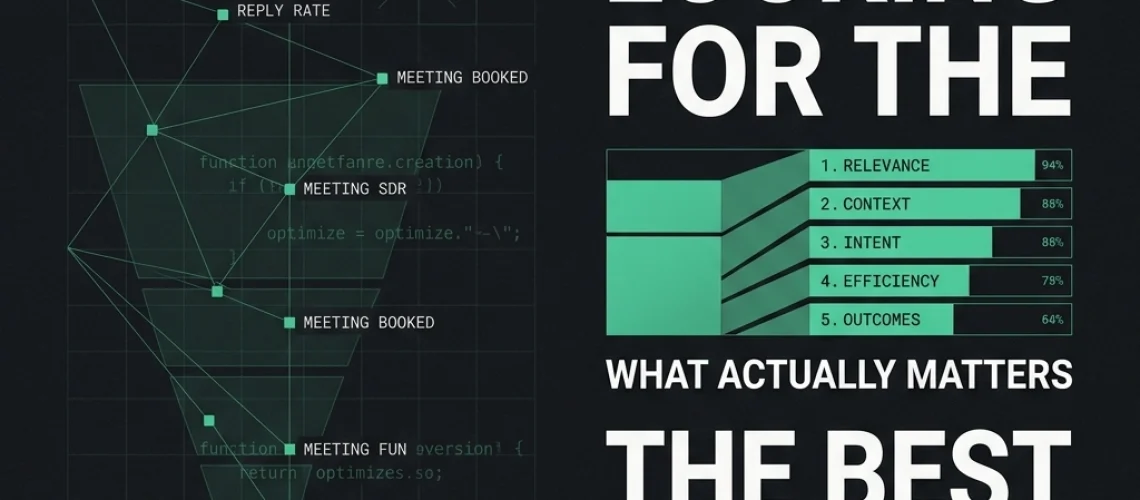
Before you put your credit card down for a $2,000-a-month "AI Agent," you need a scorecard. The market is flooded with wrappers that have great marketing but zero substance. To find the tool that actually works, you need to look at four specific pillars.
1. Signal Quality over Database Size
Most tools brag about having 700 million records. Who cares? If the data is six months old, you’re emailing people who have already changed jobs. The best AI SDR tools don't just pull from a database; they look for signals.
Is the company hiring for a specific role? Did the founder just post a frustrated rant on LinkedIn about a problem you solve? Did they just raise a round or lose a key competitor? First-party intent signals are 5-10x more predictive of a meeting than a simple "firmographic match." If your AI SDR isn't looking at real-time signals, it’s just guessing.
2. Research Depth
If the "AI" part of the SDR only handles the "Hi [First_Name]" tag, it’s not an AI SDR. It’s an email sequence tool. A true AI SDR should be able to browse a prospect’s website, read their latest blog post, and look at their LinkedIn activity to find a genuine hook.
3. Human-in-the-Loop Oversight
This is where most "fully autonomous" tools fail. They promise to handle everything from lead gen to booking. But AI still hallucinates. It still makes weird jokes that don't land. It still misses the nuance of a prospect’s specific situation. The best systems allow you to see the research and the draft before it goes out. You shouldn't be the one doing the work, but you should be the one giving the final nod.
4. Technical Hygiene and Deliverability
Sending 500 emails a day from a single domain is a suicide mission for your startup's email health. You need a tool that understands inbox rotation, warm-up periods, and plain-text formatting. If a tool doesn't talk about deliverability in the first five minutes of a demo, run.

The Difference Between Automation and Intelligence
There is a fundamental misunderstanding in the sales world right now. People use "automation" and "AI" interchangeably, but they are opposites in practice.
Automation is about doing a task repeatedly with zero variation. It’s a factory line. In outbound sales, automation is what gave us the 0.1% reply rate. It’s the "spray and pray" method that burned out the market.
Intelligence is about context. It’s about knowing that you shouldn't send an email today because the prospect just announced a massive layoff. It’s about realizing that a prospect’s recent podcast appearance mentioned a specific pain point that perfectly aligns with your product.
Most "Best AI SDR" contenders are just high-speed automation tools. They allow you to fail faster. A truly intelligent SDR tool acts as a researcher first and a writer second. It spends 90% of its "brain power" finding a reason to reach out and only 10% actually writing the text.
Why Research is the Only Way to Break Through the Noise
In 2026, your prospects are getting 50+ AI-generated emails a day. They can smell a template from a mile away. Even the "personalized" ones that mention their university or their city feel fake.
The only way to break through is to demonstrate that you actually understand their business. This is why research-first outbound is the only thing that still works for founders.
When an AI SDR does deep research, it looks at:
- The "Why Now": Why is this person a fit today specifically?
- The Technical Stack: Does their website use tools that suggest they have the problem you solve?
- The Language: How do they describe their own problems? Using their own vocabulary back to them is the ultimate rapport builder.
If you are a founder doing your own outbound, you know this intuitively. You spend 15 minutes on a LinkedIn profile before writing three sentences. If your AI tool isn't doing that same level of deep dive, it's just contributing to the noise.

Objection: "Will this replace my entire sales team?"
We hear this from founders constantly. They are either excited to fire their expensive SDRs or terrified that they are losing the "human touch."
Here is the truth: An AI SDR will not replace a great salesperson. But it will absolutely replace the "manual labor" parts of the job that your current team hates.
Think about the loaded cost of a human SDR. Between salary, benefits, and tech stack, you are looking at $80k-$120k a year. It takes three months to ramp them up. Then, they spend 6 hours a day doing data entry and basic prospecting.
Ramen isn't about replacing the human; it's about empowering the founder or the lean sales team. Instead of hiring three SDRs who might quit in six months, you use an AI agent to handle the heavy lifting of research and drafting. You (the founder) stay as the "Human-in-the-loop." You spend 20 minutes a morning reviewing high-quality drafts and clicking "send."
You keep the authority. You keep the nuance. But you get back your Sundays.
The Cost of the "Magic" Promise
Many tools in the "Best AI SDR" category charge a massive platform fee: sometimes upwards of $10k to $20k a year: just for the privilege of using their "agent." Then they charge you for leads on top of that.
As a founder, you know that every dollar counts. This is why we believe in the BYOK (Bring Your Own Key) model. You shouldn't be paying a 500% markup on OpenAI or Claude tokens. You should pay for the intelligence of the platform and keep control over your own infrastructure costs.
When you control your own API keys and your own data, you aren't locked into a "black box" that might stop working if the vendor changes their pricing. You are building a sustainable outbound engine that grows with you.
Why Ramen is Different
We didn't build Ramen to be another mail-merge tool. We built it because we were tired of seeing founders burn their domains using "autonomous" bots that sent embarrassing emails to high-value prospects.
We focus on two things: Deep Research and Human-in-the-Loop.
Ramen goes into the trenches of a prospect's digital footprint. It finds the real reasons to talk. Then, it presents you with a draft that actually sounds like you. You aren't just a passenger; you are the pilot. You can replace your SDR tasks with an AI agent without losing the soul of your brand.
If you’re a seed-stage founder who needs to build a pipeline but can’t justify a $100k hire, you don't need a "magic" bot. You need a research partner that works at the speed of AI.
The "Best AI SDR" isn't the one that sends the most emails. It's the one that helps you start the most meaningful conversations.
If you're ready to see what research-first outbound looks like without the domain-burning fluff, see how Ramen works. We’ll help you get back to building your product while we handle the hunt.