
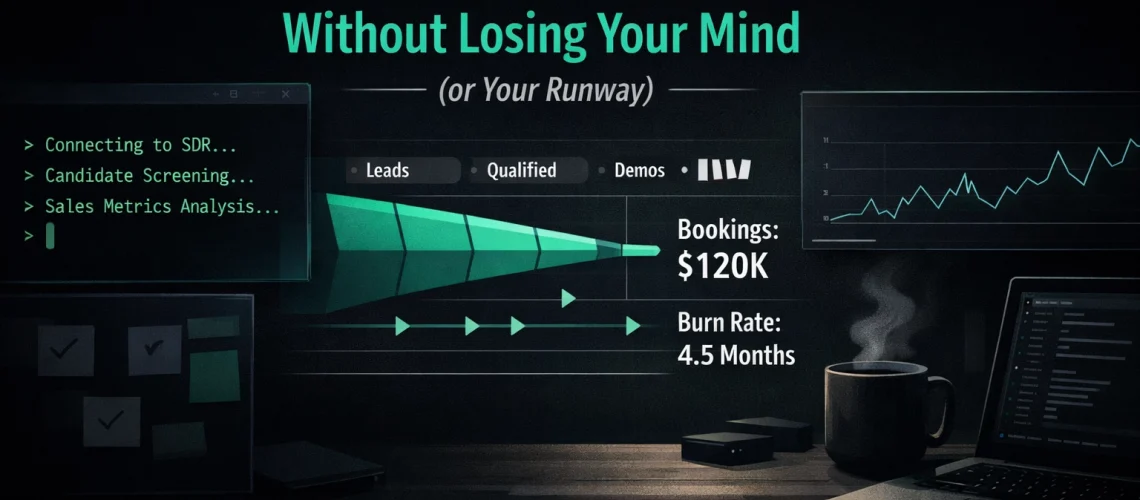
It’s 10:00 PM on a Sunday. You’re staring at a spreadsheet of 200 leads that you haven’t touched in three weeks. You know that if you don't start sending emails, your calendar for next month is going to be a graveyard. But you also have a product roadmap to manage, a board deck to prep, and a customer support ticket that’s been glowing red since Friday.
This is the moment most founders decide to hire a remote Sales Development Representative (SDR). You think: "If I can just find someone in a different timezone for $2,000 a month to handle the outbound, I can finally focus on the 'real' work."
Then the reality hits. You spend three weeks interviewing. You hire someone who looked great on paper. You spend another month training them. Then, two months in, they quit for a job that pays $500 more, or worse, they stay and send 500 "checking in" emails that burn your domain and annoy your best prospects.
Managing a remote SDR often feels like a second full-time job. Between the constant micromanagement, the fluctuating lead quality, and the high turnover, you end up losing more than just money: you lose your peace of mind and your runway.
There is a way to scale your prospecting without the drama. It involves shifting your mindset from "hiring a person" to "building a research-led system."
The hidden overhead of a remote SDR
When you see a job post for a remote SDR at $1,500–$3,000 a month, it looks like a bargain. Compared to a US-based SDR costing $80k plus benefits, it’s a no-brainer, right?
Not exactly. The "sticker price" of a remote hire is just the tip of the iceberg.
First, there’s the management tax. A remote SDR, especially an entry-level one, needs a script, a list, and a daily schedule. They need you to check their work. If you aren't spending at least five hours a week reviewing their outbox and correcting their tone, the quality will crater. If your time is worth $150/hour, you’re adding $3,000 a month in "management costs" to that $2,000 salary.
Then there’s the tech stack. You have to pay for their Seat on the CRM, their LinkedIn Sales Navigator account, their email sending tool, and their data provider. Suddenly, that "cheap" hire is costing you $4,500 a month.
Finally, there’s the ramp-up risk. It takes 60 to 90 days for a human SDR to become fully productive. If they leave at the six-month mark (which is the industry average for remote SDRs), you’ve spent three months paying for zero results and three months of mediocre results, only to start the process all over again.
If you must hire a human: How to do it right
If you’re determined to go the human route, don't just post on LinkedIn and hope for the best. You need a process that filters for "figure-it-out-ness."
- Define the role before the search: Don't just say "book meetings." Are they doing cold calls? Are they purely on LinkedIn? Are they writing custom deep-dive emails? If you don't know the playbook, they won't either.
- Use work-sample exercises: Never hire an SDR based on an interview alone. Give them a prospect and 15 minutes to write a three-email sequence. If they use a generic template from 2018, pass. You need people who can think, not just copy-paste.
- Standardize the rubric: As the research suggests, using a consistent set of questions and a grading rubric is the only way to stay objective. It’s easy to hire someone because they’re "nice" or "well-spoken," but "nice" doesn't handle 40 rejections a day.
- Prioritize curiosity over experience: A remote SDR with "three years of experience" might just have three years of bad habits. Look for the candidate who asks you hard questions about your product-market fit.
Why research-based automation wins
The reason most remote SDRs fail isn't because they’re "lazy." It’s because the task we give them is fundamentally boring and repetitive. We ask humans to act like robots: finding data, cleaning lists, and following up: and then we’re surprised when they lose interest or make mistakes.
The shift happening right now is toward research-first outbound.
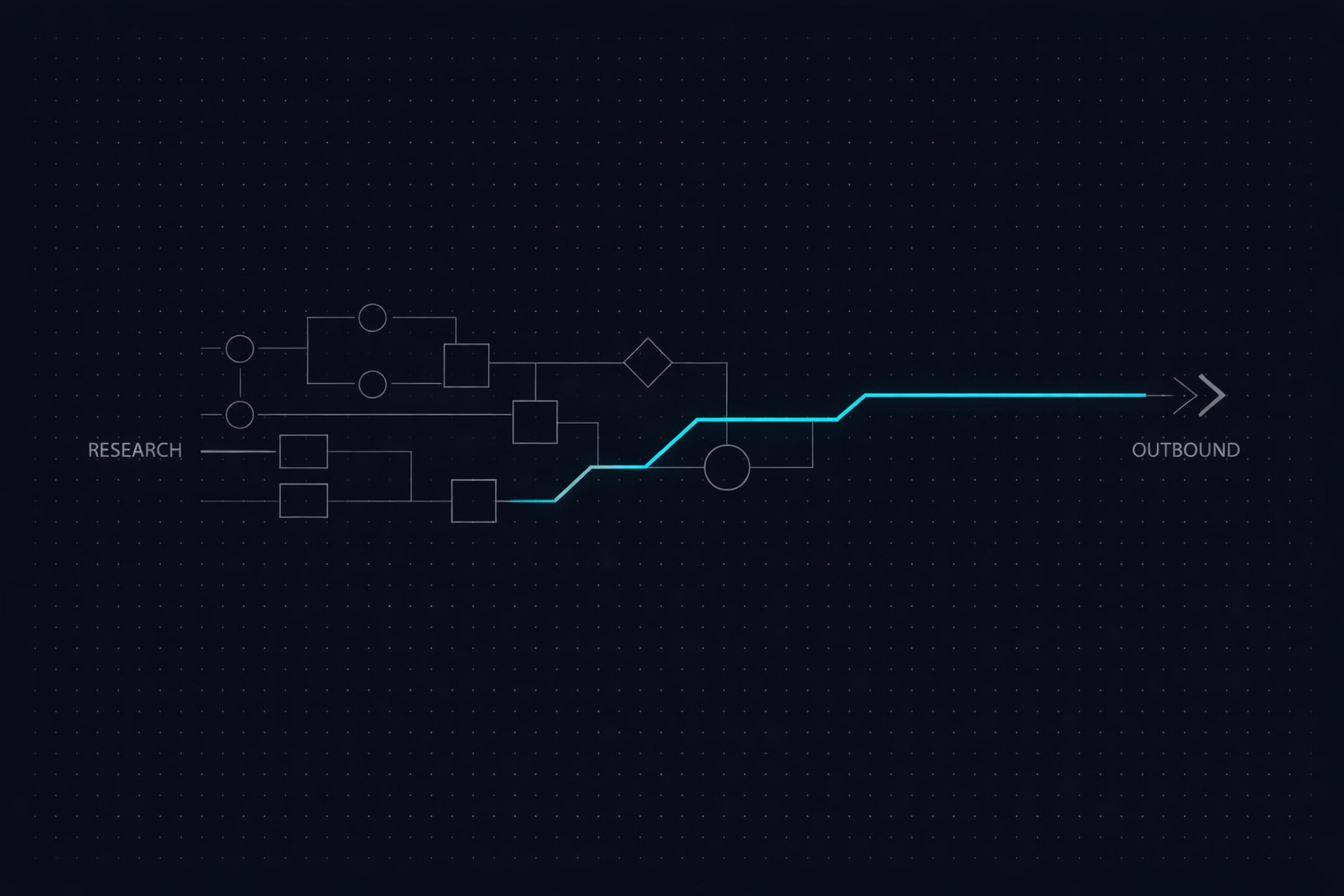
Instead of hiring a person to manually browse LinkedIn profiles and company "About Us" pages, you can now use AI agents to do that at a scale no human can match. But there’s a catch: most people use AI to write generic, "I saw your post about X" emails that feel like spam.
The "nuance" that founders worry about losing isn't in the writing; it's in the research. When an AI can read a prospect’s latest 10-K filing, listen to their podcast appearance, and cross-reference that with your product’s specific value prop, the output is actually more relevant than what a junior SDR would produce in 20 minutes of manual work.
This is where the research-first outbound AI SDR model changes the game. It doesn't sleep, it doesn't need a 1:1 meeting every Monday morning, and it doesn't quit for a better offer.
Addressing the elephant: "Can it handle nuance?"
The biggest objection founders have to replacing a human SDR with an AI agent is the "human touch."
"My industry is complex," they say. "AI won't understand the nuances of my ICP (Ideal Customer Profile)."
Here’s the hard truth: Your $2,000/month remote SDR doesn't understand those nuances either. They are usually working off a script you wrote. When a prospect asks a difficult question, the SDR usually forwards it to you anyway.
An AI agent built on a foundation of deep research actually handles nuance better than a human who is trying to hit a quota of 100 emails a day. The AI can analyze thousands of data points to find the specific "trigger" that makes a prospect likely to buy. It can identify that a company just lost their VP of Engineering and mention how your tool helps with technical debt: something a human SDR might miss while scanning a profile for five seconds.
And the best part? You don't have to give up control. Modern AI SDR platforms allow for a human-in-the-loop workflow. You can set the system to do all the heavy lifting: the research, the drafting, the lead sourcing: but you still hit "send" on the final versions. You get the scale of a machine with the quality control of a founder.
The math of the new outbound stack
Let’s look at the AI SDR pricing breakdown.
A human remote SDR costs you roughly $3,000 to $5,000 a month (fully loaded).
An AI SDR agent like Ramen costs $499 a month.
With the AI model, you aren't paying for a "seat." You aren't paying for healthcare or a recruiter fee. You’re paying for a system that builds your pipeline while you’re sleeping.
For a pre-seed or seed-stage founder, that $3,000/month difference is the difference between six months of runway and nine months of runway. It’s the difference between being able to hire a second engineer or being stuck in the "founder-led sales" trap forever.

Getting your Sundays back
Hiring a remote SDR shouldn't be a gamble with your company's future. If you’re at the stage where you know who your customers are but you just don't have the time to reach out to them, you don't need a new employee. You need a better engine.
At Ramen, we built a tool for the founders who are tired of the agency cycle and the hiring treadmill. We believe that replacing a human SDR with an AI agent isn't about being "anti-human": it’s about being "pro-founder."
Our platform does the deep research that makes people actually want to reply to your emails. We handle the lead sourcing, the personalization, and the follow-ups. You just show up to the booked demos.
The best part? It doesn't cost your entire runway. For $499/mo, you get a system that works harder than any remote hire ever could. And because we use a BYOK (Bring Your Own Key) model, you have total control over your costs and your data.
Stop spending your Sunday nights in spreadsheets. The robots are finally good enough to take this off your plate.
Ready to scale your outbound without the hiring headache? See how Ramen works.