
You think a freelance SDR is the low-risk way to test outbound. It feels safe. You aren't committing to an $80,000 base salary, you don't have to provide health insurance, and you can fire them with a two-week notice.
But here is the reality you probably already suspect: You aren't paying for a strategic sales partner. You are paying for someone to send templates to a generic list while they spend half their day on LinkedIn looking for their next full-time gig. You’re paying for 10 hours a week of "effort," but getting 2 hours of actual results.
In the early stages, your biggest enemy isn't the cost of the tools, it’s the cost of lost time. Every month you spend with a freelancer who "just doesn't get the ICP" is a month of burn wasted.
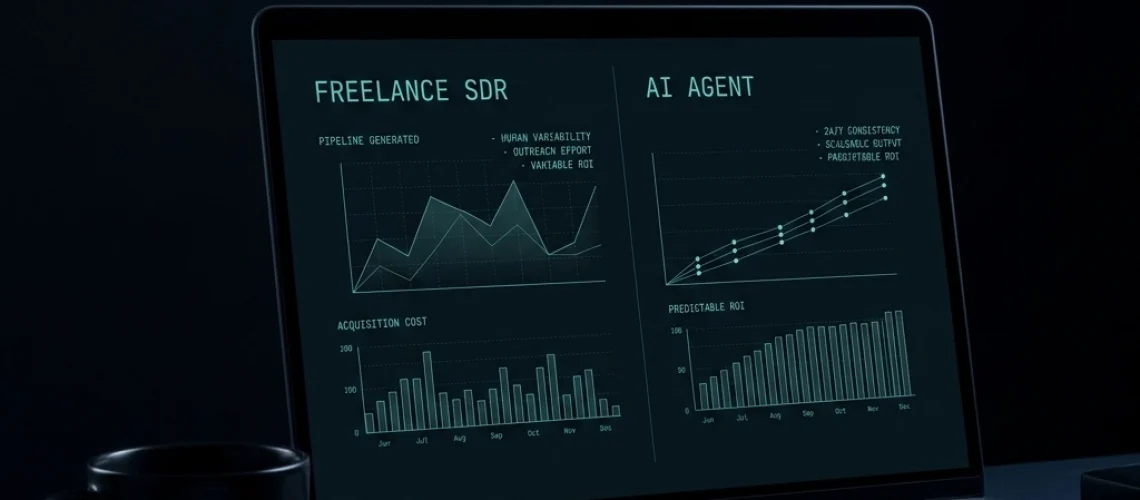
Let's look at the numbers and the structural reality of choosing between a part-time human and a dedicated AI agent.
The Multi-Client Conflict of Interest
When you hire a freelance SDR, you are rarely their only priority. Most freelancers are balancing three to five clients simultaneously to make their income math work.
Think about what that means for your outbound strategy. If a freelancer has four clients and one of them is a Series B startup paying a $5,000 monthly retainer while you’re paying $2,000, where do you think their best creative energy goes?
They aren't sitting at their desk thinking about how to pivot your messaging because your reply rate dropped 0.5% last week. They are doing the bare minimum to keep you from canceling the contract. They are copy-pasting your "standard" sequence into a tool and hitting send.
This isn't just about effort; it’s about focus. Outbound is a game of momentum. An AI agent, like Ramen, doesn't have other clients. It doesn't get bored. It doesn't check its phone or wonder if it should go back to a corporate job. It executes the strategy you set, 24/7, with 100% of its processing power dedicated to your specific campaign.

Data Quality: Human Guesswork vs. AI Research
Most outbound fails because the research is shallow.
A human freelancer, tasked with finding 50 leads a day, has a physical limit on how much they can learn about each prospect. They look at a LinkedIn profile for 30 seconds, see a job title that fits, and add them to the list. Maybe they mention the university the prospect went to if they're feeling "personalized."
Prospects see right through this. They know a template when they see one.
The Human Process:
- Search LinkedIn Sales Navigator.
- Export a list.
- Use a generic enrichment tool.
- Send a "Hi [Name], I saw you are the [Title] at [Company]" email.
The AI Agent Process:
- Scrape the prospect's LinkedIn, recent posts, and company website.
- Read their latest 10-K filing or a recent podcast transcript they appeared on.
- Identify a specific pain point based on that data.
- Write a custom opening line that actually proves they did the work.
Because an AI agent can process thousands of data points in seconds, it can achieve a level of research-first outbound that no human freelancer can match, at least not without charging you ten times the price.
When you use Ramen, the "research" isn't a buzzword. The agent actually looks for reasons why you should reach out. If it can't find a reason, it doesn't send the email. A freelancer, on the other hand, has a quota. They will send the email regardless of fit because they need to show "activity" to justify their retainer.
The Math: Side-by-Side ROI
Let's get into the spreadsheets. To get 20 qualified meetings a month, here is what the typical comparison looks like.
The Freelance SDR (The "Safe" Bet)
- Monthly Retainer: $3,000 – $5,000
- Bonus per Meeting: $200
- Total Monthly Cost (for 20 meetings): ~$7,000 – $9,000
- Show Rate: ~75%
- Cost per Meeting Held: ~$460 – $600
At $600 per meeting, your ACV (Annual Contract Value) needs to be significant to make the math work. If you are selling a $10k/year product, your sales cycle and win rates have to be perfect just to break even on the lead gen costs.
The AI Agent (The Scale Model)
- Platform Cost: $500 – $2,000 (depending on volume)
- API Costs (BYOK): ~$100 – $300
- Total Monthly Cost: ~$600 – $2,300
- Show Rate: ~60% (Slightly lower because humans are better at the "confirmation" call)
- Cost per Meeting Held: ~$50 – $150
The difference is staggering. Even if the AI agent's meetings close at a slightly lower rate, the AI SDR pricing breakdown shows that you are saving enough capital to run four or five different experiments simultaneously.
You aren't just saving money; you are buying the ability to fail faster and find the winning message sooner.

Objection: "Aren't freelancers more flexible?"
One of the biggest reasons founders hesitate to use an AI agent is the fear of losing control. They think, "A human can pivot when things aren't working. A machine just keeps hitting the wall."
This is a misunderstanding of how modern AI agents work. At Ramen, we built the platform to be infinitely configurable. You aren't turning over your brand to a black box.
Our human-in-the-loop philosophy means you have total oversight. You can set the agent to "draft mode," where it does all the research, finds the leads, and writes the custom emails, but nothing goes out until you hit "approve."
This gives you more flexibility than a freelancer. If you want to change your targeting mid-day, you don't have to wait for a "sync call" or send an email that might get read tomorrow. You just update your criteria in the dashboard, and the agent adjusts instantly.
You get the scale of a machine with the strategic control of a founder. You can replace your SDR with an AI agent without losing the "nuance" that makes your brand unique.
The Ramp-Up Reality
How long does it take to train a freelancer? Usually, it's 2 to 4 weeks of calls, document sharing, and feedback before they send their first decent email. Then another month of "dialing it in."
If they quit or find a full-time job three months in, you are back to zero. You’ve lost the time, the training effort, and the momentum.
An AI agent ramps up in hours. You feed it your website, your case studies, and your ICP. It learns your voice immediately. If you want to scale from 50 emails a day to 500, you don't hire another person and start the training process over. You just move a slider.
The "Founder-Led" Trap
Many founders stay with freelancers because they think it's the only way to keep the "founder touch" in their sales. They worry that AI will sound like… well, AI.
But think about your current "founder-led" sales. Are you actually writing those emails? Or are you spending your Sunday nights staring at a spreadsheet, dreading the manual labor of outbound?
If you're using a freelancer, you've already lost the founder touch. You've outsourced it to someone who doesn't own equity in your company.
The highest ROI path is to use an AI agent to handle the heavy lifting: the research, the initial outreach, the follow-ups: while you, the founder, step in only when a prospect shows interest. That is how you scale outbound without agencies or expensive part-time help.
Skip the Freelancer, Scale with Ramen
The era of the "part-time SDR" is ending because the math no longer makes sense. You can pay thousands for someone’s distracted attention, or you can pay a fraction of that for a dedicated agent that executes your strategy with more precision and better data.
If you are tired of paying for "activity" instead of meetings, it's time to change the model.
Ramen was built for founders who need a pipeline but can't justify the overhead of a human team yet. We give you the tools to do deep, research-backed outbound at a scale that was previously impossible.
Stop managing freelancers and start managing your growth.