
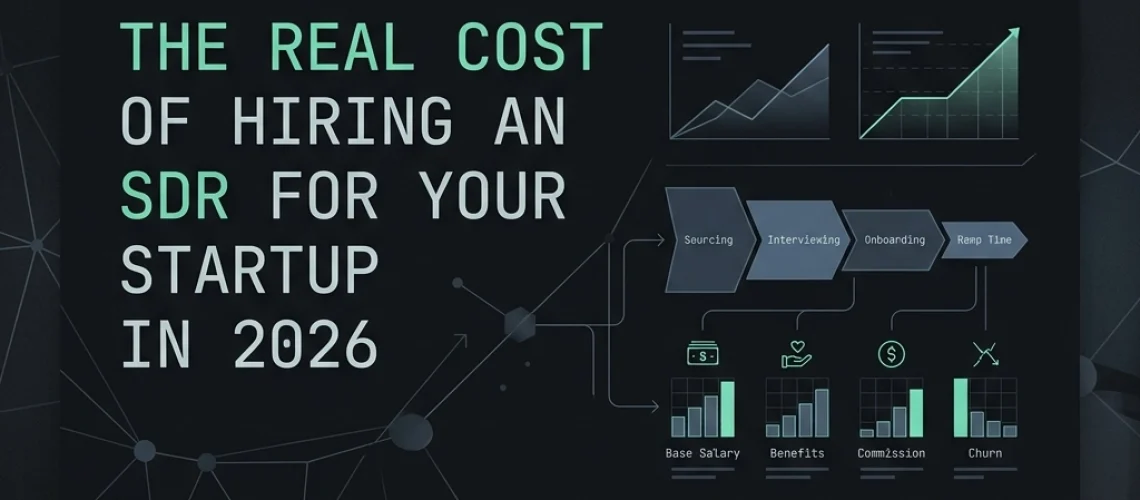

You see the $60k base salary for a sales development rep for your startup and think it's manageable. It’s a standard line item in a seed-stage budget. But once you add in the $15k recruiting fee, the $2k/mo tech stack, and the 3 months of missed revenue during training, your "budget" hire is now a six-figure liability.
Most founders don’t realize they aren’t just hiring a person; they’re buying a complicated, high-maintenance system that usually breaks before it starts working. In 2026, the traditional SDR model isn't just expensive: it’s often the fastest way to burn through your remaining runway without actually filling your calendar.
We’re going to break down the real SDR costs and show you how to get better results for 1/10th of the price.
The Hidden Line Items in Your SDR Budget
When you look at a job offer, you see the salary. When your accountant looks at that same hire, they see a "fully loaded" cost that is usually 1.5x to 2x the base pay.
First, there’s the recruiting fee. Unless you want to spend 40 hours a month sourcing candidates on LinkedIn yourself, you’re paying a recruiter. The standard rate is 20-25% of the first-year base salary. On a $60k hire, that’s $15,000 gone before they even show up for their first Zoom call.
Then come the payroll taxes and benefits. Health insurance, 401k matching, and employer taxes add another 25% on top of the salary.
But the real silent killer is the tech stack. An SDR is useless without tools. To actually do the job in 2026, they need:
- A CRM seat (Salesforce or HubSpot)
- A data provider (Apollo, ZoomInfo)
- A LinkedIn Sales Navigator license
- An email sending platform
- A research/intelligence tool
By the time you’ve provisioned all the seats, you’re looking at an additional $1,500 to $2,000 per month, per rep. This isn't optional overhead; it’s the ammunition for their gun. If you skimp here, you’re paying a $60k salary for someone to manually scrape websites, which is an even worse use of capital.

Why Training and Ramp-up Time is Your Biggest Expense
Founders often calculate ROI based on the day the SDR starts. That’s a mistake. The first 90 days of an SDR's tenure is essentially a charity donation from your startup to their career development.
The average ramp-up time for a new SDR is between 3 and 4 months. During this window, they are learning your ICP (Ideal Customer Profile), figuring out your messaging, and likely burning your best leads with "standard" outreach that doesn't convert.
Think about the math:
- Month 1: 0% productivity, 100% cost.
- Month 2: 25% productivity, 100% cost.
- Month 3: 50% productivity, 100% cost.
You’ve effectively paid $15,000 to $20,000 in salary alone to get maybe three or four qualified meetings. And that doesn't account for the "missed revenue" cost. If an experienced rep could have booked 15 meetings in that same timeframe, you’ve lost the pipeline value of those missing 11 demos.
For a startup with a $10k ACV (Annual Contract Value) and a 20% close rate, those 11 missed demos represent $22,000 in lost potential revenue. When you add the salary paid during ramp to the revenue lost during ramp, the "cost" of those first three months is closer to $40,000.
The Management Trap: "Can't I Just Hire a Junior Person?"
A common objection we hear is: "I’ll just hire a hungry junior person for $45k and train them myself to save money."
This is actually the most expensive way to build a sales team. Why? Because management time is the most expensive resource in your company.
As a founder, your time is worth hundreds, if not thousands, of dollars per hour. If you hire a junior SDR, you are now their full-time manager. You have to write their scripts, review their call recordings, check their email drafts, and keep them motivated when they get rejected 50 times in a row.
If you spend just 5 hours a week managing that SDR, and your time is valued at $200/hr, you’re spending $4,000 a month in "founder equity" just to keep a $3,750/mo employee moving.
Junior hires also have the highest churn rate. The average tenure for an SDR is about 14 months. If it takes 4 months to ramp them up, you only get 10 months of full productivity before they either get promoted, quit for a $10k raise elsewhere, or burn out because they realized cold calling is actually quite difficult. Then you start the $15k recruiting process all over again.

The SDR Death Spiral
Most startups fall into a predictable pattern. They raise a seed round, hire two SDRs to "scale," and realize six months later that they’ve spent $100k to book 20 meetings.
The math doesn't work. The AI SDR pricing breakdown for 2025 has completely shifted the landscape. In the past, you had no choice but to hire humans because "AI" meant bad templates and spam.
But in 2026, the technology has caught up. The problem isn't that SDRs are bad people; it's that humans are physically incapable of doing deep research on 50 prospects a day while maintaining high-volume output. A human SDR gets tired. They get bored. They start cutting corners and sending "Just circling back!" emails because they don't have the mental bandwidth to find a specific podcast interview your prospect gave three years ago.
Scaling Outbound Without the Overhead
If you're doing $30k to $100k a month in revenue, you can't afford to miss. Every hire has to be a force multiplier.
The alternative to the $150k loaded SDR cost is a system that does the research for you. Instead of paying someone to sit in a CRM all day, you use tools that can scan a prospect’s LinkedIn, read their latest company 10-K, and reference a specific problem they mentioned in a Twitter thread: all before the first email is even drafted.
This is the "Research-First" approach. It’s how you replace a traditional SDR with an AI agent that doesn't need a $15k recruiting fee or a health insurance plan.
The goal isn't to send more emails. The goal is to send better emails to the right people. When you automate the "grunt work": the prospecting, the data cleaning, and the initial personalization: you stop paying for "activity" and start paying for "results."
Why Founders Are Switching to AI SDRs
The shift toward AI-driven outbound isn't just about saving money; it’s about control. When you hire an agency or a junior SDR, you lose visibility into what’s being said to your market.
With an AI-powered system like Ramen, you’re the "Human-in-the-Loop." You see every lead, you see the research the AI found, and you approve the message before it goes out. It gives you the scale of a 10-person sales team with the precision of a founder-led sale.
You don't need a $2k/mo tech stack when the platform has the intelligence built-in. You don't need a 3-month ramp-up period when the system can learn your product and ICP in an afternoon.
The "Real Cost" of an SDR isn't a number on a spreadsheet. It’s the opportunity cost of the money you could have spent on product development or paid ads, and the time you could have spent closing deals instead of managing a 22-year-old’s daily activity log.
Skip the Overhead at Ramen
If you’re tired of the hiring, the training, and the inevitable churn of the SDR role, there’s a better way. You can scale your outbound without agencies or expensive hires.
At Ramen, we built a platform for founders who are doing their own outbound and realize they can't do it alone anymore, but can't justify the $100k+ liability of a full-time hire. We provide a research-first AI SDR that acts as your personal sales assistant.
It does the deep research, drafts the personalized hooks, and handles the follow-ups. You just show up to the demos.
Stop looking at base salaries and start looking at the total cost of ownership. The math for a human SDR in a 2026 startup rarely adds up. It’s time to build a system that works as hard as you do, without the six-figure price tag.
Skip the overhead and start booking more demos at Ramen.so.