
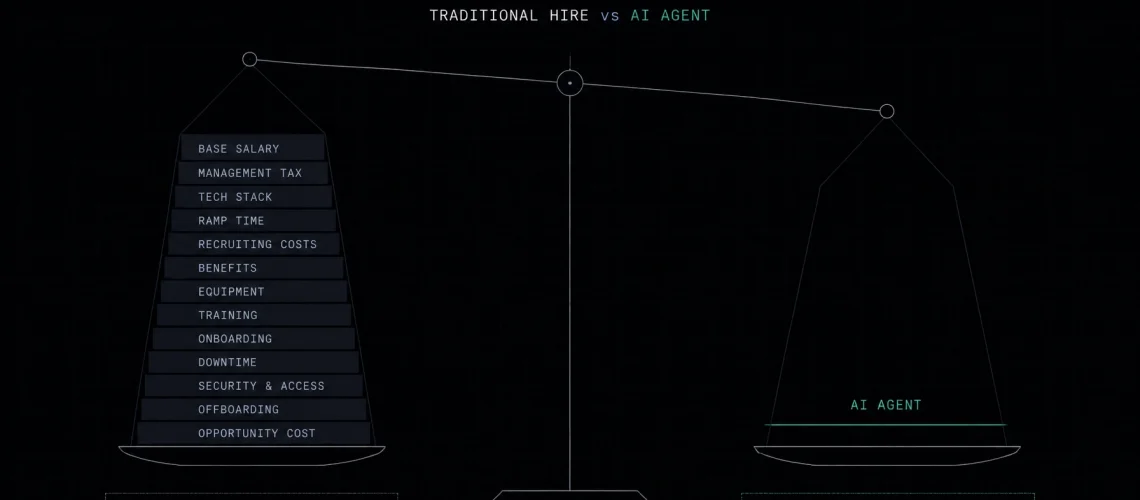
You calculated the salary, but you forgot the "management tax."
If you’re a founder who just hired your first SDR, or you’re looking at the budget for one, you probably have a number in your head: maybe $60,000 for a base salary. You figure that for five figures, you’re buying yourself forty hours a week of pure pipeline generation.
Then reality hits.
Every hour your sales development rep for startup spends on basic research is an hour you spend correcting their generic, "hope you're having a great week" outreach. You find yourself spending your Sunday nights rewording their emails because they don't quite "get" your technical product. You’re paying a premium for someone to learn your industry on your dime, and the math just doesn't add up for early-stage teams.
The truth is that hiring a human SDR is often the most expensive way to realize that your outbound process isn't ready for a human yet.
The Hidden Fees of Human Outreach
When we talk about the cost of a sales development rep for startup, we usually talk about OTE (On-Target Earnings). In 2024 and 2025, that number is typically between $80,000 and $100,000.
But that’s not the real number. The "fully loaded" cost of a single SDR often lands closer to $140,000 per year.

Here is what you’re actually paying for:
- The Tech Stack: You aren't just paying for a person. You’re paying for their LinkedIn Sales Navigator seat, their ZoomInfo or Apollo subscription, their CRM seat, and their sequencing tool. That’s another $5,000–$10,000 per year right there.
- The Ramp Time: It takes 3 to 5 months for a human SDR to become fully productive. During that time, you are paying 100% of the salary for about 20% of the output. In a startup, five months is a lifetime.
- The Churn: The average tenure of an SDR is roughly 15 months. By the time they finally understand your ICP (Ideal Customer Profile) and start booking consistent demos, they are looking for a promotion or a new job.
- The Management Tax: This is the one that kills founders. You didn't hire an SDR to become a full-time Sales Manager, but that’s exactly what happens. You spend hours every week in 1-on-1s, reviewing call recordings, and looking over their email drafts.
If you value your own time at even $100/hour, the 5–10 hours a week you spend "managing" a junior rep adds another $25,000–$50,000 to their annual cost. Suddenly, that $60k hire is costing your company $200k in cash and lost founder productivity.
Why Personalization Doesn't Scale with Headcount
We’ve been told that if you want more meetings, you need more "boots on the ground." But in the modern inbox, more boots usually just means more noise.
The dirty secret of the SDR world is that personalization and headcount have an inverse relationship.
When an SDR has a quota of 50–100 activities a day, they physically cannot do deep research. They have to use templates. They might swap out a company name or mention a recent LinkedIn post, but that’s "token personalization," and prospects can smell it a mile away.

To get a 2% or 3% reply rate today, you need to know more about the prospect than just their job title. You need to know:
- What they talked about on a podcast last month.
- The specific challenges their industry is facing (e.g., new regulations or market shifts).
- The actual technology they are currently using (and why it’s failing them).
A human SDR can do this for 5 people a day. If they do it for 50, the quality drops off a cliff. This is the "scaling trap": as you add more reps to hit higher targets, the quality of each outreach decreases, your domain reputation takes a hit, and your cost-per-meeting skyrockets.
"Can AI really be as personal as a human?"
It’s the most common objection we hear. "I don't want to send robotic, AI-generated spam."
We agree. Most "AI SDR" tools are just fancy wrappers for ChatGPT that take a CSV and "rewrite" a template. That’s not what we do at Ramen.
The difference between a human SDR and a platform like Ramen isn't that the human is "more creative." It’s that the human (theoretically) does better research.
Ramen solves this by acting as a research engine first and a writer second. Our agents don't just "write an email." They:
- Scrape the prospect’s website and recent news.
- Analyze their LinkedIn profile and past activity.
- Cross-reference your internal data to find a genuine reason to reach out.
The result isn't a "personalized template": it's a 100% research-based email that reads like it was written by a founder who actually knows their business.
And here is the kicker: You still have the final say.
Unlike a human SDR who might send 100 emails while you’re asleep that burn your best leads, Ramen uses a human-in-the-loop approach. You or your team approve every single email before it goes out. You get the scale of AI with the quality control of a founder.
The Math of the Modern Pipeline
Let's look at the numbers side-by-side.

For $499/month, Ramen gives you unlimited AI agents. You bring your own API keys (BYOK), which means you have complete control over your costs. You aren't paying for "ramp time" or "benefits." You're paying for a system that gets smarter with every feedback loop and never gets bored of doing deep research on 500 prospects at once.
If you’re a pre-seed or seed-stage founder, your goal isn't to build a massive sales team. Your goal is to find Product-Market Fit and build enough pipeline to raise your next round.
Spending $140,000 on a human SDR who might churn in a year is a massive gamble. Investing in an AI-powered outbound engine that you own and control is a strategic asset.
Give Yourself Your Sundays Back
Most founders we work with are spending their weekends in spreadsheets, trying to manually find enough leads to keep the lights on. They know outbound works, but they can't scale themselves, and they can't afford an $80k-a-year gamble.
Ramen was built for the founder who is tired of the "management tax." It’s for the team that needs a reliable, research-first outbound process that doesn't require a six-figure salary or three months of training.
You don't need more sales development reps for your startup. You need a better way to do research at scale.