
You’re looking at a $5,000 monthly base salary for a junior SDR and thinking it’s a bargain. You’ve got a product, you’ve got a market, and you just need someone to "hammer the phones" and "grind out emails" so you can focus on building.
But you’re forgetting the recruitment fees that just ate your first month's budget. You’re forgetting the three months of onboarding where they’ll book exactly zero meetings. You’re forgetting the $1,200/month tech stack you have to buy them. And most importantly, you’re ignoring the 60% chance they’ll quit before they even pay for themselves.
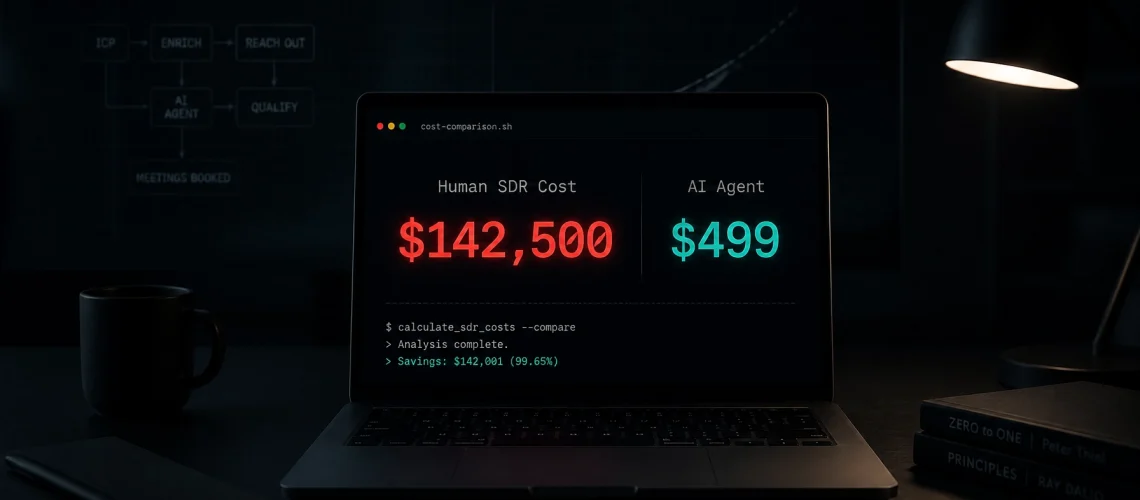
That "affordable" hire is actually a $140,000 annual liability sitting on your cap table. For a pre-seed or seed-stage founder, that’s not a hire: it’s a capital mistake.
In the next ten minutes, I’m going to break down the true, "fully loaded" cost of a human SDR in 2026. Then, I’ll show you how to swap that six-figure headache for a $499/month revenue engine that doesn't sleep, doesn't quit, and does better research than any human junior.
The Fully Loaded Cost of a Human SDR
When you hire a human, you aren't just paying a salary. You are paying for a complex infrastructure of "stuff" required to keep that human functioning. Most founders calculate their "SDR math" based on base salary + commission. That’s like calculating the cost of a car based only on the monthly lease payment while ignoring insurance, gas, maintenance, and the fact that the car might spontaneously vanish every 14 months.
Here is what the real math looks like for a US-based tech SDR today:
- On-Target Earnings (OTE): A typical base of $60k plus $25k in variable commission. We’re already at $85,000.
- Employer Burden: Payroll taxes, health insurance, 401k matching, and workers' comp. This usually adds 25-30%. Let’s call it $22,000.
- The Tech Stack: You can’t send an SDR into battle with just a Gmail account. You need a CRM (Salesforce/HubSpot), a sequencing tool, data providers (Apollo/ZoomInfo), and enrichment tools. That’s easily $500–$800 per month per seat.
- Recruitment & Training: Unless you want to spend 40 hours a week interviewing, you’re paying a recruiter or spending your own $500/hour founder time. Plus, the first 3 months of salary are essentially a donation while they "ramp."
When you add it up, the real SDR costs land somewhere between $120,000 and $170,000 per year.

The Hidden "Turnover Tax"
The industry's dirty secret is the churn. The average SDR tenure is now roughly 14 months. If it takes 4 months to ramp them to full productivity, you are only getting 10 months of "real" work.
Think about that. You spend 4 months paying someone to learn your ICP, burn through your best leads with bad templates, and take up your Sunday nights for "training sessions." Just as they start hitting their stride and booking demos, they leave for a "Senior SDR" role or an AE promotion elsewhere.
Then you start the cycle again. The cost to replace a single SDR is estimated at over $14,000 in direct costs, not including the opportunity cost of the empty seat and the lost pipeline. For a founder, this isn't just expensive: it's exhausting. You’re not building a sales machine; you’re running a halfway house for junior talent.
Ramp Time: Paying for 4 Months of Silence
A human SDR is a "variable performance" asset. They have bad days. They get sick. They have "creative blocks" when writing emails. But most importantly, they have a ramp time.
In the SaaS world, it takes an average of 3.2 to 5 months for a new SDR to reach full quota. During those months, your burn rate stays high, but your pipeline stays empty. You are effectively subsidizing their education in sales.

Compare this to an AI SDR agent. There is no ramp. There is no "learning the ropes." You feed it your ICP, give it your case studies, and within 24 hours, it is conducting deep research on every prospect in your list. It starts at 100% productivity on Day 1.
The $499 Engine: Why AI Isn’t "Too Cheap" to be Effective
When founders see Ramen’s pricing of $499/month, they often ask: "How can it be that cheap and still work? My last lead gen agency charged $5k/month and sent garbage."
The reason agencies are expensive and bad is that they are also hiring humans. They hire low-cost VAs who use templates because deep research is too "expensive" for their margins.
Ramen flips the model. We don't hire VAs. We use AI agents that perform research-first outbound. By "Bring Your Own Key" (BYOK), you pay the raw cost of the AI (like GPT-4 or Claude) directly. This means you aren't paying for our office rent or some manager's health insurance: you're paying for pure, raw compute power focused entirely on finding reasons why a prospect should talk to you.

Predictable Pricing vs. Variable Human Performance
With a human, your cost-per-meeting is unpredictable. If they have a bad month, your cost-per-meeting spikes to $2,000.
With Ramen, your costs are fixed. $499/month for unlimited agents. Whether you want to scale to 10 agents or keep it at 1, the price stays the same.
And unlike a junior SDR who might "hallucinate" a personalized line that makes no sense, Ramen uses a human-in-the-loop approach. You approve every email before it sends. You get the scale of a machine with the quality control of a founder.
Building Pipeline Without the Sunday Night Scramble
Most founders we talk to are spending their weekends writing personalized emails. They know outbound works, but they can't scale themselves. They’ve tried VAs, but the quality was so low it burned their domain reputation. They know they need an SDR to raise their next round, but they can't justify the $150k burn without the funding they haven't raised yet.
It’s a classic chicken-and-egg problem.
Ramen is the bridge. It gives you back your Sundays. It builds your pipeline while you sleep, using personalized workflows that actually get replies. It doesn't ask for a promotion. It doesn't complain about the leads. It just sits there, 24/7, turning your ICP into a list of booked demos.

Stop Making Capital Mistakes
Hiring a human SDR is a move for a Series B company with a proven playbook and a massive management layer. If you are a solo founder or a seed-stage team, you don't need a "sales culture": you need meetings.
Every dollar you spend on a human SDR's health insurance is a dollar you aren't spending on product or engineering. Every month you spend "ramping" a junior hire is a month of runway you'll never get back.
Stop trying to hire your way out of a productivity problem.
Audit your true sales costs. If you’re spending more than $500 a month to get meetings booked, you’re overpaying. See how much time (and capital) you could be saving with a virtual SDR team that actually works.