
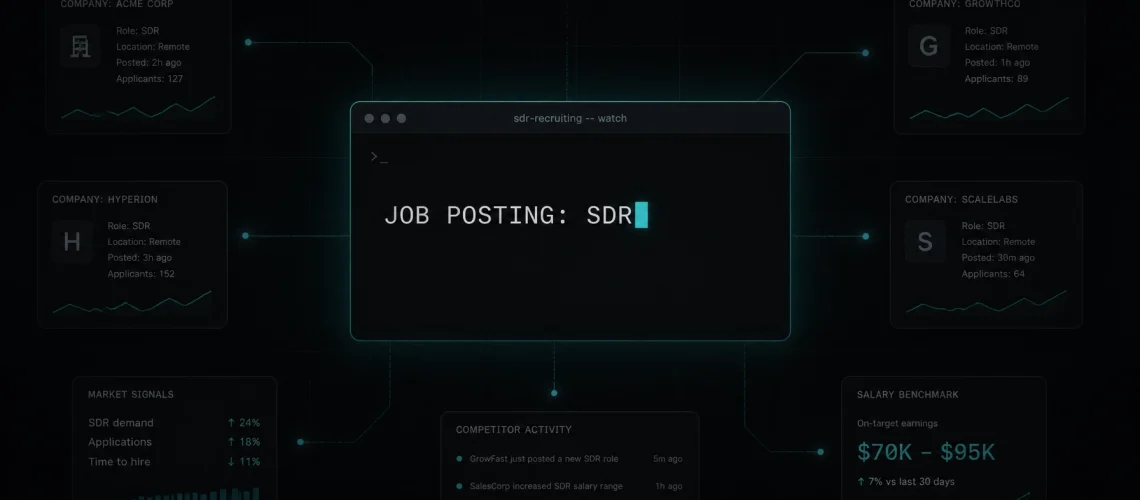
You post a job for an SDR on LinkedIn. By Monday morning, you have 500 applications. 490 of them are completely unqualified. The other 10 are talented, ambitious, and already interviewing at three other companies. Even if you land one of the "winners," they’ll likely leave in six months for a $10k bump in base salary or a promotion you can’t offer yet.
While you’re spending your Sunday reading resumes and your weekdays doing first-round interviews, your competitors are already in your prospects' inboxes. They aren’t hiring more people; they’re deploying AI agents that do the research and outreach while they sleep.
In 2026, a "Hire SDR" ad isn't just a recruiting task. It’s a signal to the market that your sales process is manual, expensive, and slow to scale.
The SDR Churn Crisis
The traditional SDR model is fundamentally broken for early-stage companies. Recent benchmarks show that SDR turnover has reached as high as 65%. The median tenure for an SDR is now between 14 and 22 months, but it takes about three months just to get them fully ramped and productive.
Think about that math. You spend 90 days training someone on your product, your ICP, and your voice. You pay for their seats in the tech stack: which now costs $6k–$7k per year per rep: and just as they start hitting their stride, they start looking for an AE role.

Every time an SDR leaves, it costs you. Between recruiting fees, manager time, and the inevitable pipeline gap, the fully loaded cost of replacing one SDR often exceeds $100,000. For a pre-seed or seed-stage founder, that isn't just a line item; it's a threat to your runway.
Automation vs. Headcount
When you hire a human SDR, you aren't just paying a salary. You’re paying for a "maybe." Maybe they’ll hit their numbers. Maybe they’ll stay long enough to recoup your investment. Maybe they’ll actually do the research instead of "spraying and praying."
Compare that to an AI SDR stack. You can deploy unlimited AI agents for a flat monthly fee: at Ramen, that’s $499/month. Instead of an $80k-$120k loaded cost for one person who might send 50 personalized emails a day, you have a system that works 24/7, never burns out, and doesn't ask for a promotion.
The biggest advantage isn't just the cost; it's the lack of "vacancy periods." When a human SDR quits, your pipeline goes to zero for months while you hire and retrain. AI doesn't quit. It doesn't have a bad Monday. It just keeps booking demos.
The Competitive Signal
Posting that job ad tells your competitors exactly where you’re vulnerable. It says:
- You’re the bottleneck. You’re still building a team to do what software can do faster.
- Your margins are under pressure. You’re opting for a high-burn headcount model in a market that rewards efficiency.
- You’re slow. By the time your new hire finishes onboarding in 90 days, an automated competitor has already run three different A/B tests on your entire market.
Smart founders are realizing that replacing the SDR role with an AI agent isn't about cutting corners: it's about gaining a tactical advantage. It’s about spending your time on the 20% of sales activities that actually require a human (like the actual demo) and letting the machine handle the 80% that is just pure data-driven research and outreach.
Objection Handling: "Don't I Need a Human for the 'Human Touch'?"
This is the most common pushback. "I don't want to spam people with robotic templates."
You're right to worry. Template-based automation is exactly how you burn your domain reputation and get ignored. But the "human touch" in 2026 isn't about a person clicking "send." It's about the quality of the research behind the email.
Most human SDRs are so pressured by volume targets that they barely spend 30 seconds on a prospect's profile. They find a name, a title, and maybe a generic "congrats on the round" and hit send.

At Ramen, we take a research-first approach to outbound. Our AI agents do deep research on every single prospect: reading their latest blog posts, listening to their podcast appearances, and analyzing their company's strategic priorities.
What makes it actually work is the human-in-the-loop model. The AI writes the hyper-personalized email based on that research, but you (the founder) approve it before it ever goes out. You get the quality of a founder-led email with the scale of an automated system. You’re not outsourcing your brand to a 22-year-old with a script; you’re augmenting your own expertise with a research assistant that never sleeps.
Regain Your Sundays
The "chicken-and-egg" problem for founders is real: you can't raise your next round without a solid pipeline, but you can't spend 40 hours a week building that pipeline if you're also building the product.
Most founders try to solve this by working through the weekend, manually writing personalized emails to 50 prospects. It’s a recipe for burnout.

Hiring an SDR feels like the "grown-up" solution, but in reality, it often just adds another management layer to your already crowded plate. You end up spending your time managing a person instead of managing your business.
The shift to AI SDRs is about moving from a "headcount" mindset to a "systems" mindset. It’s about building an outbound machine that you own and control, without the $100k price tag or the 65% churn risk.
If you’re tired of the hiring headache and ready to build a pipeline that doesn't depend on a revolving door of SDRs, it’s time to rethink your stack.
Skip the hiring headache. Stop reading resumes and start booking demos. See how Ramen gives you back your Sundays while keeping your pipeline full.