
It’s Sunday night. You’re three tabs deep into LinkedIn Sales Navigator, copying and pasting "personalized" snippets into a spreadsheet because your latest outbound experiment just hit a wall. You’re a founder. You should be thinking about your product roadmap or your next fundraise. Instead, you’re playing detective on a Director of Ops in Chicago to see if they actually care about "operational efficiency."
You’ve probably thought about hiring a contract SDR. It feels like the safe move. A "test" to see if outbound works without the $120k overhead of a full-time hire. You figure you’ll bring someone on for three months, give them a script, and the demos will start rolling in.
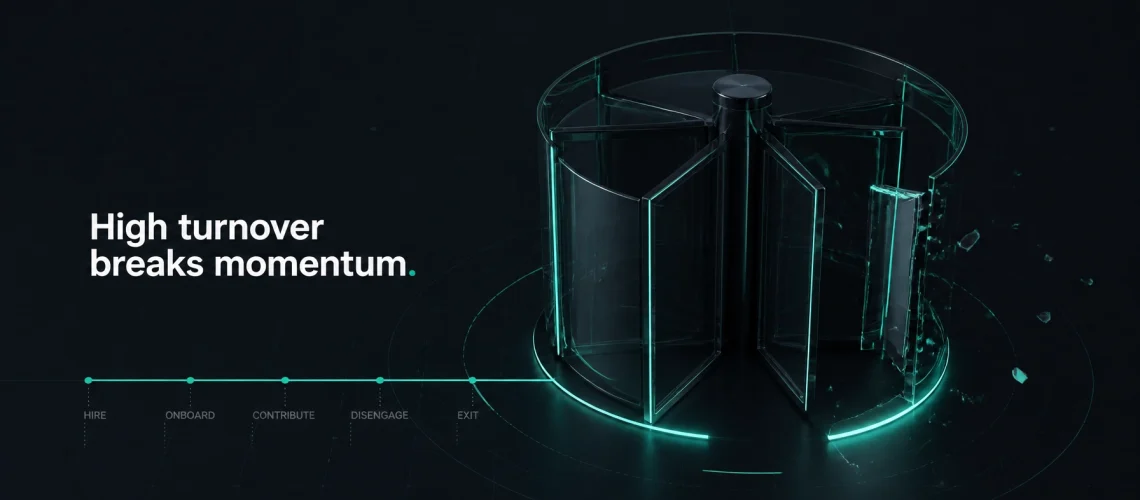
But here’s the cold truth: by the time that contractor learns what your product actually does, they’re already updating their resume for their next gig. You aren't paying for results; you're paying for their learning curve. And once they leave, they take every bit of institutional knowledge with them, leaving you right back where you started: sitting at your desk on a Sunday night, staring at a blank sequence.
I’m going to show you why the contract SDR model is often a revolving door for your pipeline, and why switching to AI agents provides the permanent, instant scalability your growth actually needs.
The Learning Curve Tax
When you hire a human SDR, contract or otherwise, you aren't just paying their fee. You're paying a "Learning Curve Tax" that most founders fail to calculate.
According to 2024 industry benchmarks, the average SDR takes roughly 3.2 months to fully ramp. If you’re hiring a contractor on a 3-month or 6-month "pilot," you are effectively subsidizing their education for half the duration of the contract.
Think about what happens in those first 90 days:
- Month 1: They are learning your ICP (Ideal Customer Profile). They are burning through your best leads with "standard" messaging because they don't quite understand the nuances of your value prop yet.
- Month 2: They start to get the "vibe," but they’re still pinging you on Slack every five minutes asking how to handle a specific objection. You’re still doing the heavy lifting; they’re just the one clicking "send."
- Month 3: They finally hit their stride. They’ve booked a couple of meetings. They know which angles work.
And then? If it’s a short-term contract, the clock is already ticking. If they’re good, they’re looking for a full-time role with benefits and equity. If they’re bad, you’re firing them and starting over. Either way, that 3-month investment in "teaching" them your business just walked out the door. You’ve spent thousands of dollars in loaded costs just to reach the starting line.

Why Short-Term Contracts Kill Long-Term Growth
Outbound sales isn't a faucet you can just turn on and off. It’s a compounding asset. When you rely on a revolving door of contractors, you lose the three things that actually make outbound work over time:
1. Institutional Knowledge
Every time a prospect says "No," or "Not right now because of X," your company should be getting smarter. A contractor often treats these interactions as checkboxes. When they leave, the subtle insights: the reasons why a specific industry is pivoting or why your messaging is falling flat with VPs: disappear. You’re forced to rediscover the same lessons with the next hire.
2. Domain Reputation Risk
A contractor who knows they’re only around for 90 days has a different incentive structure than a founder. They want to hit their "activity metrics" to justify their invoice. This leads to volume over quality. They might "spray and pray" 500 emails a day, burning your domain reputation and landing you in the spam folder before you’ve even had a chance to scale. Recovering from a burned domain takes months. A contractor can leave in a week.
3. The Incentive Mismatch
A contract SDR is a mercenary, not a missionary. They aren't there to help you find product-market fit; they are there to fulfill the terms of a contract. In the early stages, your outbound needs to be a feedback loop. You need to know exactly why people aren't interested so you can iterate on the product. Most contractors aren't incentivized to provide that level of depth.
The AI Alternative: Permanent Scalability
The "chicken-and-egg" problem for founders is real: you can't raise money without a pipeline, but you can't build a pipeline without the time or money to hire a sales team.
This is where AI SDR agents change the math. Unlike a contractor, an AI agent doesn't have a 3-month ramp. It doesn't take lunch breaks, it doesn't get "bored" with research, and it doesn't leave for a better offer after you’ve spent weeks training it.
At Ramen, we built a platform that allows you to deploy unlimited AI agents for $499/month. Compare that to the $4k–$8k you’d spend on a decent contract SDR.
But the cost isn't even the biggest win. It's the research-first approach.
Most AI tools just use templates and swap out the "First Name" and "Company." That's just a faster way to get marked as spam. Ramen’s agents do deep research on every single prospect. They read recent LinkedIn posts, scan company news, and understand the prospect’s actual pain points before drafting a single word. It’s the level of personalization you’d do yourself if you had 40 hours a week to spare, but at a scale no human can match.
"Can I Trust AI With My Brand's Voice?"
This is the number one objection we hear. "I don't want an LLM hallucinating and telling my biggest prospect that we offer a feature we don't have."
It’s a valid fear. Most "set it and forget it" AI tools are dangerous for your brand. That’s why Ramen uses a human-in-the-loop model.
You (or someone on your team) approve every single email before it actually hits an inbox. You get the speed and research depth of AI, but the final editorial control of a human. If an AI agent drafts a perfect email but misses a tiny bit of context about a prospect's recent acquisition, you can tweak it in two seconds and hit "Approve."

You aren't spending your time researching or drafting; you're spending 15 minutes a day acting as the "Editor-in-Chief" of your outbound engine. This approach ensures your outbound stays high-quality while giving you back 90% of your time.
Stop Paying for the Learning Curve
If you’re a solo founder or a seed-stage team, your most valuable resource isn't money: it's time.
Every hour you spend interviewing contractors, onboarding them, and managing their "ramp" is an hour you aren't building your company. And every dollar you spend on a contractor who might leave in six months is a dollar that isn't going toward your actual growth.
The revolving door of contract sales is a relic of a time when we didn't have a better option. But the world has changed. You can now build a complete outbound pipeline with full cost control by bringing your own AI API keys and using a platform designed specifically for the founder-led sales motion.
Stop subsidizing other people's careers and start building an asset that stays with your company.
Ready to stop the revolving door? See how Ramen gives you a permanent, research-backed sales team for a fraction of the cost.