
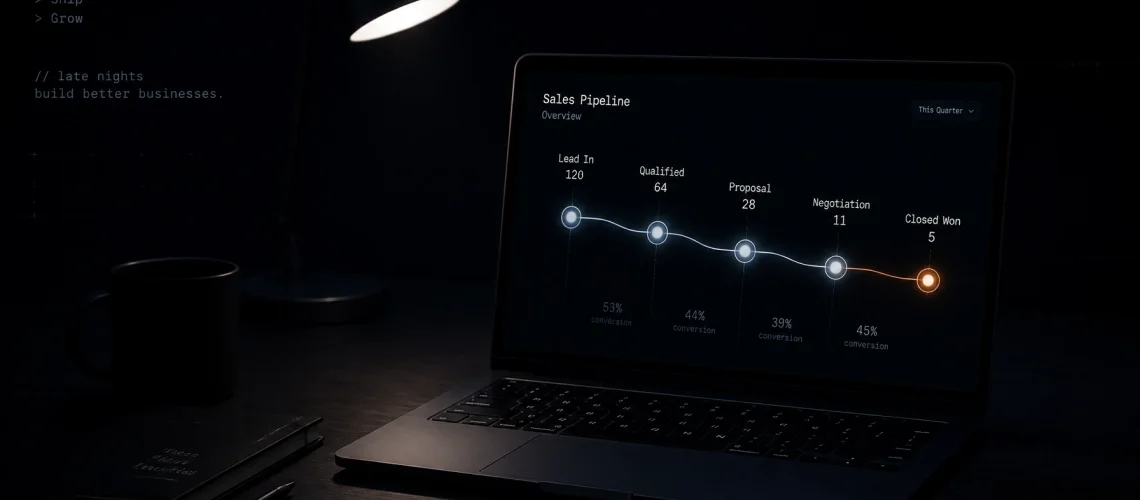
It’s Sunday night, and you’re staring at a spreadsheet of 200 prospects. You know that if you don't spend the next four hours researching these people and writing personalized emails, your calendar will be empty by Wednesday. You also know that if your calendar is empty, your next board meeting is going to be brutal.
The pressure to build a pipeline at the seed stage is crushing. You’ve probably thought about hiring your first sales development rep (SDR) to take this off your plate. But then you look at the math: an $80k base salary, plus benefits, plus commissions, plus the tech stack. You're looking at a $130k+ bet on a single person who might quit in six months or, worse, spend three months "ramping up" without booking a single qualified meeting.
There is a safer, faster, and more effective way to scale your outbound without the hiring risk. For most early-stage startups today, your first "SDR" shouldn't be a person: it should be an AI agent.
The High Stakes of the First Sales Hire
Hiring your first sales development rep for startup is one of the most dangerous moves a founder can make. Unlike a developer or a designer, an SDR's output is binary: they either book meetings or they don’t.
When you hire a human SDR, you aren’t just paying for their time. You are paying for:
- The Search: 20+ hours of founder time spent interviewing.
- The Loaded Cost: Base salary, payroll taxes, health insurance, and 401k.
- The Tech Stack: ZoomInfo, Salesloft/Outreach, LinkedIn Sales Navigator, and email warmup tools. This can easily add $1,000/month to the bill before they've even sent a single email.
- The Opportunity Cost: If they fail, you've lost six months of runway and zero pipeline to show for it.
The "fully loaded" cost of a junior SDR in the US often hits $139,000 in the first year. If that person books 10 meetings a month (after a 4-month ramp), you are paying roughly $1,500 per meeting. For a seed-stage startup, that is an incredibly expensive way to learn if your outbound messaging works.

Why Startups Can't Afford the Ramp-Up Time
In a startup, time is the only resource you can't get back. A typical human SDR takes 3 to 4 months to reach full productivity.
- Month 1: Learning the product and "shadowing" calls.
- Month 2: Starting to send emails and failing to handle objections.
- Month 3: Finally starting to build some momentum.
By the time they are actually contributing to your bottom line, you've already spent $40,000. If they decide to leave for a "better opportunity" at month seven: which is common in the high-churn world of sales: you have to start the entire process over again.
An AI agent, by comparison, ramps up in a weekend. Once you feed it your ICP (Ideal Customer Profile) and your value proposition, it can begin deep research on thousands of prospects immediately. There is no training period, no "learning the ropes," and no slump in motivation on a Tuesday afternoon.
The Research Gap: Templates vs. Personalization
Most founders are hesitant to use AI for outbound because they’ve been on the receiving end of "AI-generated" spam. You know the ones: "I saw you were the CEO of Ramen and thought you'd be interested in our revolutionary synergy platform."
That isn't AI sales; that’s just a bad template.
The reason human SDRs were traditionally better is that a person can actually read a prospect’s LinkedIn posts, listen to their podcast appearances, and check their recent company news. They can find a "hook" that makes the email feel human.
This is where the research-first outbound AI SDR model changes the math. Tools like Ramen don't just blast templates. They act like a digital researcher. They spend 15 minutes "reading" every prospect's online presence before writing a single word. They find the specific pain points that a human would find: but they do it for 1,000 people at once.

Objection: "Can AI Really Represent My Brand?"
The biggest fear for a founder is that an AI will go rogue and burn their domain reputation or offend a high-value prospect.
This is why we built Ramen with a Human-in-the-Loop (HITL) philosophy.
You should never give an AI (or a junior SDR) the "keys to the kingdom" on day one. With Ramen, the AI does the heavy lifting: the research, the drafting, the follow-up logic: but you maintain 100% control. You can see every email before it goes out. You can tweak the tone, approve the research, or hit "send all" once you trust the output.
It’s the best of both worlds: you get the scale of an AI but the quality control of a founder. You aren't replacing yourself; you're giving yourself a team of 10 researchers who work for $499 a month.
The BYOK Model: Controlling Your Costs
Most sales platforms try to lock you into their "credits" or markup the cost of the AI they are using. We think that's a bad deal for startups.
Ramen operates on a BYOK (Bring Your Own Key) model. You plug in your own OpenAI or Anthropic API keys. This means:
- Transparency: You pay exactly what the AI costs to run, with no hidden markups.
- Control: You choose which models to use for different tasks.
- Scalability: If you want to send more emails, you don't need a "Pro Plus" subscription; you just use your API key.
When you combine a flat $499/month for unlimited agents with your own API costs, the total AI SDR pricing breakdown usually lands at about 1/20th the cost of a human hire.
When Should You Hire a Human?
We aren't saying you should never hire a human SDR. Humans are great at handling nuanced qualification calls, navigating complex multi-stakeholder deals, and providing qualitative feedback from the market.
But you shouldn't hire a human to do the "grunt work" of prospecting.
Hire an AI agent first to prove your messaging and fill your calendar. Once you are consistently booking 20+ demos a month and you literally don't have enough hours in the day to take the calls, that is when you hire your first salesperson. Except now, you aren't hiring them to prospect: you're hiring them to close.
By the time you make your first sales hire, you should have a "machine" already running. Your human hire shouldn't be the person building the machine; they should be the person operating it.
Build Your Pipeline Without the Burnout
If you are a solo founder or a seed-stage team, your time is your most valuable asset. Spending 20 hours a week on manual outbound is a slow death for your product velocity.
You need a pipeline to raise your next round, but you don't need the $130k liability of a human SDR hire right now. You need a research-driven agent that works while you sleep and asks for your approval before it speaks to your customers.
Stop spending your Sundays in spreadsheets. Let an AI agent handle the prospecting so you can focus on the product.