
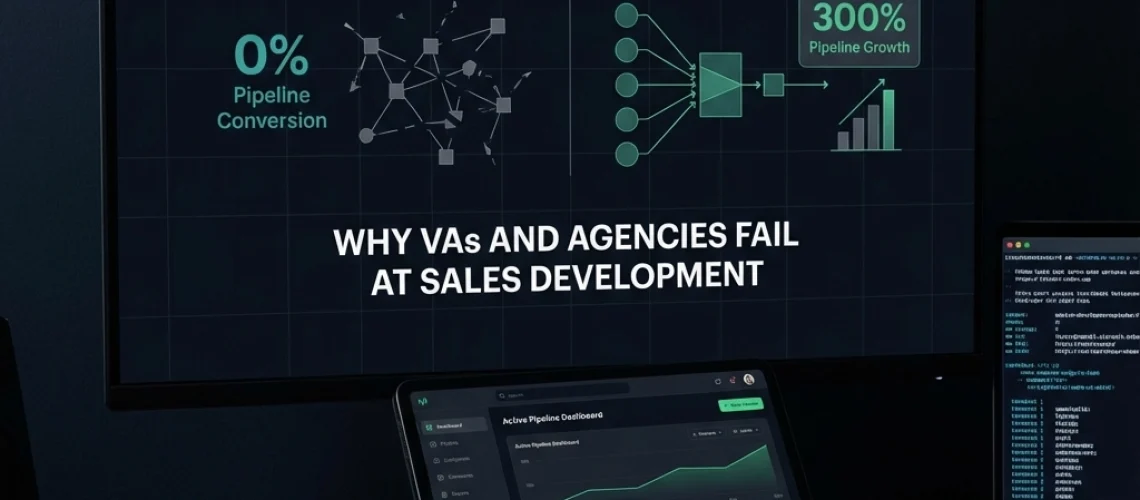
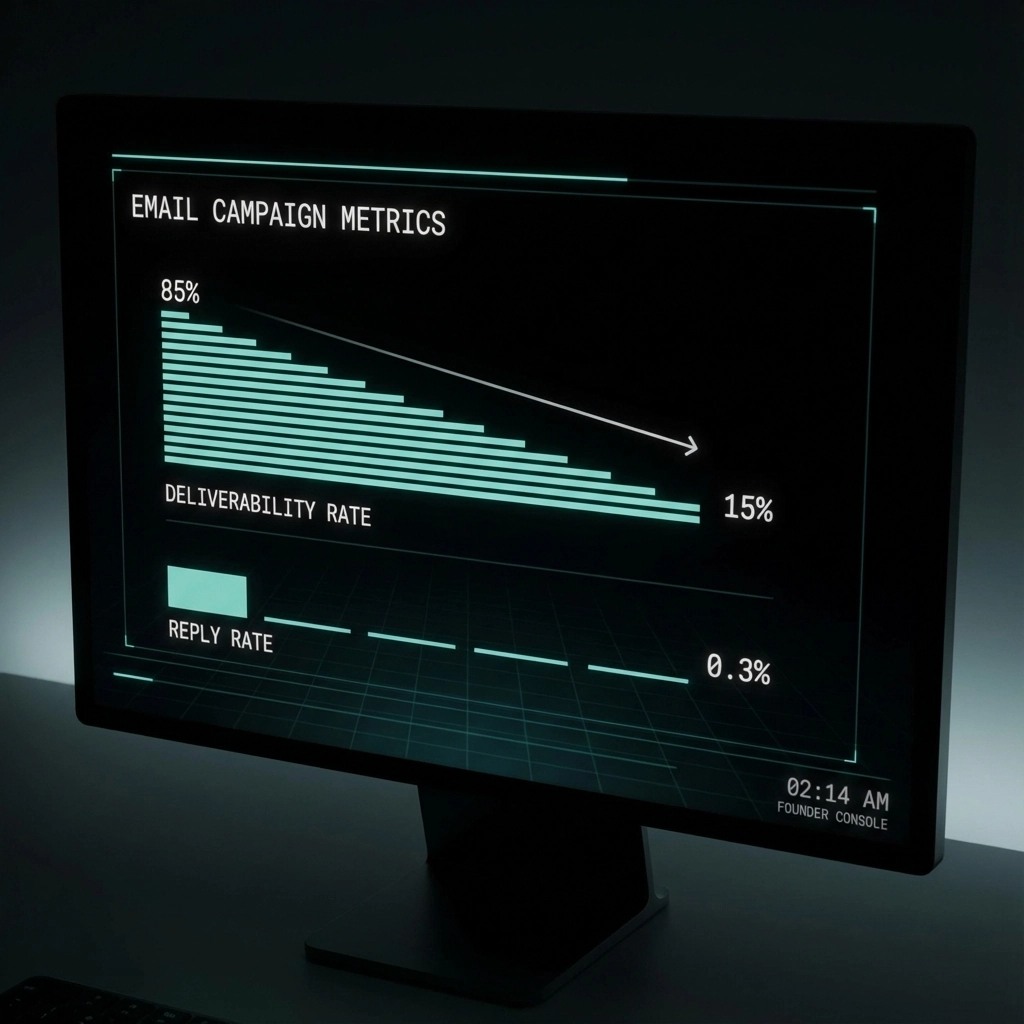
You hired a VA for $15/hour to handle your outbound. Two weeks later, your domain is flagged as spam, your reply rate is 0.3%, and you're getting angry responses from prospects who received the same "Hi [FIRST_NAME]" template that 500 other people got that week.
Or maybe you went the agency route. Paid $3,000 upfront, plus $150 per "qualified" meeting. Three months in, you've spent $8,000 and booked exactly two demos: both with prospects who had zero budget and were just curious about AI.
Here's the uncomfortable truth: most VAs and agencies aren't built for real sales development work. They're built to execute volume-based playbooks that worked in 2019 but fail spectacularly in today's inbox environment.
Let me break down exactly why this happens and what actual SDR work looks like.
Why VAs Fail at Sales Development
Domain Reputation Is Everything (And They Don't Own It)
Your VA is probably using their own email infrastructure, or worse, some shared service that's already been flagged. They don't understand sender reputation, SPF records, or domain warm-up. They just blast emails from whatever setup they can access cheapest.
The math on this is brutal. Once your domain gets marked as spam, your deliverability drops from 85% to 15% overnight. That means 85% of your emails never even reach an inbox. You could have the best copy in the world: nobody will see it.
VAs also don't understand volume limits. They'll send 500 emails in one day from a fresh domain because "more emails = more replies," not realizing they just torched your sender reputation for the next six months.
Shallow Personalization at Scale
Most VAs work off a simple brief: "Send 100 emails per day to [your ICP]." They'll use basic merge tags like company name and first name, maybe throw in an industry reference, and call it personalized.
But real personalization requires research. Understanding the prospect's specific challenges, recent company news, tech stack changes, hiring patterns. A VA making $15/hour can't spend 10 minutes researching each prospect: the economics don't work.
So they default to templates. "I noticed [COMPANY] is in [INDUSTRY]" emails that scream automation to anyone who receives them.
Zero Accountability for Results
Here's where the model breaks: VAs get paid for activity, not outcomes. They're incentivized to send volume, not book qualified meetings.
Your VA reports "sent 500 emails this week" as a win. They don't mention that 450 bounced, 48 went to spam, and 2 got replies: both asking to be removed from your list.
When the campaign fails, they blame your ICP, your offer, or your messaging. Never the execution. Because they're not sales development professionals: they're task executors.
Why Agencies Aren't Much Better
The Lead Generation Factory Model
Most agencies run what I call the "lead gen factory." They have one person writing templates, another building lists, and junior VAs executing sends. It's optimized for agency profit margins, not client results.
They promise "500 qualified leads per month" but define "qualified" as anyone who responds, even if it's "stop emailing me." They're selling hope and volume, not actual sales development.
Client Churn Is Built Into Their Model
Agencies typically lose 60-70% of clients within six months. Not because they're bad people, but because their economic model requires constantly acquiring new clients to replace the ones who leave after discovering the results don't justify the cost.
This creates a perverse incentive: spend more on client acquisition than on actually improving client results.
No Skin in Your Game
Your agency gets paid whether your campaign works or not. Some even get paid more when campaigns perform poorly, because struggling clients buy additional "optimization" services.
They're not losing sleep over your burned domains or angry prospects. You are.
What Real SDR Work Actually Looks Like
Let me show you the actual job map of sales development work:
Research & List Building (30% of time)
- Identify ICP companies showing buying signals
- Map decision makers and influencers
- Research recent company events, funding, tech changes
- Prioritize accounts by likelihood to buy
Message Strategy (25% of time)
- Craft personalized first touch based on research
- Plan 4-6 touch sequence with different angles
- A/B test subject lines and messaging approaches
- Adjust messaging based on response patterns
Execution & Follow-up (30% of time)
- Send emails at optimal times
- Track opens, clicks, and responses
- Handle objections and replies professionally
- Route interested prospects to sales
CRM & Reporting (15% of time)
- Update prospect status and interaction history
- Track what's working and what isn't
- Report on metrics that matter: meetings booked, pipeline generated
- Clean lists and manage deliverability
The economics are simple: a loaded SDR costs $80-120K per year, takes 3 months to ramp, and might quit after 18 months. Most early-stage founders can't justify that math when they're trying to prove product-market fit.
What a Real SDR System Looks Like Instead
Research-First Approach
Real sales development starts with research, not templates. Every prospect should be researched individually: recent news, team changes, tech stack, competitive landscape, potential pain points.
This means spending 5-10 minutes per prospect before sending anything. Most agencies and VAs skip this because it doesn't scale profitably for them.
Human-in-the-Loop Approval
Every email should be reviewed before sending. This isn't about micromanagement: it's about maintaining your voice and catching mistakes before they reach prospects.
Your VA sending "Hi [FIRST_NAME], I noticed [COMPANY_NAME] is doing great work in [INDUSTRY]" to Apple's CEO isn't just embarrassing: it's brand damage.
Full Visibility Into Results
You should see exactly what's being sent, when, and to whom. Plus the actual metrics that matter: deliverability rates, response rates, meeting booking rates, and pipeline generated.
Not activity metrics like "emails sent." Results metrics like "qualified meetings booked."
Cost Control and Scalability
Here's the math that matters:
| Traditional SDR | VA/Agency | Real SDR System |
|---|---|---|
| $80-120K/year | $3-8K/month | $499/month |
| 3-month ramp | 2-week setup | Same day start |
| 18-month avg tenure | Client churn risk | Consistent execution |
| Benefits + taxes | Management overhead | Flat cost |
A real SDR system gives you SDR-quality work at a fraction of the cost, with none of the hiring risk.

The Approval Workflow That Changes Everything
The difference between spam and sales development is human oversight. Every email should be approved before it sends, but the system should make this fast and easy.
You review 20-30 emails each morning, approve the ones that sound like you, and edit the ones that don't. Takes 15 minutes and ensures every prospect interaction represents your voice and brand.
This is what agencies and VAs can't provide: they're optimized for volume, not quality control.
Why This Matters for Early-Stage Founders
You're building product, trying to raise money, and figuring out product-market fit. The last thing you need is a burned domain, angry prospects, or wasted money on campaigns that don't work.
Ramen is a virtual SDR team that handles research, personalized emails, and follow-ups: with approval before anything sends. You get SDR-quality outbound for $499/month, bring your own API keys to control costs, and maintain complete visibility into what's being sent in your name.
It's not magic. It's just sales development done right, at a price that makes sense for founders who can't justify $100K on their first sales hire.
See how it works and get your Sundays back.