
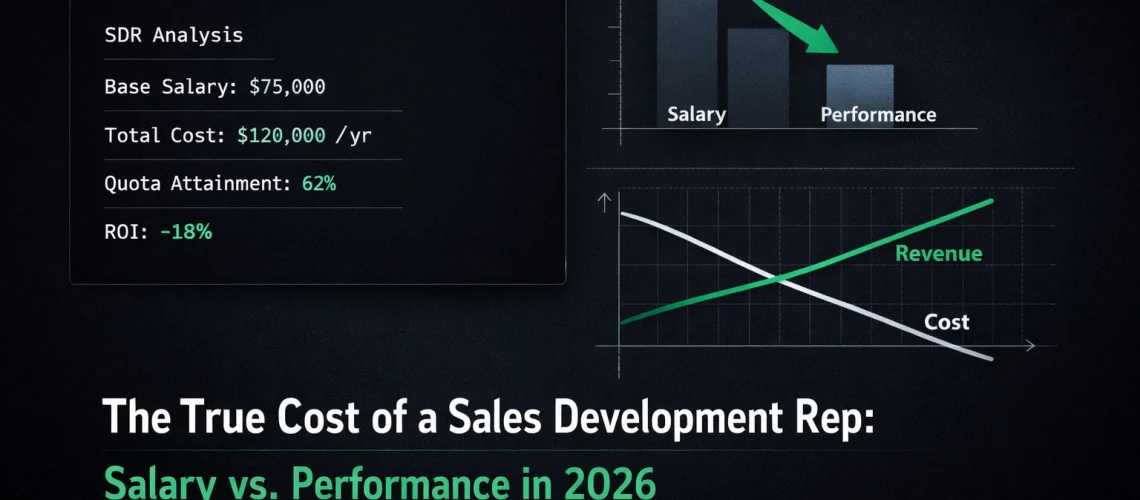
You're sitting on $500K in runway. Your MRR is crawling. Every founder you talk to says the same thing: "You need someone doing outbound full-time." So you start browsing LinkedIn for SDRs, and the math hits you like a brick.
The average Sales Development Rep salary in 2026 is $57,921 base, according to Built In. ZipRecruiter says $55,018. Comparably claims $74,746. But here's what nobody tells you in those job postings: salary is just the beginning.
Let me walk you through what an SDR actually costs, and what you get for that money.
The Real Number: Base Salary Is a Fiction
When founders budget for an SDR, they look at salary listings and think, "Okay, $55K base plus commission. I can do that."
Wrong.
Here's what hiring an SDR actually costs you in 2026:
Base salary: $55,000–$75,000 depending on market and experience
Payroll taxes: Add 10–15% ($5,500–$11,250)
Benefits: Health insurance, 401k match, PTO: figure $8,000–$12,000
Commission structure: Most SDRs expect $20,000–$40,000 in variable comp if they hit quota
Tools and software: Outreach/SalesLoft ($100/month), Apollo/ZoomInfo ($200/month), email infrastructure ($50/month)
Onboarding time: 2–3 months before they're productive. That's $15,000+ in salary while they learn your ICP, messaging, and product
Total loaded cost: $90,000–$140,000 for the first year. And that assumes they stay the full year and hit quota.

Now add the hidden costs: your time training them, the slack messages about "is this a good prospect?", the weekly 1-on-1s, the pipeline reviews where you realize they've been emailing the wrong titles for three weeks.
What You're Actually Buying
So what do you get for six figures?
The industry benchmark for a decent SDR is:
- 50–80 outbound touches per day (emails, calls, LinkedIn)
- 2–5% reply rate on cold emails if they're good
- 1–2% conversion to booked meetings from total outreach
- 8–12 qualified meetings per month if everything goes right
Let's do the math. If your SDR sends 1,200 emails per month:
- 24–60 replies
- 12–24 meetings booked
- Maybe 6–10 actually show up
- Perhaps 2–4 turn into real opportunities
At a $100,000 fully-loaded cost, you're paying $8,333 per month for 2–4 qualified opportunities. That's $2,000–$4,000 per opportunity created.
Now ask yourself: what's your close rate from opportunity to customer? If it's 20%, you're spending $10,000–$20,000 in SDR cost per closed deal. Before product delivery. Before customer success. Before anything else.
The Performance Problem Nobody Talks About
Here's what the salary surveys don't tell you: most SDRs don't hit quota.
The average SDR tenure is 14 months. Not because they get promoted: because they churn out. Some burn out. Some aren't good. Some realize cold calling isn't what they signed up for. And you're back to square one, eating another $15,000 in recruiting and onboarding costs.
And even good SDRs have a ramp problem. Month 1: useless, they're learning. Month 2: dangerous, they're confident but wrong. Month 3: starting to be productive. Month 4: actually decent. By month 14, they're gone.
You also get the experience cliff. An SDR with 0–1 years of experience averages $51,043 in base salary. Someone with 3–5 years averages $56,879. But that experience gap means everything for your pipeline.
A junior SDR will:
- Spray and pray instead of researching
- Use generic templates that scream "mass email"
- Book meetings with unqualified prospects to hit their number
- Need constant hand-holding on your ICP and value prop
A senior SDR will cost you $75,000+ base, $110,000+ loaded. And guess what? They don't want to work for a pre-seed startup with no brand. They want Oracle's benefits package and HubSpot's inbound flow.
The ROI Question You're Avoiding
Let's be direct: can you afford $100,000+ for 24–48 qualified opportunities per year?
If your ACV is $50,000 and your close rate is 25%, those 48 opportunities turn into 12 customers. That's $600,000 in new ARR. Sounds great until you remember:
- You spent $100,000 on the SDR
- Your product costs money to deliver
- You're probably giving discounts to early customers
- Half of those deals will take 6–9 months to close
The math works if you're Series A with product-market fit and a proven playbook. It doesn't work if you're pre-seed trying to figure out your ICP while also building product.
And here's the part that keeps you up at night: you won't know if it's working for 6 months. By the time you realize your SDR is booking the wrong meetings or your messaging is off, you've burned $50,000 and six months of runway.
What Your $100K Is Really Buying
Strip away the salary surveys and quota plans. Here's what you're actually paying for:
Human judgment. Someone who can look at a prospect's LinkedIn, read between the lines, and decide if they're worth reaching out to.
Personalization at scale. The ability to send 50 emails a day that each feel like they were written for that specific person.
Persistence. Following up 6–8 times because the first email always gets ignored.
Qualification. Sniffing out tire-kickers from real buyers before they waste your time on a demo.
The question isn't "can I afford an SDR?" The question is "can I afford to pay $100,000 for these four things when I'm not sure they'll produce pipeline?"
The Alternative Nobody Mentions in Salary Surveys
If you stripped an SDR down to their core function: deep research on prospects, personalized outreach, persistent follow-up: could you get that for less than six figures?
This is where most founders get trapped. Agencies promise results but run generic plays on your dime. Freelance SDRs sound cheap until you realize you're managing them like a full-time hire without any of the commitment. Cold email tools blast thousands of templates and wreck your domain.
The right answer isn't "hire an SDR or don't do outbound." It's "get the judgment and personalization of an SDR without the $100K price tag and 3-month ramp time."
That's what we built Ramen for. You bring your own API keys (no markup), approve every email before it sends (human-in-the-loop), and get deep research on every prospect: not template blasting. It's not an SDR replacement; it's what an SDR would be if they didn't need to eat lunch or hit quota or get promoted.
If you're staring at that $100,000 loaded cost and wondering if there's a better way, see how Ramen works.