
You just closed your Seed round. The wire hit, the board is happy, and now the pressure is on. You need a pipeline. You need it yesterday.
Naturally, you look at your spreadsheet and think, "I’ll hire an SDR." You pencil in a $60,000 base salary plus some commission. It looks manageable on paper. You figure that after a few weeks of training, they’ll start booking 10 or 15 meetings a month, and the math will eventually work out.
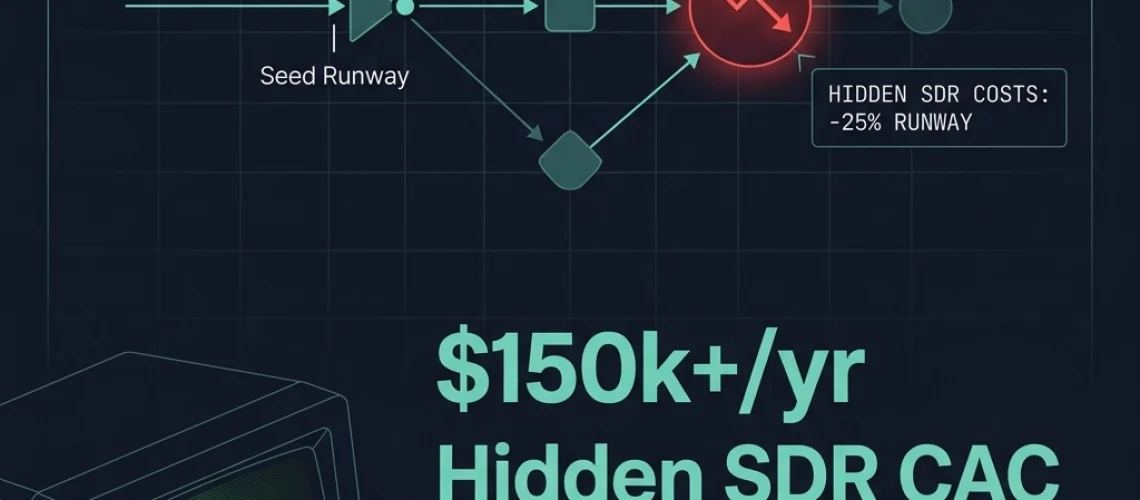
But here is the reality: that $60,000 hire is actually costing you closer to $120,000 when you factor in the "SDR tax." Between recruiter fees, a bloated tech stack, management overhead, and the agonizingly slow ramp-up period, your runway is getting shorter every single day they aren't hitting their numbers.
If you aren't careful, the cost of trying to build a sales team will kill your company before you even find product-market fit. We’re going to break down the true costs of a human SDR and show you why there’s a leaner, faster way to build your pipeline without burning through your capital.
The Salary is Only the Tip of the Iceberg
When founders talk about hiring, they almost always talk about "base salary." But in the world of outbound sales, the base is just the entry fee.
First, let’s talk about the recruiter. If you’re a busy founder, you don’t have time to sift through 400 applications on LinkedIn. So, you hire a recruiter. They charge 20% to 30% of the first year’s salary. On a $60k hire, that’s $12k to $18k out of your pocket before the person even walks through the door (or joins the Slack).
Then there are the payroll taxes, health insurance, 401k matching, and equipment. A MacBook Pro, a monitor, and a desk setup add another $3k. By the time they’ve sent their first "Just following up" email, you’ve already spent $20k over their base salary.
And we haven't even talked about the "loaded cost." Most finance experts estimate that an employee costs 1.25x to 1.4x their base salary. For a seed-stage startup, this is capital that should be going toward engineering or product development. Instead, it’s being drained by administrative overhead for a role that has a historically high turnover rate.
Tech Stacks and Training Debt
Even the most talented SDR is useless without tools. In 2026, the "standard" outbound stack is a budget-killer.
To give your new hire a fighting chance, you’re looking at:
- LinkedIn Sales Navigator: $100/month
- Lead Database (Apollo, ZoomInfo, or Clay): $100 – $500+/month
- Email Sending Platform (Instantly or Salesloft): $100/month
- Data Enrichment/Verification: $200/month
- AI Writing Assistants: $50/month
Suddenly, you’re paying an extra $1,000 to $1,500 every month just to keep the lights on for one person. This is what we call "Tech Debt for Sales." You are subsidizing their productivity with expensive software that they may or may not even know how to use effectively.

Then comes the "Training Debt." Most SDRs are entry-level. They don’t know your industry, they don’t know your persona, and they certainly don't know your product. You: the founder: have to spend at least 5 to 10 hours a week coaching them, reviewing their drafts, and explaining why "circling back" for the fifth time is annoying your prospects.
Your time is the most expensive resource in the company. If you’re spending your Sunday nights editing cold emails for a junior hire, you aren't just paying their salary: you’re losing the value of your own time.
The Management Trap: Why SDRs Don't Scale Linearly
A common mistake founders make is thinking that if one SDR is good, three must be three times better.
The math actually breaks down as you scale. A single SDR might be manageable by a founder. But once you have a "pod" of three, you need a Manager. Now you’re paying $120k for a Sales Manager to watch over three people who cost $80k each.
Research shows that most startups hit a revenue wall because their outbound doesn't scale. To triple your revenue, you don't just triple your SDRs; you often have to quadruple your costs because of the added management layers and the decreasing quality of lead lists.
This is the "chicken-and-egg" problem: you can’t raise your Series A without a predictable pipeline, but you can’t build that pipeline without hiring a team that drains the very cash you need to survive. It’s a vicious cycle that many smart founders are now avoiding by choosing AI agents over human hires.
Opportunity Cost: The 4-Month Dead Zone
The most hidden cost of all is the time it takes to see a result.
A human SDR usually takes 3 to 4 months to "ramp."
- Month 1: Learning the product and setting up tools.
- Month 2: Sending the first batches of emails and getting rejected.
- Month 3: Starting to see the first few "not interested" replies.
- Month 4: Finally booking their first 2 or 3 qualified meetings.
During those four months, you’ve spent $40,000 on salary and tools. If those 3 meetings don't close: which, let's be honest, they probably won't at first: you've essentially set that money on fire.
Compare that to an AI-driven approach. An AI SDR doesn't need to "learn" how to use LinkedIn. It doesn't need a month to understand your ICP. It can do deep research on 500 prospects in the time it takes a human to finish their morning coffee. You can be in the market and booking demos in two weeks, not four months.
Objection: "Isn't AI Just Another Cost?"
I get this question all the time from founders who are tired of being nickel-and-dimed by SaaS companies. "Mudassar, if I buy an AI tool, am I not just adding another line item to my burn?"
The answer depends on how the tool is built.
At Ramen, we designed our pricing to be the exact opposite of the traditional SDR model. Instead of paying for "seats" or inflated "credits," we use a "Bring Your Own Keys" (BYOK) model.
When you use Ramen, you connect your own API keys for things like OpenAI or Claude. You pay exactly what the AI costs to run: not a cent more. There’s no hidden markup. You get an all-in-one pricing structure that replaces the $1,500 tech stack and the $8,000/month employee with a single, predictable fee.
But the real value isn't just the price; it’s the control.
Most AI tools are "black boxes." You press a button, and it blasts out generic spam that ruins your domain reputation. Ramen is built on a "Human-in-the-Loop" philosophy. You approve the research and the drafts before they go out. It gives you the scale of a 10-person SDR team with the precision and brand safety of a founder doing manual outbound.

Stop the Burn and Build Your Pipeline the Smart Way
Building a startup is hard enough without the added weight of an expensive, underperforming sales team. You don't need a massive payroll to prove your business model works. You need high-quality conversations with your target customers.
The traditional SDR model was built for the zero-interest-rate era when capital was cheap and "growth at all costs" was the mantra. In 2026, the game has changed. Every dollar in your bank account needs to work harder.
If you're still spending your weekends writing cold emails or wondering why your $80k SDR hire hasn't booked a meeting in six weeks, it's time to rethink your strategy. You can scale your outbound without hiring an agency or a bloated team.
Stop letting hidden SDR costs kill your runway. Focus on building your product, and let an AI agent handle the research-heavy lifting. You get to keep your Sundays, your sanity, and: most importantly: your cash.
Ready to stop the burn? See how Ramen can help you build a pipeline without the $120k price tag.