
You just closed your pre-seed round. $500K in the bank. Six months of runway if you're careful. Your co-founder is heads-down on product. You're the one who has to fill the pipeline.
The math is simple: hire an SDR at $80K loaded, wait three months for them to ramp, hope they don't quit after six. Or keep doing outbound yourself on Sunday nights while your inbox management deteriorates and your domain reputation tanks.
Neither option feels right. Because they aren't.
The hidden truth most founders discover too late: the real cost of your first SDR isn't the salary. It's everything else.
The Real Cost of Human SDR Burn Rate
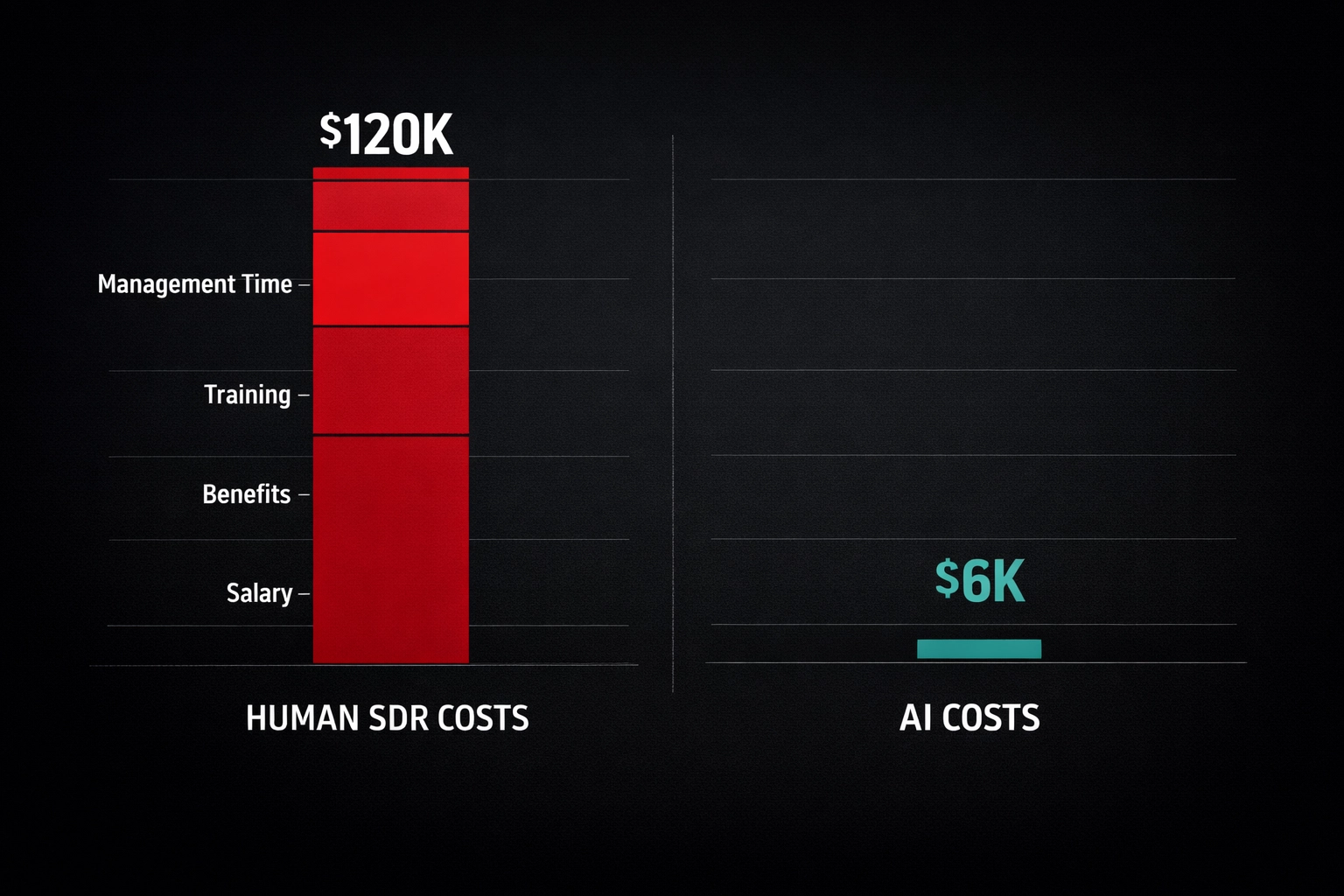
Let's talk about what $80-120K actually buys you.
A junior SDR needs three months to ramp. That's $20-30K before they send their first qualified meeting. They'll need training on your ICP, your value prop, your objection handling. They'll burn through domains learning what works. They'll book meetings with the wrong prospects while they figure out pattern matching.
Then there's the management overhead. You're not just paying their salary, you're spending 10-15 hours per week coaching, reviewing emails, sitting in on calls, fixing their mistakes. At a $200K founder opportunity cost, that's another $15-25K per quarter in your time.
And if they leave after nine months? You're back to square one with nothing but a burned email domain and a Salesforce full of cold leads.
The average SDR tenure is 14 months. Most founders can't afford that cycle even once.
The API Economics Nobody Talks About
AI agents run on API costs, not salaries.
A typical AI SDR setup costs $200-500/month in infrastructure. That includes your OpenAI credits, data enrichment tools, and email sending infrastructure. Compare that to $6,500/month minimum for a human SDR before benefits, taxes, and equipment.
The difference is $72,000 per year in direct costs alone.
But the real ROI gap is in output consistency. A human SDR sends 50-80 emails per day on a good day. An AI agent sends 200+ with the same level of research and personalization, every single day, without vacation days or sick leave.
Companies using AI SDR platforms are seeing 2-3x increases in qualified meetings while cutting costs nearly in half. One mid-market SaaS company jumped their response rate from 12% to 28% because the AI agent had time to do the research no human SDR would ever do manually, reading their prospect's recent LinkedIn posts, checking their tech stack, analyzing company news.
The economics aren't even close.
What You're Actually Paying For: Research Time vs. Sending Time
Here's what founders don't realize until they've managed an SDR team: 70% of the job is research and list building. Only 30% is actual outreach.
Your $80K SDR spends most of their day on LinkedIn, scraping contact info, reading company websites, trying to figure out if someone fits your ICP. By the time they write the email, they're rushing because they have a quota to hit.
AI agents invert this ratio.
They automate the research grunt work, enriching contact data, analyzing tech stacks, reading recent funding announcements, pulling relevant trigger events. The heavy lifting happens in seconds instead of hours. What remains is the high-value work: crafting personalized outreach that actually references what they found.
One technical sales team using AI agents saw their human SDRs shift from spending 70% of their time on research to focusing entirely on high-value conversations. The result? A 65% increase in technical validation calls and a 40% shorter sales cycle.
Your first "hire" should multiply your time, not consume it.
The Management Overhead You're Not Calculating
Let's be honest about what managing an SDR actually means.
You're reviewing their daily email drafts. You're jumping on calls when they can't handle an objection. You're rewriting their sequences because they don't understand your ICP nuances yet. You're checking their activity metrics to make sure they're not just hitting send on garbage.
This isn't a criticism of SDRs, it's the reality of the role. Junior sales talent needs coaching. They need feedback. They need someone to notice when they're drifting off-message or targeting the wrong accounts.
With AI agents, that management overhead drops by 80%.
You're not reviewing 50 emails a day hoping your SDR understood the assignment. You're approving batches of AI-generated outreach that's already been filtered for relevance, tone, and personalization depth. The agent flags edge cases for your review. Everything else just works.
One founder described it as "having an SDR with a perfect memory who never gets tired and never needs a pep talk after a bad day."
The time you save on management goes back into product, fundraising, or actually closing deals.
But What About Email Quality?
This is the objection everyone has: "AI emails are spam."
And yeah, if you're using some template blaster tool, they are. But that's not what we're talking about.
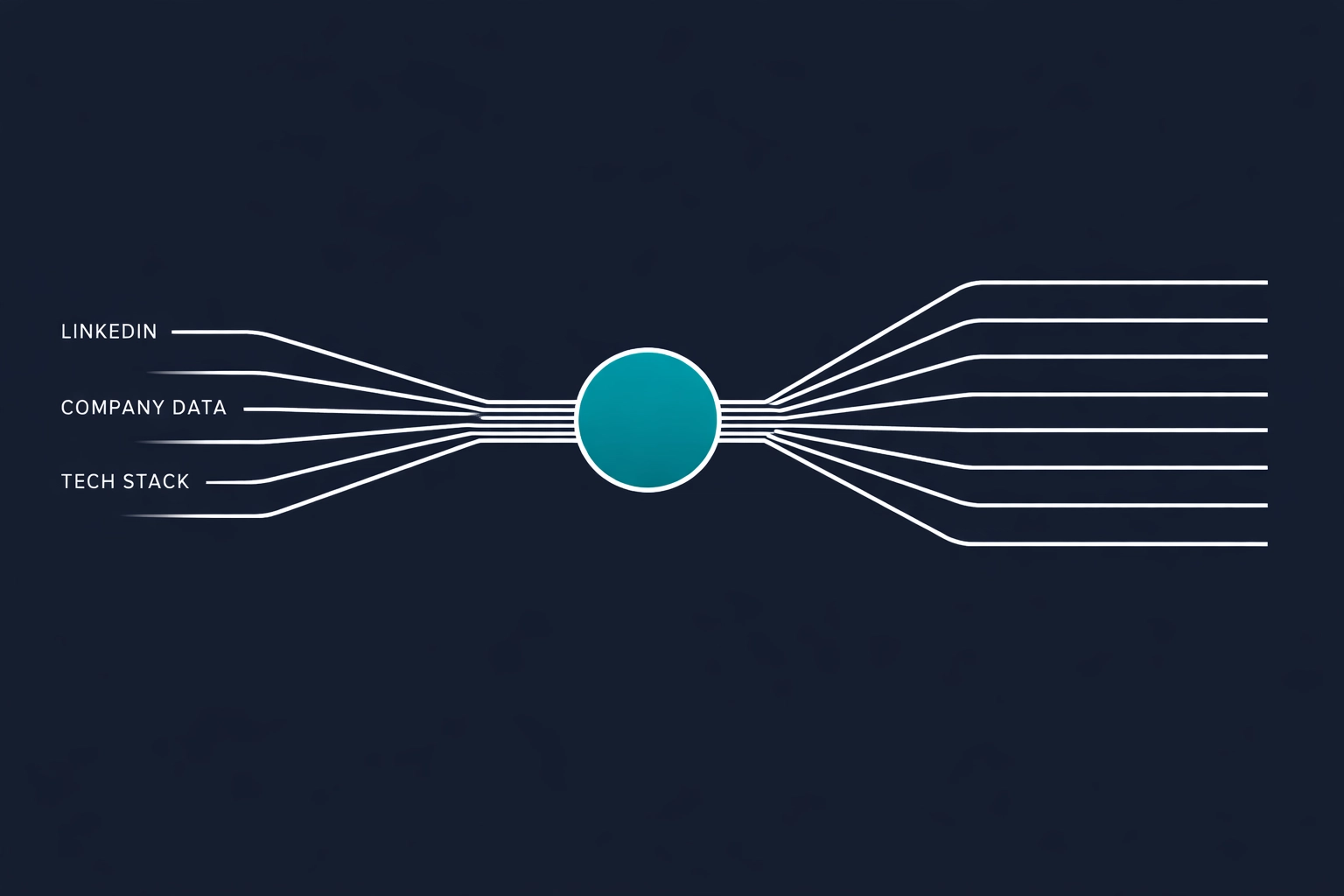
Modern AI SDR platforms don't send templates. They do actual research on every single prospect: the same research a good human SDR would do if they had unlimited time. They read LinkedIn activity, check recent company news, analyze tech stack changes, look for relevant trigger events.
Then they write a custom email referencing what they found.
The result? Response rates that match or beat human SDRs because the quality floor is higher. No more Monday morning emails that clearly weren't personalized. No more "just checking in" garbage. Every email has a reason to exist.
Companies using AI agents with deep research capabilities are seeing response rates jump from 2-3% (typical cold email) to 8-12% (warm outreach quality). That's the difference between spray-and-pray and actually doing your homework.
The quality isn't the limitation. It's the forcing function.
The Ramp Time Reality
Your human SDR needs three months to ramp. Your AI agent is productive on day one.
There's no onboarding. No training on your ICP. No trial-and-error phase while they figure out what messaging resonates. You configure the agent with your ideal customer profile, your value prop, your objection handling: and it starts working.
One SaaS company reported a 300% return on investment with a six-month payback period after switching from human SDRs to AI agents. The difference? No ramp time. No turnover risk. No retraining cycles.
The agent learns from every interaction across your entire organization, getting better over time instead of plateauing after the first year like most SDRs.
If you're pre-seed or seed stage, three months of ramp time is three months you don't have.
When Human SDRs Still Make Sense
Let's be clear: AI agents aren't perfect for every situation.
If you're doing high-touch enterprise sales with six-month cycles and need someone building relationships over golf games and dinners, hire a human. If your ICP requires deep technical conversations that span multiple touchpoints before qualification, you need human judgment.
But if you're in the 0-to-1 phase where you need to test messaging, find your ICP, and book 10-20 discovery calls per week to figure out what resonates? AI agents give you that data faster and cheaper than any human SDR ever could.
The optimal approach treats AI as your first hire, not your only hire. Get the pipeline machine running. Prove your messaging works. Then bring in human SDRs to handle the complexity and relationship-building your AI agent surfaces.
Most founders hire in the wrong order and burn cash figuring it out.
The Chicken-and-Egg Problem AI Solves
Here's the trap every early-stage founder faces: you can't raise your next round without pipeline. But you can't build pipeline without money or time.
Hiring an SDR means committing $80-120K before you know if your outbound motion even works. That's 4-6 months of runway on a bet.
AI agents let you test outbound for $500/month. You can run three different messaging angles simultaneously. You can target two different ICPs and see which converts better. You can iterate weekly instead of quarterly because you're not retraining a human every time you pivot.
The companies seeing 3x increases in sales pipeline while cutting cost-per-lead by 30% aren't doing anything magical. They're just removing the constraint of human bandwidth from their experimentation cycle.
Your first "hire" should be the thing that helps you learn faster, not the thing that locks you into a specific approach for six months.
What This Actually Looks Like
One founder we talked to was spending 15 hours per week on outbound. Sunday nights drafting emails. Monday mornings sending them. Wednesday afternoons following up. Zero time for anything else.
He switched to an AI agent with a human-in-the-loop model. Now he spends 3 hours per week reviewing AI-generated outreach and approving sends. The agent does the research, writes the emails, handles the follow-ups.
His reply rate went from 2% to 9%. His weekly meeting volume went from 2-3 to 8-10. His Sundays came back.
That's what good ROI looks like at the early stage. Not doubling your output: getting your time back while improving results.
If you're doing your own outbound right now, or you're about to pull the trigger on that first SDR hire, run the numbers on what an AI agent could do for the same timeline at a fraction of the cost.
You might be surprised at how quickly the ROI compounds when you're not betting six months of runway on a single hire.