
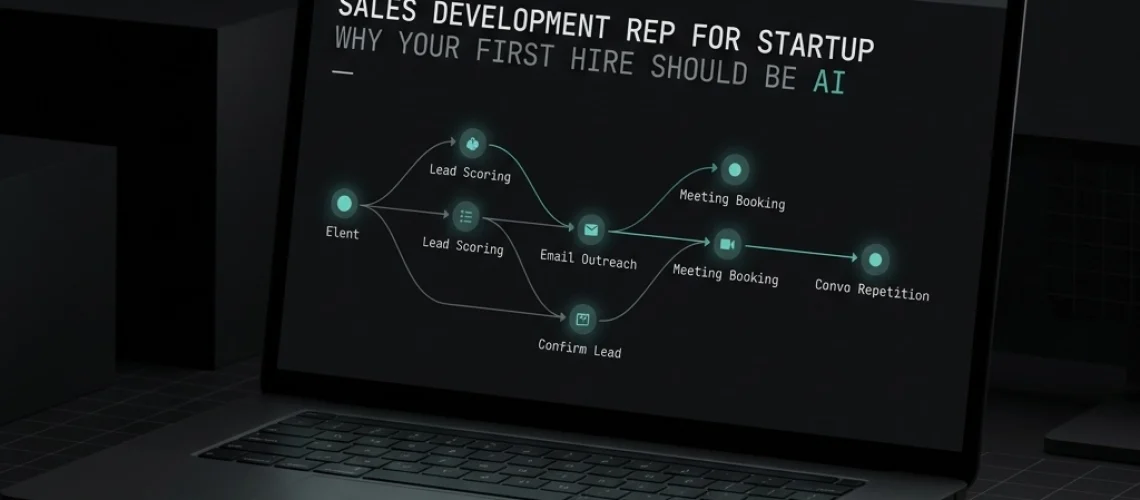

You’re finally ready to scale. The product is working, you’ve got a few happy customers, and your calendar is open. But hiring your first human sales development rep for a startup feels like a $100k gamble you simply can't afford to lose. If they ramp and hit their numbers, you’re a hero. If they quit after three months or: worse: spend six months sending "Hope this finds you well" emails to the wrong people, you’ve just burned a hole in your runway that might not be patchable.
The traditional advice says you need a body in the seat to "grind" through the outbound. But in 2026, the grind is a data problem, not a personality problem. Starting with an AI agent is the smarter, faster way to build your pipeline without the overhead, the drama, or the six-figure liability.
The Hidden Risks of Junior Sales Hires
When you hire a junior human SDR, you aren't just paying a salary. You’re paying for a massive list of hidden costs that most founders ignore until the first credit card bill hits.
The loaded cost of a human SDR in a major market: including base, commissions, benefits, seat costs for your CRM, and LinkedIn Sales Navigator: ranges from $80k to $120k per year. That is a lot of capital to deploy on an unproven motion.
But the money isn't even the biggest risk. It’s the time.
Junior hires require constant management. They need to be told who to target, what to say, and how to handle every single objection. If you don't have a perfectly documented sales playbook (and let’s be honest, most pre-seed or seed startups don't), you’re essentially paying someone to guess on your behalf.
Then there’s the "Black Box" problem. A human SDR often keeps their best learnings in their head or in messy spreadsheets. If they leave for a better offer in six months, your entire outbound process walks out the door with them. You’re left with zero pipeline and no data on why the last 2,000 emails didn't work.

Speed to Market: AI vs. Human Onboarding
Think about the timeline for a human sales development rep for a startup.
Month 1: They’re learning the product. They’re setting up their Slack and trying to understand your ICP. You’re spending 5–10 hours a week in 1:1s.
Month 2: They start sending their first sequences. You realize their writing style doesn't match your brand. You spend hours editing templates.
Month 3: They finally book their first three meetings. One is a "no-show," one is a student doing research, and one is a legitimate prospect.
Total cost: ~$25,000. Total result: One qualified lead.
Compare that to an AI agent. An AI SDR doesn't need to "learn" your culture or set up a desk. You feed it your successful past emails, your website URL, and a list of your best customers. It starts researching prospects immediately.
With a tool like Ramen, you can go from "we need more leads" to "first batch of researched emails sent" in about twenty minutes. The ramp time isn't months; it’s the time it takes to finish a cup of coffee. Because the AI doesn't get bored, it doesn't "forget" to follow up on a Tuesday afternoon because it got distracted by a ping in the general Slack channel.
Why the First SDR Job Is Actually About Research
In a young startup, the goal of outbound isn't just to book meetings. It’s to find out if anyone actually cares about what you’re building. You are testing hypotheses.
- Does the VP of Engineering care about "security"?
- Or do they care about "compliance speed"?
- Does the "Director of Operations" have the budget, or should you be talking to the CFO?
Most junior SDRs aren't equipped to do this kind of high-level pattern matching. They are trained to hit "send" on a volume of emails. AI, however, thrives on information processing.
An AI agent can analyze thousands of LinkedIn profiles, company news reports, and job postings to find the "trigger" that actually matters. It can tell you that the last 50 companies that replied all recently hired a new Head of Growth. That is a level of insight you usually only get from a veteran sales leader: one you definitely can't afford right now.
Can AI Really Personalize Like a Human?
This is the biggest objection founders have. "I don't want to spam my market with bot-written garbage."
You’re right to be worried. Most "AI tools" are just GPT wrappers that take a template and swap out the {{FirstName}} and {{CompanyName}}. That’s not personalization; that’s a Mail Merge from 1998 with a better UI. It doesn't work, and it burns your domain reputation.
At Ramen, we take a "Research-First" approach. Instead of just writing an email, the AI acts like a high-level researcher. It goes to the prospect’s website, reads their "About" page, looks at their recent LinkedIn posts, and checks for recent funding or hiring news.
It finds a specific reason to reach out. For example, instead of saying "I saw you work at Stripe," it might say: "I noticed you recently spoke at the Fintech Summit about the shift to modular API architecture. Since you’re leading the team responsible for X, I thought our approach to Y might save you some of that manual overhead you mentioned."
That’s the kind of email most human SDRs are too busy (or too tired) to write for every single prospect. When you combine that deep research with a human-in-the-loop system, you get the best of both worlds. The AI does the heavy lifting of research and drafting, and you: the founder: simply hit "approve" or make a quick 10-second tweak.
You keep your quality high, but your time investment stays low.

The Economics of "Bring Your Own Keys" (BYOK)
Most sales platforms want to lock you into a massive annual contract. They charge per seat, and they charge a premium for the "AI credits" you use.
We think that’s a bad deal for startups. When you use Ramen, you bring your own API keys for tools like OpenAI or Anthropic. You pay exactly what the compute costs. If you aren't sending emails this week because you’re heads-down on a product launch, your costs drop to zero.
A human SDR is a fixed cost. They get paid whether they book ten meetings or zero. An AI SDR stack is a variable cost that scales with your ambition. For a founder trying to preserve runway while proving traction to investors, the math isn't even close.
When Should You Actually Hire a Human?
We aren't saying you should never hire a salesperson. Humans are incredible at building deep relationships, navigating complex internal politics during a deal, and closing six-figure contracts.
But you should only hire a human SDR when:
- You have a proven playbook. You know exactly who buys and why.
- The AI is overwhelmed. You have so many warm replies coming in that you can't handle the discovery calls yourself.
- You can afford to fail. You have enough cash that if the hire doesn't work out, it doesn't end the company.
Until you hit those three markers, a human hire is a distraction. They will ask you for collateral you haven't written yet. They will ask for a CRM setup you don't have time to build. They will ask for "leads" that you are still trying to define.
Using an AI SDR allows you to document everything. Every reply, every objection, and every winning subject line is saved in your system. When you eventually do hire that first human rep, you aren't handing them a blank Slack channel. You’re handing them a machine that is already working. You’re setting them up to win, rather than asking them to build the plane while they’re flying it.
Stop Burning Your Sunday Nights
Every founder has been there. It’s 9:00 PM on a Sunday, and you’re sitting on the couch with a laptop, manually scraping LinkedIn and trying to write 20 "personalized" emails to send out for Monday morning.
It’s soul-crushing work. It takes you away from the product, and it makes you hate the sales process.
You started a company to solve a problem, not to be a manual data-entry clerk. An AI sales development rep for a startup isn't just a cost-saving measure; it’s a sanity-saving measure. It gives you back your Sundays. It ensures that while you’re sleeping, your outbound is still running, your research is still being done, and your pipeline is staying warm.
Building a Pipeline You Can Trust
The "chicken-and-egg" problem of early-stage startups is brutal. You can’t raise your next round without a solid pipeline, but you can’t build a pipeline without the money to hire a sales team.
AI breaks that cycle. It gives you the leverage of a three-person sales team for the price of a Netflix subscription and some API credits. It allows you to stay founder-led while operating at a scale that makes you look like a much larger organization to your prospects.
If you’re tired of the "spray and pray" approach from agencies, or if you’re staring at a $100k hiring budget and feeling a pit in your stomach, it’s time to rethink the role of the SDR.
You don't need a body in a seat. You need a system that learns.
Build your outbound engine on data, not on hope. Get your first AI SDR at Ramen.so and start booking demos without the $100k gamble.