
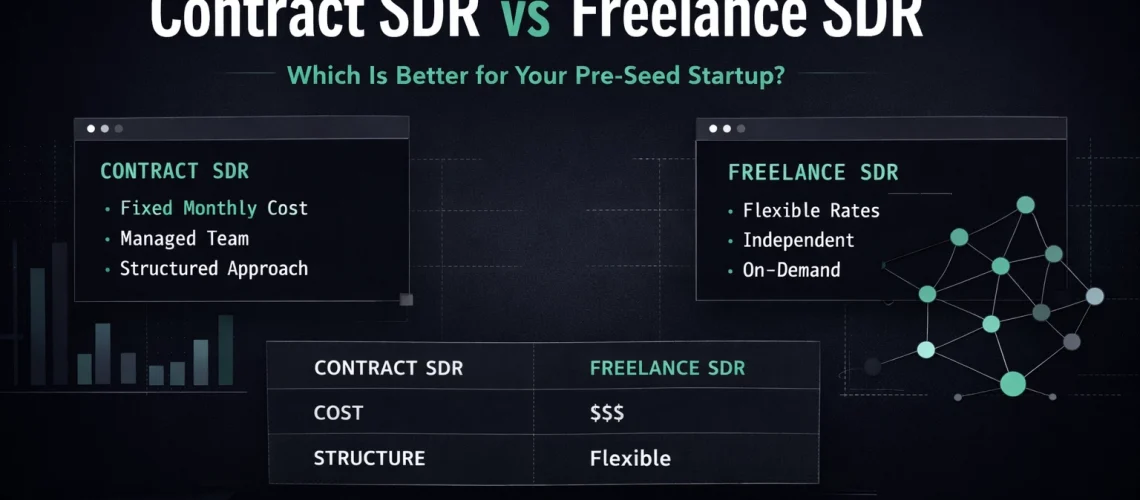
You've got maybe $150K in the bank, a product that's 80% there, and zero pipeline. You know you need to start conversations with potential customers yesterday. But hiring a full-time SDR at $60-80K base plus benefits? That's not happening. So you start googling "contract SDR" and "freelance SDR" and suddenly you're drowning in Upwork profiles, agency pitches, and contradicting advice.
Here's the clarity you actually need.
The Pre-Seed Sales Reality
At pre-seed, you're operating in a weird limbo. You need customer conversations to validate your product, refine your pitch, and potentially show traction to investors. But you also need to preserve runway like your startup depends on it: because it does.
The classic advice is "founders should do their own sales first." And that's true. But you're also building product, managing contractors, trying to raise, and occasionally sleeping. Something has to give.
Enter the remote SDR debate: do you hire a freelance SDR for maximum flexibility, or commit to a contract SDR for more dedicated focus?
Both paths have real tradeoffs. And the "right" answer depends on where you actually are, not where LinkedIn thought leaders think you should be.
Freelance SDRs: The Appeal and the Reality
What freelance SDRs offer:
Freelance SDRs are attractive because they match the pre-seed operating model. You can hire one within 24-48 hours, pay per deliverable (messages sent, meetings booked), and cut ties without drama if it's not working.
The cost math looks good on paper. Instead of $5-8K/month for a contract SDR, you might pay $1,500-3,000 for specific outreach campaigns. For a bootstrapped founder watching every dollar, that flexibility feels like a lifeline.
Where freelance SDRs struggle:
Here's what the Upwork profiles don't tell you: freelance SDRs are juggling 4-7 clients at any given time. Your pre-seed startup with an unproven product and unclear ICP? You're probably not their priority account.
The quality variance is massive. Some freelancers are former enterprise SDRs who genuinely know outbound. Others are running spray-and-pray campaigns that will torch your domain reputation in three weeks.
You're also inheriting a hidden job: SDR manager. You'll spend hours onboarding them on your product, reviewing their prospect lists, editing their email copy, and wondering why response rates are sitting at 0.3%.
For pre-seed specifically, the freelance model works best when:
- Your sales process is still being tested
- You need to validate demand before committing budget
- You have clear, specific deliverables (like "book 10 discovery calls this month")
Contract SDRs: More Commitment, More Consistency
What contract SDRs offer:
Contract SDRs sit between freelance and full-time hire. You're typically looking at 3-6 month commitments with agencies or staffing firms, at $4,000-8,000/month depending on experience level and whether you're working with a US-based or offshore remote SDR.
The key difference: dedicated focus. A contract SDR isn't splitting attention across a dozen accounts. They integrate with your workflow, attend your standups, and build context on your product over time.
For startups that have validated some product-market fit and need predictable pipeline generation, this dedicated attention translates to better results. They learn your ICP's objections, refine messaging based on real conversations, and create the kind of sustained outreach that actually moves pipeline metrics.
Where contract SDRs struggle:
The commitment cuts both ways. If you sign a 6-month contract and realize your messaging is wrong, your ICP is off, or frankly the SDR just isn't good: you're stuck paying out the term or negotiating an awkward exit.
At pre-seed, that $5K/month contract is meaningful runway. Three months of a mediocre contract SDR is $15K you could have spent on product development, paid ads for landing page testing, or extended runway to find the right approach.
Contract SDRs make more sense when:
- You've validated your core messaging and ICP
- You need consistent, daily outreach volume
- You're moving toward seed funding and need to show pipeline metrics

The Hidden Cost Nobody Talks About: Management Overhead
Here's the part that both freelance and contract SDR providers conveniently skip in their sales pitches.
You become an SDR manager.
Whether you hire a freelance SDR at $25/hour or a contract SDR at $6K/month, you're now responsible for:
- Onboarding them on your product, market, and competitive landscape
- Building or reviewing prospect lists
- Writing or approving email sequences
- Monitoring domain health and deliverability
- Having weekly (or daily) check-ins on pipeline
- Reviewing their conversations and providing feedback
- Troubleshooting when reply rates tank
Conservative estimate? You're spending 5-10 hours per week managing your SDR. At pre-seed, when you're also the CEO, product manager, and chief fundraiser, those hours are brutally expensive.
This is the real cost equation. It's not just the $3K or $6K monthly invoice. It's the $3K invoice plus 30-40 hours of founder time per month. Time you could spend on customer calls, product iterations, or investor conversations.
Some founders accept this tradeoff because they believe human SDRs catch nuances that automation misses. And historically, that was true.
The Objection: "AI Can't Do What a Human SDR Does"
You've probably heard some version of this: "AI outreach is spammy. Real SDRs build relationships. You can't automate genuine connection."
Let's be honest about what's true here.
What human SDRs legitimately do better:
- Handle complex, multi-threaded email conversations
- Pick up on subtle buying signals in replies
- Navigate unexpected objections in real-time
What that argument gets wrong:
Most SDR work isn't nuanced relationship building. It's research, list building, initial outreach, and follow-up sequences. The "relationship" part happens after someone replies: and that's typically where founders step in anyway.
The question isn't "AI vs. human" in some abstract sense. It's: "What's the highest-value use of limited resources at pre-seed?"
If you're spending $5K/month on a contract SDR plus 30 hours of your time managing them, and they're booking 8-12 meetings per month at a 2% reply rate: is that actually the best allocation?
The honest answer for most pre-seed founders: probably not.
A Different Approach Worth Considering
The freelance vs. contract debate assumes you need a human doing the prospecting work. But the real bottleneck at pre-seed isn't "who sends the emails": it's research quality and founder oversight.
Bad outreach happens when someone blasts generic templates to a poorly researched list. That's true whether it's a freelance SDR, contract SDR, or AI tool.
Good outreach happens when someone actually researches each prospect, crafts relevant messaging, and maintains quality control. At pre-seed, that "someone" is usually you: regardless of who's technically clicking send.
This is where AI tools designed for founder-led sales start making sense. Not as a replacement for human judgment, but as a way to handle the research and drafting work while you maintain control over what actually goes out.

Finding Your Path Forward
If you're at pre-seed with limited runway and an evolving sales process:
Freelance SDR makes sense for short-term experiments: testing messaging angles, validating an ICP segment, or getting quick market feedback. Keep engagements short (4-6 weeks) and deliverables specific.
Contract SDR makes sense if you've found initial traction, have validated messaging, and need sustained pipeline development heading into a seed raise. Budget for the management time, not just the invoice.
AI-assisted outbound makes sense if you want to maintain founder control over every message while eliminating the research and drafting grind. You stay in the loop without the 30-hour-per-week management burden.
The worst choice? Doing nothing because you're paralyzed by the options. Your competitors are filling their pipeline while you're still researching the "perfect" approach.
If the management overhead is what's holding you back, Ramen was built for exactly this situation. Deep research on every prospect, drafts ready for your approval, and you control what actually sends. No SDR management required: just founder-approved outreach at a fraction of the cost. See how it works.