
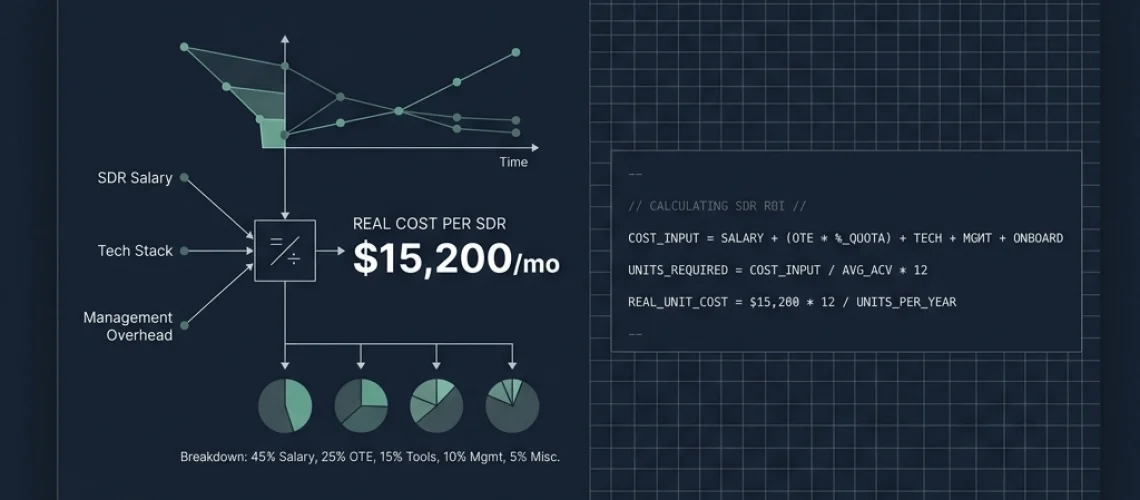
You’re looking at your pre-seed runway and realizing that a single junior SDR hire will cost you nearly $100k a year once you factor in taxes, tech stack, and management time. It’s a Saturday night, and instead of building the product or talking to users, you’re staring at a spreadsheet trying to figure out how to generate meetings without lighting your remaining cash on fire.
The math for a human SDR hire at the pre-seed stage almost never works. You need pipeline to raise your Seed, but you need the Seed money to afford the person who builds the pipeline. It’s a classic chicken-and-egg problem that kills startups before they even get off the ground.
Base Salary is Only the Beginning
When you look at a job board and see an SDR asking for a $60,000 base salary, your brain likely registers that as a $5,000 monthly expense. In reality, that $60k is just the tip of a very expensive iceberg.
For a startup in 2026, the all-in cost of a junior hire is significantly higher than their sticker price. First, you have employer payroll taxes and benefits. In the US, you should expect to add 25% to 30% on top of the base salary for health insurance, 401(k) matches, and government taxes. Suddenly, your $60k hire is costing you $78k before they’ve even sent their first "Hope this finds you well" email.
Then there is the commission. An SDR who doesn’t have a variable component to their pay is usually an SDR who isn't motivated to book meetings. A standard pre-seed OTE (On-Target Earnings) for a mid-level SDR is now hovering around $80k to $90k. Even if they only hit 70% of their target, you are writing checks for $70k to $75k in pure cash compensation.
When you add those 25% on-costs to an $80k OTE, you are at $100,000. That is $8,333 leaving your bank account every single month. For most pre-seed companies, that represents 10% to 20% of your total monthly burn.
The Tech Stack Tax
A human SDR is only as good as the tools you give them, and those tools are getting more expensive. To run a modern outbound motion, you aren't just paying for the person; you’re paying for their digital workbench.
A typical "lean" stack for an SDR looks like this:
- CRM: Even a basic HubSpot or Pipedrive seat adds up.
- Data/Enrichment: You need Apollo, ZoomInfo, or specialized lists. That’s $150 to $400 a month.
- LinkedIn Sales Navigator: This is non-negotiable for most industries. That’s another $100 a month.
- Sequencing/Sending: Tools like Instantly or Smartlead for the actual sending.
By the time you finish equipping one person, you’ve added another $500 to $1,500 a month in software subscriptions. Over a year, that’s another $6k to $18k. If you go the "enterprise" route with high-end data providers, you could easily spend $30k just on the data before a single lead is contacted.

The Management Overhead (The Invisible Cost)
This is the cost most founders ignore until they are three weeks into the hire and realize they haven't written a line of code or closed a deal in days. An SDR, especially a junior one, does not manage themselves.
You have to build the lists. You have to write the scripts. You have to handle the objections they don't know how to answer. You have to sit through 1-on-1s, review their calls, and debug why their open rates just cratered.
At the pre-seed stage, your time is the most valuable asset the company has. If you value your time at a modest $150 an hour and you spend just 5 hours a week managing an SDR, that is $3,000 a month in "shadow cost." Over a year, that is $36,000 of founder productivity diverted away from the product.
When you add the $100k in loaded compensation, the $10k in tech stack, and the $36k in management time, that one "junior" SDR is costing your company $146,000 a year.
The True Cost of a Mis-hire for Startups
The biggest risk isn't just the monthly burn; it's the cost of failure. The average tenure for an SDR in SaaS is less than 15 months. In the startup world, it’s often much shorter.
Imagine this scenario: You hire an SDR. It takes them 3 months to "ramp", meaning they are learning your product and ICP while you pay them full salary. By month 4, they start booking a few meetings. By month 6, you realize they aren't a culture fit, or their work ethic isn't there, or they simply can't sell your complex solution.
You let them go. In those 6 months, you have spent:
- $50,000 in loaded salary.
- $5,000 in tech stack fees.
- Hundreds of hours of your own time.
- Most importantly: 6 months of your runway.
You can get more money, but you cannot get those 6 months back. For a pre-seed founder, a bad SDR hire isn't just a line item error; it can be a company-ending event.
Rethinking the SDR Model: AI vs. Human
In 2026, the question isn't whether you need outbound, you do. The question is whether that outbound needs to be powered by a human who requires health insurance and 401(k) matches.
An AI SDR team doesn't take 3 months to ramp. It doesn't have "bad Mondays." It doesn't quit to join a Series B company for an extra $10k in base salary. Most importantly, it costs a fraction of the $146,000 annual price tag we just calculated.
At Ramen, we see founders replacing the traditional $100k SDR role with automated systems that handle the heavy lifting. Instead of one person sending 50 emails a day, you have an AI agent doing deep research on 500 prospects a day.

Objection: "Isn't AI just a template sender?"
The biggest fear founders have about AI outbound is that it will turn their brand into a spam machine. They’ve seen the "Hi [First_Name], I see you work at [Company_Name]" emails, and they hate them.
Here is the truth: Most AI tools are just template senders. They scrape a name and a title and blast out 5,000 emails. That is a great way to get your domain blacklisted and your brand ignored.
Ramen’s approach is different because it’s research-first. A human SDR is expensive because they (theoretically) spend time looking at a prospect’s LinkedIn, reading their recent posts, and understanding their company’s recent news. Ramen does that same deep research but at the speed of software.
Our AI agents don't just "fill in the blanks." They analyze the prospect's profile, find a relevant hook, and write a message that actually sounds like it came from you. And because we believe in a human-in-the-loop model, you still have the final say. You can approve every email before it goes out, ensuring your brand stays intact while your volume scales.
The "Bring Your Own Key" Advantage
Another hidden cost of many outbound platforms is the "platform tax." They upcharge you for data and mark up the cost of sending.
We built Ramen on a BYOK (Bring Your Own API Key) model. You control your costs. You use your own OpenAI or Anthropic keys. You use your own email sending accounts. This means you aren't just saving money on the SDR's salary; you’re saving money on the infrastructure itself. You pay for what you use, and not a penny more.
Calculating the ROI for Your Startup
If you are a pre-seed founder, your goal is to find a repeatable motion. You need to prove that if you put $1 into outbound, you get $3+ out in pipeline.
Doing this with a human SDR at a $150k all-in cost means they need to generate $450,000 in pipeline just to be "okay." For most early-stage startups with a $10k-$20k ACV, that is a massive mountain to climb.
When you lower the cost of the "SDR" to a fraction of that, the math changes. Your CAC (Customer Acquisition Cost) drops. Your runway extends. You can afford to experiment with different ICPs without the fear that a failed experiment will bankrupt the company.
Stop looking at the $60k base salary. Look at the $140k+ total reality. If you aren't ready to set that much cash on fire, it’s time to look at a different way to build your pipeline.
Save your runway and start booking demos without the headcount headache.

Save your runway at Ramen.so.