
You've seen the LinkedIn posts. Every third ad promises an AI SDR that'll "10x your pipeline" while you sleep. You've watched the demos, read the case studies, maybe even tried a few tools. But here's what nobody talks about: most AI SDRs send emails. The best AI SDRs book demos. There's a massive gap between those two outcomes, and it's costing founders real pipeline.
If you're evaluating AI SDR tools right now, or burned by one that flooded your domain with templated garbage, this post breaks down exactly what separates tools that generate activity from tools that generate revenue.
What to Look for in an AI SDR: The Non-Negotiables
Before we dive into why certain approaches work, let's establish the baseline. If you're comparing AI SDR platforms, here's your checklist:
Speed-to-lead capability: Does it respond to inbound leads instantly, or does it batch process once a day? The difference is a 391% swing in conversion rates.
Research depth: Is it pulling LinkedIn headlines and calling that "personalization," or is it analyzing company signals, funding events, tech stack, hiring patterns, and recent content?
Learning capability: Does it get smarter over time based on your reply rates and booking patterns, or does it send the same sequences forever?
CRM integration: Does every conversation auto-log with context, or do you manually copy-paste notes?
Human-in-the-loop or autopilot: Can you approve emails before they send, or does it blast on your behalf with no oversight?
Cost structure: Are you paying per-seat like a human SDR ($60K+ annually), per-lead (unpredictable), or are you using your own API keys (predictable, scalable)?
Most tools nail 2-3 of these. The best AI SDR platforms nail all six. Let's break down why each matters.
Speed Isn't a Feature, It's the Entire Game
Here's a stat that should change how you think about response time: responding to a lead within one minute boosts conversion rates by 391% compared to responding an hour later. One minute.
Now think about your current process. Inbound lead hits your CRM. You get a Slack notification. You're in a meeting, or writing code, or it's 11 PM and you're asleep. You follow up the next morning. That lead is already cold.
Human SDRs typically respond in 2-4 hours during business hours. They're off nights and weekends. They work in one time zone. By the time they reach out, your lead has already talked to two competitors.
AI SDRs engage instantly, 24/7, across every time zone. A lead fills out a form at 2 AM? They get a personalized response in under 60 seconds. A prospect in Singapore submits interest during your Saturday afternoon? They're qualified and booked before you finish your coffee on Monday.
SaaStr ran an experiment using an AI SDR for inbound qualification and reported 6% response rates, comparable to or better than most human SDR teams, with 130+ meetings booked since August. The primary variable? Speed. Every other factor was secondary.
This isn't theoretical. If you're evaluating a sales development rep for startup use cases, speed-to-lead is the first filter. Anything that doesn't respond within minutes is already obsolete.
Intelligence Separates Winners from Noise
Speed gets you in the door. Intelligence gets you the meeting. This is where most AI SDR tools completely fall apart.
The bad ones work like this: pull prospect data from a list, insert first name and company into a template, send 500 emails, hope for 2% reply rate. That's not an AI SDR. That's mail merge with an API wrapper.
The best AI SDR platforms research every prospect before reaching out. They analyze:
- Recent funding announcements or leadership changes
- Job postings that indicate buying intent
- Tech stack gaps your product solves
- Content the prospect published or engaged with
- Signal data showing they're in-market
Then they personalize messaging based on that research, not with a lazy "I saw you're hiring" line, but with specific observations tied to how your product solves a problem they're actively experiencing.
Here's what that looks like in practice: instead of "Hey [First Name], we help [Industry] companies with [Generic Pain]," you get "Noticed you posted about scaling your sales team last week: most teams at your stage hit a wall around 10 reps because coordination breaks down. Here's how [Your Product] solves that coordination tax."
The AI doesn't just send that once. It learns continuously from engagement patterns. Which subject lines get opened? Which CTAs get clicks? Which lead types convert fastest? The system refines targeting automatically, improving performance week over week.
This is why cost comparisons matter so much. Hiring a human SDR costs $60K+ annually before they book a single meeting. Companies using AI SDRs with genuine intelligence report 3-5x pipeline growth at 70-85% lower cost per qualified meeting, with payback periods under 30 days. The difference isn't the volume: it's the intelligence behind every message.

The Handoff Strategy Nobody Talks About
Here's the uncomfortable truth: AI SDRs should not be closing deals. They shouldn't be handling complex objections or navigating procurement. They're specialists designed for high-volume, top-of-funnel work: initial prospecting, qualification, meeting scheduling.
The best AI SDR setups treat AI as a specialized role, not a full replacement. Think of it like this: AI handles the first three touches. It qualifies the lead, books the meeting, and passes clean context to your sales rep. The rep enters the call with full background, previous conversation history, and qualification notes: all auto-logged in your CRM.
This hybrid approach is why 81% of sales teams using AI tools report higher productivity, with reps handling 20+ qualified leads per day when paired with AI SDRs. The AI eliminates the grunt work (list building, first outreach, follow-up sequences), so reps focus exclusively on conversations that require judgment.
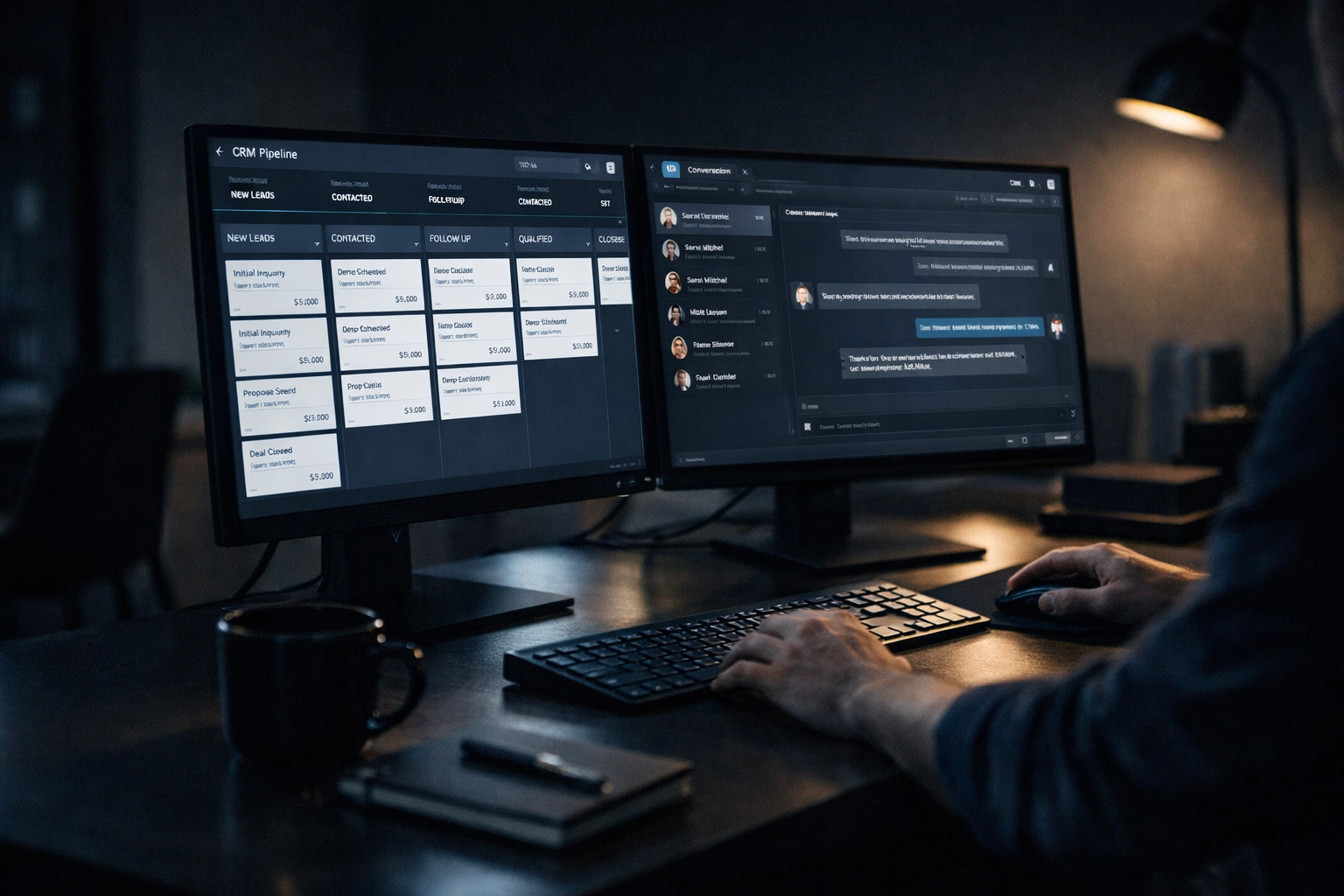
What does that look like operationally? Every conversation gets logged, summarized, and categorized automatically. Your CRM shows exactly where each lead sits in the pipeline. If a prospect asks a complex question, the AI flags it for human review instead of fumbling through an automated response. If a lead goes cold, the AI re-engages with new angles based on updated signals.
The result: 85% of sales reps working with AI agents report that AI frees them to focus on higher-value work: closing deals, building relationships, negotiating contracts. The stuff you actually need a human for.
If you're evaluating a contract SDR versus an AI SDR, this is the key distinction. A contract SDR costs $3-5K/month, ramps in 4-6 weeks, and books maybe 5-8 meetings if you're lucky. An AI SDR costs a fraction of that, ramps instantly, and books 15-25 meetings in the same time frame: while logging every interaction automatically.
Objection: "But AI Emails Feel Robotic"
Let's address the elephant in the room. You've seen bad AI emails. We all have. The ones that open with "I hope this email finds you well" and close with "Let me know if you'd like to discuss further." They're generic, lifeless, and obviously automated.
That's not an AI problem. That's a lazy implementation problem.
The best AI SDR platforms don't feel robotic because they're not blasting templates. They're writing emails based on real research, adapting tone to match the prospect (founder vs. enterprise buyer), and learning from what works. The email your AI SDR sends to a technical co-founder looks nothing like the email it sends to a VP of Sales: because those are different people with different pain points.
If the AI SDR you're testing feels robotic, it's because it's not doing real research. It's a symptom of shallow data and bad prompting, not an inherent limitation of AI.
The Real Question: Does It Actually Book Demos?
Strip away the marketing fluff, the "AI-powered" buzzwords, the promises of pipeline magic. The only metric that matters is this: does it book qualified demos that turn into revenue?
Most AI SDR tools optimize for activity: emails sent, sequences launched, leads contacted. The best ones optimize for outcomes: meetings booked, pipeline created, deals closed.
When you're evaluating tools, ask for these numbers:
- How many demos booked per month (not "emails sent")?
- What's the show rate on those demos?
- What's the average time from first contact to booked meeting?
- How many of those meetings convert to qualified pipeline?
If a vendor can't answer those questions with real data, they're selling activity, not results.
What This Means for You
If you're a founder running outbound yourself, or evaluating whether to hire a sales development rep for startup workflows, here's the bottom line:
The AI SDR that books demos in 2026 isn't the one with the fanciest UI or the biggest marketing budget. It's the one that combines instant response times, genuine prospect research, continuous learning, and clean handoffs to humans at the exact moment conversations require judgment.
Platforms that treat this as simple automation: blast emails, hope for replies: underperform every time. Platforms that treat AI as a specialized role within a human-led sales process outperform by multiples.
If you're still doing outbound manually, or burned by agencies that promised pipeline and delivered burned domains, it's worth testing an AI SDR that actually does research before hitting send. The kind that gives you your Sundays back without sacrificing reply rates.
Ramen is built for founders who can't justify $80K for an SDR who takes three months to ramp, but need pipeline yesterday. Deep research on every prospect, human approval before emails send, and you bring your own API keys so costs stay predictable. If that sounds like your situation, see how it works.