
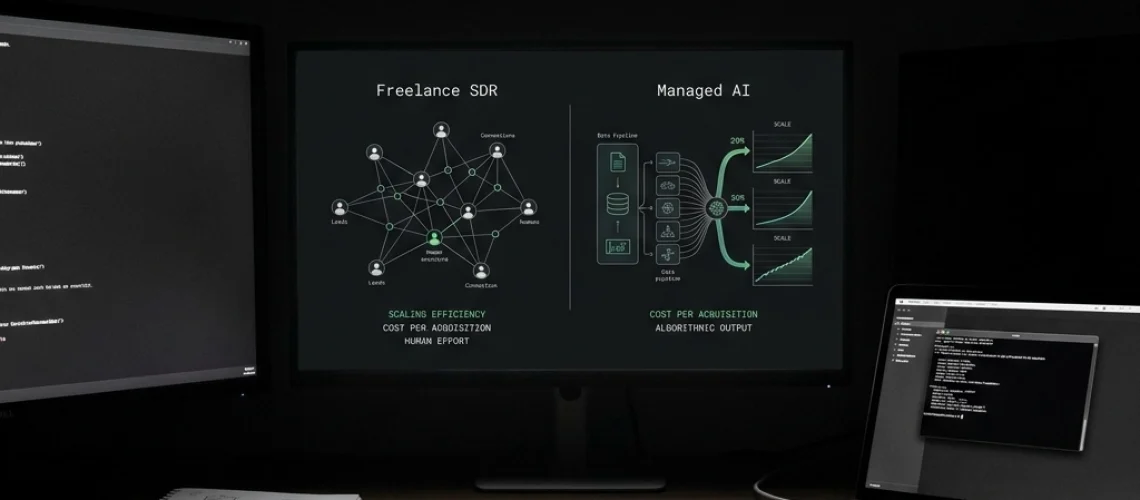
It’s Sunday night. Instead of relaxing or planning your product roadmap, you’re staring at a Google Doc, rewriting a batch of outreach emails your freelance SDR sent over for "approval." You thought hiring a contractor would be the low-risk way to test outbound without the $80k overhead of a full-time hire. Instead, you’ve just inherited a second job: babysitting. You’re spending more time correcting their "creative" interpretations of your value prop than you are actually closing the deals they were supposed to find.
The promise of the freelance SDR is simple: flexibility. But the reality is often a management debt that bankrupts your most valuable resource, your time.
If you’re a founder trying to scale from zero to one, or from $10k to $100k MRR, you don't need another person to manage. You need a system that works while you sleep. Here is why the traditional contract SDR model is breaking, and how managed AI systems are quietly eating the outbound world.
The Management Overhead of Freelance Sales
Most founders hire a freelance SDR because they are stuck in the "chicken-and-egg" problem. You can’t afford a $120k loaded-cost sales hire because you don't have the pipeline, but you can't build the pipeline because you're too busy building the product.
So, you find someone on a marketplace or through a referral. They’re "fractional." It seems like a steal. Then the "Founder Tax" kicks in.
First, there’s the training. You have to explain your ICP (Ideal Customer Profile) for the tenth time. You have to teach them why your product isn't "just another CRM" or "just another analytics tool." Then comes the SOP (Standard Operating Procedure) creation. You end up writing the scripts anyway because their first draft sounds like a 2012 LinkedIn automation bot.
By the time you’ve spent 10 hours a week managing a $2,000-a-month freelancer, your effective hourly rate has plummeted. You aren't scaling sales; you're scaling an agency-of-one inside your own company.
The biggest hidden cost is churn. Freelance SDRs are, by definition, looking for their next gig or a full-time role. The moment they get a better offer or find your niche "too hard" to break into, they vanish. All that training and context you poured into them? Gone. You’re back at square one, looking at a cold inbox and a stagnant calendar.

Consistency: The Secret Sauce of Winning Outbound
Outbound isn't about the one "perfect" email. It’s about the 1,000th email being just as researched, thoughtful, and well-timed as the first one. This is where humans, especially fractional ones, fail.
A human SDR has bad days. They get tired. They get rejected 50 times in a row and start to cut corners. They stop looking at the prospect's recent LinkedIn posts. They stop checking if the company recently raised a round or hired a new VP of Engineering. They start "template blasting" because they want to hit their activity KPIs so they can get paid their retainer.
Consistency is the only thing that builds a predictable pipeline.
Managed AI systems don't have "off" days. An AI SDR can perform deep research on 500 prospects in the time it takes a human to drink a coffee. It doesn't get bored of your messaging. It doesn't decide to "try something new" without telling you because it saw a TikTok about a new sales hack.
When you use a platform like Ramen, you’re setting a floor for quality that a freelancer simply can't match at scale. Every single output is based on the parameters you set, backed by live data, and delivered with the same level of precision every single day of the month.
Objection: "Isn't it cheaper to just use a VA or freelancer?"
This is the most common trap founders fall into. You look at the price tag of a managed AI system or a high-end tool and compare it to the $10/hour you’d pay a virtual assistant in a different time zone.
But you aren't paying for labor. You’re paying for the outcome.
Let’s break down the "Cheap Freelancer" math:
- Retainer: $1,500/month.
- Your Time: 5 hours/week (minimum) at a founder's internal rate of $150/hour = $3,000/month.
- Missed Opportunities: One "creative" but terrible email sent to a Tier-1 prospect can burn a bridge for years. If your average contract value is $10k, losing just one deal due to poor outreach is a massive hit.
- Tooling: You still have to pay for their Apollo seat, their Sales Navigator, and their email warming tools.
Suddenly, your "cheap" freelancer is costing you $5,000+ a month in real and opportunity costs.
Managed AI, particularly the AI SDR agents model, eliminates the management debt. You aren't paying for someone's time; you're paying for a system that researches, drafts, and prepares outreach for your approval. You become the editor-in-chief instead of the exhausted middle manager.

The Scalability Wall
If you want to double your outreach with freelancers, you have to hire a second person. That means doubling your management time, doubling your training effort, and dealing with two different personalities.
With managed AI, scaling is a toggle.
If you want to move from 20 leads a day to 100, you don't need a recruiting pipeline. You don't need a culture fit interview. You just increase the volume. The quality remains identical. This is why AI-driven outbound is the only way for a lean team to compete with venture-backed giants who have 50-person SDR rooms.
The AI SDR pricing usually scales linearly with your results, not exponentially with your management headaches.
The Human-in-the-Loop Advantage
The biggest fear founders have about AI is that it will turn their brand into a spam cannon. And they’re right to be afraid, most "AI" tools are just glorified mail-mergers.
The difference between a "contract SDR" and a "Managed AI" approach like Ramen is the Human-in-the-Loop philosophy.
You shouldn't let an AI send emails blindly, just like you shouldn't let a new freelancer send emails without checking them. The power of Managed AI is that it does 95% of the heavy lifting, the data scraping, the intent signals, the personalized "P.S." lines based on a prospect's recent interview, and leaves the final 5% for you.
You spend 15 minutes a morning reviewing a queue of high-quality, pre-researched drafts. You hit "Approve" or make a 5-second tweak.
That is how you get the flexibility of a freelancer with the consistency of a machine. You stay in control of your brand voice without being the one who has to do the data entry.
Choosing Your Path
If you are in a high-ticket, relationship-only sale where you only have 50 total potential customers in the world, you don't need an SDR or an AI. You need to pick up the phone yourself.
But if you have a market of thousands and you need to build a repeatable engine, the "freelance SDR" route is often a detour that ends in frustration.
A managed AI system gives you:
- Predictability: No churn, no sick days.
- Research-First Outreach: Every email is backed by actual data, not just a "Hey, I saw your profile" template.
- Cost Control: Especially with a BYOK (Bring Your Own Key) model, you aren't paying a middleman for the privilege of using GPT-4.
Stop being a sales manager and start being a founder again. You didn't start a company to spend your life in the "sent" folder of a freelancer's Gmail account.
If you’re ready to stop babysitting and start booking, it’s time to look at how a research-first outbound AI can do the work of a three-person SDR team for a fraction of the cost: and zero of the drama.

Ready to see how consistency actually feels? Get consistent results at Ramen.so.