

It’s been three months since you finally pulled the trigger. You felt the relief of handing off the one thing you hate most: outbound. You found a hungry hire, agreed to a $60k base with a $20k commission structure, and set them loose on your LinkedIn and email.
But today, you looked at your calendar. It’s empty.
When you ask for an update, your new SDR doesn’t have a list of booked demos. Instead, they have a list of excuses. They tell you the leads are "low quality." They say the messaging isn't resonating. They ask you for "better data" or a new tool that costs another $300 a month.
You’re out roughly $20,000 in salary and overhead, and you’re no closer to a predictable pipeline than you were when you were doing it yourself on Sunday nights.
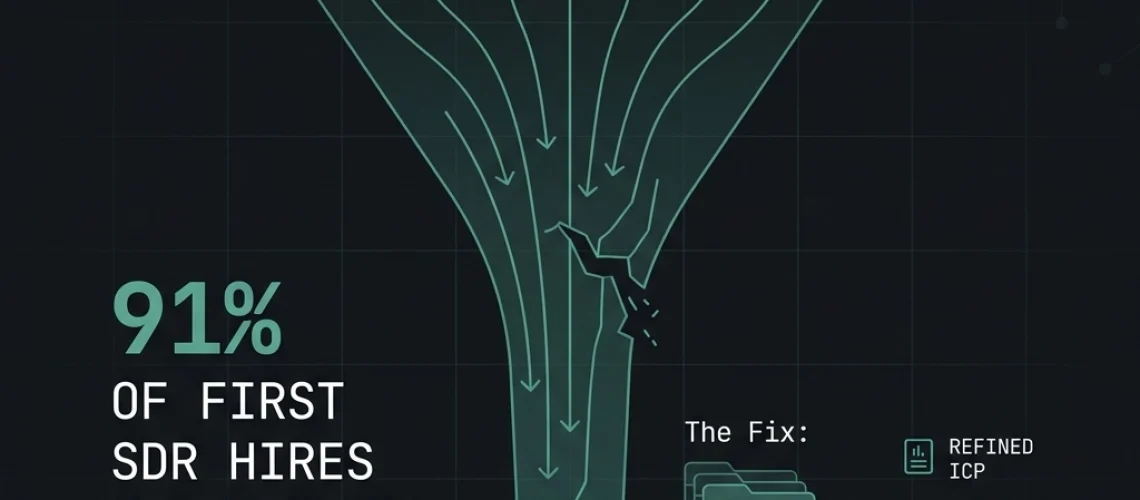
The truth is, the traditional first SDR hire is a gamble that most early-stage startups lose. It’s not necessarily that the person you hired is bad at their job: it’s that the system you put them into was designed to fail.
Why Founders Are Bad at Managing Their First SDR
Most founders hire an SDR because they are tired. You’ve been building the product, managing the engineers, and trying to close deals all at once. You hire an SDR to "take sales off your plate."
This is the first mistake. You cannot delegate a process that doesn't exist yet.
When you hire a junior Sales Development Representative, you aren't hiring a strategist. You are hiring an executor. Most SDRs are early in their careers; they need a proven script, a validated list of targets, and a clear workflow.
As a founder, you probably don’t have any of that. You’ve been booking meetings through sheer force of will, personal brand, or manual research that you haven't documented. When you hand that "process" to a new hire, it falls apart.
Managing an SDR requires a massive amount of time. You need to do daily stand-ups, weekly lead reviews, and constant message coaching. Most founders don't have the 5-10 hours a week required to manage a junior salesperson effectively. Instead, you leave them to their own devices, and they default to the easiest, least effective path: sending generic templates to huge lists of people who don't care.

The "Process First, Person Second" Rule
There is a fundamental law of scaling: you cannot scale chaos. If you haven't booked at least 10–20 meetings yourself using a repeatable method, hiring someone else to do it will only result in them failing faster.
The rule is simple: Process First, Person Second.
An SDR is a multiplier. If your current process is a 0, the SDR will produce 0, no matter how hard they work. If your process is a 1, they might turn it into a 5.
Before you even think about putting a job post on LinkedIn, you need to have three things:
- A Locked-In ICP: You need to know exactly who buys and why. Not just "Series A tech companies," but "VPs of Engineering at Series A companies who just hired a new Head of Security."
- Validated Messaging: You should have at least one email sequence that has a proven 2-5% positive reply rate.
- A Lead Sourcing Workflow: You need to show them exactly where to find the data.
If you don't have these, you aren't hiring a salesperson; you're hiring a co-founder and paying them an SDR salary. That never ends well.
The Reality of the $80,000 Gamble
Let's look at the math. A standard SDR hire in 2026 isn't just their salary. When you factor in payroll taxes, health insurance, a laptop, a Seat on LinkedIn Sales Navigator, an email sending tool, and a lead database, the "loaded cost" is easily $80,000 to $120,000 per year.
Learn more about the real cost of hiring an SDR vs. using AI.
For a seed-stage company, that is a massive chunk of runway. If that hire takes three months to ramp up (which is standard) and then fails to produce a pipeline by month six, you’ve effectively set $50,000 on fire.
For many founders, this is the "death spiral." You can’t raise your next round without a pipeline, but you’ve spent all your cash on a hire that didn't build one.

"Doesn't AI Lack the Human Touch for a First Hire?"
This is the most common objection we hear. Founders worry that replacing a human SDR with an AI agent means they’ll be sending "spammy" or "robotic" emails that ruin their brand.
It’s a valid concern: if you’re using the wrong tools.
Most "AI outreach" tools are just fancy template generators. They take a LinkedIn profile, summarize it poorly, and stick it at the top of a generic pitch. Prospects can see through that in half a second.
However, the "human touch" of a junior SDR is often an illusion. When a human SDR is under pressure to hit a quota of 100 emails a day, they stop doing deep research. They start "spray and pray." They make typos. They send the wrong company name.
Compare that to a platform like Ramen. Instead of just scraping a name, the AI performs actual research. It looks at your prospect’s recent podcasts, their company’s 10-K filings, and their specific job responsibilities. It builds a case for why you are reaching out that is often more thorough than what a $60k-a-year hire would do at 4:00 PM on a Friday.
At Ramen, we believe in "human-in-the-loop." You don't just turn on the machine and hope for the best. You approve every piece of research and every draft before it goes out. You get the scale of AI with the quality control of a founder.
See how human-in-the-loop AI protects your brand.
Building a Predictable Pipeline Without the Hire
If you aren't ready for the management overhead or the financial risk of a full-time hire, how do you fix your outbound?
You need to become the "Architect" of your sales, not the "Laborer."
By using an AI SDR agent, you can automate the part of the job that humans are actually bad at: searching through thousands of profiles, verifying emails, and writing personalized first drafts based on deep research.
This allows you to focus on the part of the job only you can do: closing the deals and refining the strategy.
The workflow for a smart founder in 2026 looks like this:
- Define your playbooks: Set your targets and your "why."
- Deploy an AI Agent: Let the agent do the heavy lifting of research and drafting.
- Review and Approve: Spend 20 minutes a morning reviewing the outgoing queue.
- Take the Demos: Wake up to a calendar that actually has meetings on it.
This approach costs a fraction of a full-time hire and requires zero "management" in the traditional sense. You don't have to worry about your AI agent getting "burnt out" or asking for a raise after three months of mediocre performance.
Stop Wasting Your Runway
Outbound isn't hard because you're bad at sales. It’s hard because you’re a bottleneck. You have more important things to do than spend four hours a day in a spreadsheet, but you can't afford to outsource that task to someone who doesn't understand your vision.

Hiring an SDR before you have a repeatable process is a recipe for an empty calendar and a depleted bank account. You don't need more headcount; you need a better system.
If you’re tired of spending your weekends writing cold emails and your weekdays wondering why your new hire isn't performing, it’s time to change the playbook. You can build a pipeline that runs while you sleep, without the $80k price tag or the management headaches.
Fix your outbound at Ramen.so. We’ll help you automate the research-first outbound that actually books demos, so you can get back to building your company.