
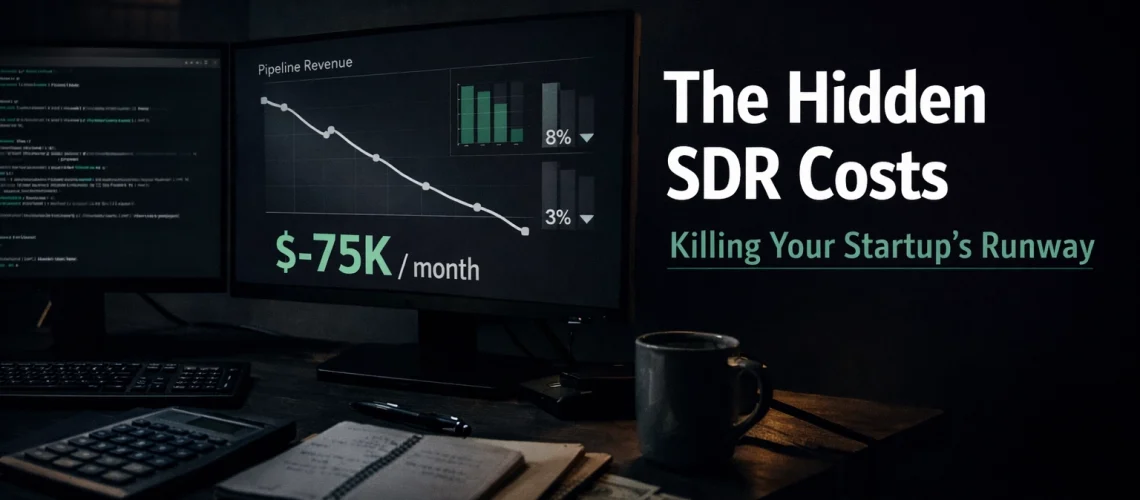
You’re sitting there on a Sunday night, staring at a spreadsheet. You just looked at your burn rate and then at your calendar. You have exactly zero demos booked for next week.
Your immediate thought is: "I need an SDR."
You figure you can find someone hungry, maybe a recent grad, and pay them $50k base plus some commission. It sounds reasonable. It sounds like the "standard" way to build a company.
But here’s the reality you won't hear from recruiters: that $50k hire is actually going to cost you $150k. And if they quit in six months: which happens more often than not: you’ve just set a massive chunk of your seed round on fire for nothing.
In 2026, the traditional SDR model isn't just inefficient; it’s a runway killer for early-stage startups. If you aren't careful, the "growth" hire you think will save your company is the very thing that will bankrupt it.
The Sticker Price is a Lie: Breaking Down True SDR Costs in 2026
When you hire a human SDR, the salary is just the tip of the iceberg. Most founders forget to factor in the "fully loaded" cost. By the time you add up taxes, benefits, and overhead, that $50,000 base salary has already ballooned to $70,000.
But we’re just getting started.
The $8,400 Invisible Tax (The Tech Stack)
An SDR is useless without tools. In 2026, the outbound landscape is a technological arms race. You can’t just give them a Gmail account and a spreadsheet. To be even baseline effective, your SDR needs:
- A data provider (ZoomInfo, Apollo, or Lusha)
- A sending platform (Outreach, Salesloft, or similar)
- LinkedIn Sales Navigator
- An email warm-up and verification tool
- A CRM seat
On average, startups spend over $700 per month per rep just on the tech stack. That’s $8,400 a year before they’ve even sent their first "Hope this finds you well" email.
The Management Debt
This is the cost that kills founders. You aren't just hiring an SDR; you’re hiring a second job for yourself.
Who is going to write the sequences? Who is going to coach them on handling objections? Who is going to check their activity levels every Tuesday when the numbers look low?
If you’re spending 10 hours a week managing a junior sales rep, you aren't spending those 10 hours on product, fundraising, or high-level strategy. Your time as a founder is the most expensive resource the company has. If your hourly rate is effectively $200, you’re "spending" another $8,000 a month just to keep that SDR moving.

The Math of the SDR Death Spiral
The average tenure of an SDR is roughly 14 months. It takes about 3 to 4 months for a new hire to "ramp": meaning they are finally producing more value than they cost.
If you do the math, you’re getting about 10 months of actual productivity. But you paid for the recruiting fee (usually 15-20% of base), the onboarding time, and the 4 months of "learning" salary.
When that SDR leaves for a "Senior" role at a Series B company, you’re left with a dead pipeline and a pile of expensive software seats you can’t cancel. This is the SDR death spiral, and it’s why so many startups fail to hit their Series A milestones. They spend their capital on "people infrastructure" before they have a repeatable process.
Why a Flat $499 Fee Beats a Variable Commission Structure
The traditional way to motivate sales is commission. It makes sense on paper: "I only pay you when you perform."
But for an early-stage founder, commission creates perverse incentives. An SDR focused on a "per-meeting" bonus will book anyone with a pulse. They’ll badger prospects, burn your domain reputation, and fill your calendar with "curiosity seekers" who have no intention of buying. You end up wasting your time on demos for people who aren't even in your ICP.
At Ramen, we believe the AI SDR pricing model should be as simple as your Netflix subscription.
A flat $499/month fee removes the friction. You aren't calculating complex commission structures or worrying about payroll taxes. You’re buying a result: a consistent, high-quality outbound machine that works 24/7 without needing a pep talk or a dental plan.
Predictability is the Ultimate Luxury
For a startup, predictability is everything. Knowing exactly what your customer acquisition cost (CAC) looks like is the difference between a confident board meeting and a stressful one. With a flat fee, your outbound costs are fixed. You don't get penalized for success, and you don't get drained by mediocrity.

Objection: "Can AI Actually Find High-Quality Leads?"
I get it. You’ve seen the "AI" emails in your own inbox. They’re usually garbage. They say things like, "I saw you are the CEO at [Company Name] and wanted to discuss synergy."
The reason those emails suck isn't because of the AI: it’s because of the lack of research. Most tools just scrape a name and a title and hit "send" on a thousand people.
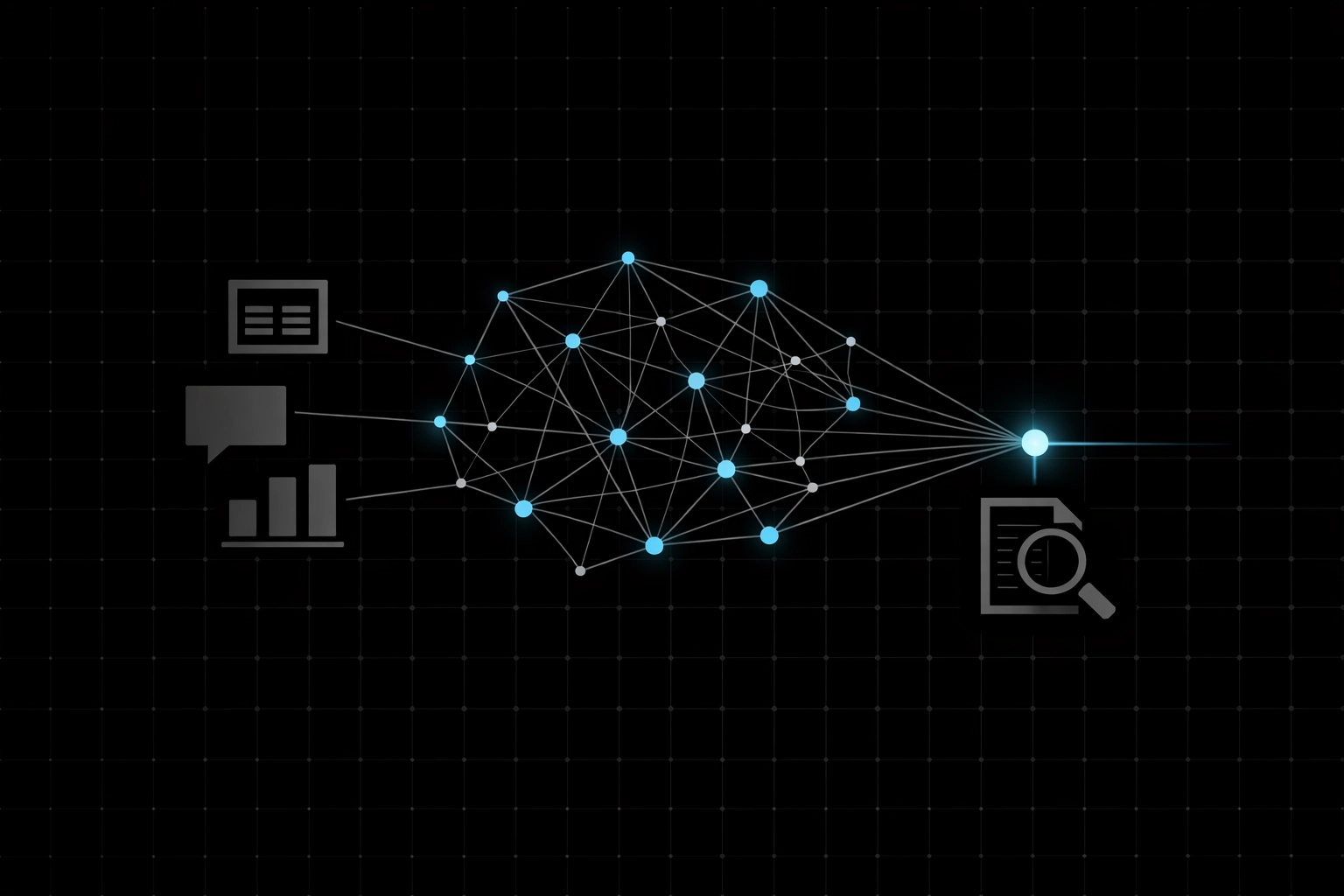
The research-first outbound AI SDR approach is different. Instead of just looking at a LinkedIn profile, a proper AI agent looks at:
- Recent news about the company.
- The prospect’s actual blog posts or podcasts.
- The specific tech stack they are using.
- Job postings (which signal what problems they are trying to solve).
This "Deep Research" USP is what separates a spam bot from a digital partner. If the AI can tell a prospect, "I saw you're hiring for a Head of Growth and just launched your SOC2 compliance: here’s how we help with that transition," the reply rates skyrocket.
At Ramen, we don't believe in "spray and pray." We believe in scaling outbound without agencies by using AI to do the heavy lifting of research that a human SDR would frankly get too bored to do.
Human-in-the-Loop: Why You Still Matter
We aren't promising magic. Any AI company that tells you to "set it and forget it" is lying to you.
The secret to a high-performing AI SDR team is the human-in-the-loop model. You are the expert on your business. You know your customers better than any algorithm.
With Ramen, the AI does the research and drafts the emails, but you have the final say. You approve the targets. You tweak the tone. You make sure it sounds like you.
This is especially critical for founders. Your reputation is your most valuable asset. You can't afford to have a bot hallucinating and promising features you don't have to a Tier-1 prospect. You give the AI the guardrails, and it gives you the scale.
The BYOK (Bring Your Own Key) Advantage
One of the biggest hidden costs in the AI space is the "hidden markup" on data. Platforms charge you a premium for every lead or every "credit."
We think that’s a racket.
With Ramen, we use a BYOK model. You bring your own API keys for the tools you already use or want to use. This gives you total control over your costs and your data. You aren't locked into our ecosystem; you’re using our intelligence to run your own. It’s the difference between renting a car and owning the engine.
Taking Back Your Runway
The math is simple.
- Human SDR: $10,000+ per month (fully loaded).
- Ramen AI Team: $499 per month.
For the price of a nice dinner in San Francisco, you can have a full-scale outbound operation that doesn't take vacations, doesn't need "1-on-1s," and won't quit to join a crypto startup the moment your lead flow dips.
If you’re a founder doing your own outbound, you know the "Sunday Night Scaries." You know the feeling of a week slipping by where you were too busy with customer support to send a single prospecting email.
You don't need a bigger team. You need a better system.
Stop letting hidden SDR costs kill your runway. Focus on building your product, and let an AI built for founders handle the grind of the pipeline.
Ready to see how it works? Check out our AI SDR agents and start booking demos without the $150k price tag.