
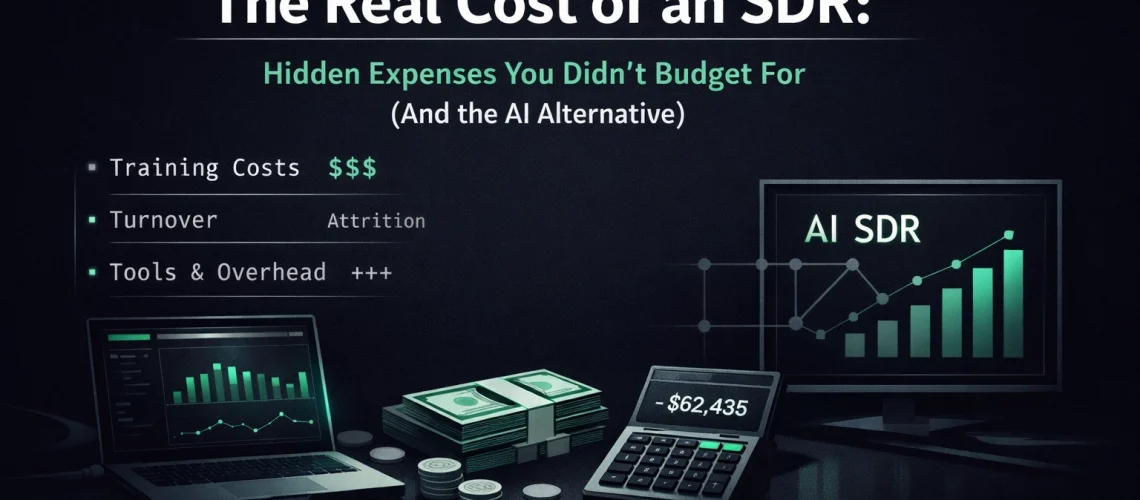
It’s 10:00 PM on a Sunday. You’re sitting at your kitchen table, scrolling through a spreadsheet of "leads" you bought from a guy on X, trying to write an email that doesn’t sound like a desperate plea for attention. You’ve got a product to build, a pitch deck to polish, and a team to lead.
You think to yourself, "I just need to hire an SDR. Someone to handle the grunt work so I can focus on the big stuff."
You look at the average base salary, maybe $50k or $60k, and think, "I can swing that."
But here’s the cold truth: the base salary is a lie. By the time you’re done paying for the taxes, the tech, the seat at the CRM table, and the three months it takes them to learn how to spell your company name correctly, that $60k hire is costing you closer to $150k.
And if they quit after four months? You’re not just back at square one; you’re in a hole.
If you’re an early-stage founder, hiring a human SDR is often the fastest way to burn through your seed round without actually filling your calendar. Let’s break down the real math of a sales hire and why the "old way" is failing founders in 2026.
The Sticker Price vs. The "Fully Loaded" Reality
When you see a job posting for an SDR with a $60,000 base, your brain does some quick math and thinks that’s about $5k a month. Manageable.
In reality, the "fully loaded" cost of an SDR is usually 2x to 3x their base salary. Research shows the actual cost typically sits between $110,000 and $160,000 per year.
Where does that extra $100k go?
First, there are the basics: payroll taxes, health insurance, 401k matching, and benefits. That adds about 25–30% right off the bat. Then there’s the recruiting fee. Unless you want to spend forty hours a week screening resumes yourself, you’ll pay a recruiter $10k to $15k just to find someone who might be a good fit.

The "Tech Stack Tax"
You can’t just give an SDR a laptop and a prayer. To be effective, they need tools. And those tools aren't cheap.
Most founders forget to budget for the SDR’s "backpack":
- LinkedIn Sales Navigator: $1,200/year.
- Data Providers (Apollo, ZoomInfo): $2,000–$5,000/year.
- Sales Engagement Platforms: $1,500/year.
- CRM Seat (Salesforce/HubSpot): $1,200/year.
- Email Verification & Warmup: $500/year.
Suddenly, you’re spending $8,000+ a year just on software for one person. And that doesn’t include the time you’ll spend fixing those tools when the integration breaks or the data goes stale. At Ramen, we’ve seen founders spend more on their SDR’s software than some startups spend on their entire AWS bill.
The Ramp-Up Period: Paying for Potential
This is the hidden cost that kills startups. A human SDR takes, on average, 4 to 6 months to become fully productive.
During months 1 and 2, they are effectively a net negative. You are paying them a full salary to sit in meetings, learn your product, and accidentally send "Hi {{first_name}}" emails to your most important prospects.
By month 3, they might start booking a few demos. By month 6, they might finally be hitting their quota.
If you’re paying $10k a month fully loaded, you’ve spent $60,000 before you even know if this person is actually good at their job. For a pre-seed or seed-stage company, that’s a massive gamble. You’re betting your runway on a 23-year-old’s ability to stay motivated while getting rejected 98 times a day.
The Management Burden (Or: Your New Full-Time Job)
Founders hire SDRs to save time. But ironically, a junior sales hire often takes more of your time.
Who is going to write the scripts? You.
Who is going to build the lead lists? You.
Who is going to coach them when they can’t handle an objection? You.
Unless you have a dedicated Sales Manager (another $150k expense), you are now the manager. You’ll spend 5–10 hours a week in 1-on-1s, reviewing calls, and managing their "morale."
When you factor in your own hourly rate as a founder, the cost of that SDR doubles again. You aren’t just paying for their salary; you’re paying for the fact that you aren't spending that time on product or high-level strategy.
The Turnover Death Spiral
Here is the most depressing stat in sales: the average tenure of an SDR is only about 14 months.
Think about that. It takes six months to ramp them up, you get eight months of decent productivity, and then they either get promoted, burned out, or poached by a Series B company with a ping-pong table and better snacks.
When they leave, you lose all that momentum. The "process" lived in their head. The follow-ups die in their inbox. You have to start the $15k recruiting process all over again.

The AI Alternative: Why $499/Month Beats $12,000/Month
The math is simple: a human SDR is a high-risk, high-cost asset. An AI SDR is a low-risk, fixed-cost utility.
At Ramen, we built a platform that handles the research-heavy, repetitive parts of outbound for a fraction of the cost. Here is how the AI SDR pricing breakdown actually compares:
| Expense | Human SDR | Ramen (AI SDR) |
|---|---|---|
| Monthly Cost | $9,000 – $13,000 | $499 |
| Ramp-Up Time | 4-6 Months | 4-6 Minutes |
| Management | 10 hours/week | 10 mins/day (approvals) |
| Tech Stack | Included in cost? No. | Bring Your Own Keys (BYOK) |
| Turnover | High | Zero |
Deep Research vs. Template Blasting
One of the biggest complaints founders have about AI is that it sounds like… well, AI. And they’re right. Most "AI" tools just blast out generic templates.
The difference with Ramen is the "Human-in-the-Loop" model. Our AI agents don't just send emails; they do deep research on every single prospect. They look at their LinkedIn, their recent posts, and their company news to find a genuine reason to reach out.
But here’s the kicker: you still have the final say. You approve every email before it goes out. It gives you the scale of an army of SDRs with the quality control of a founder-led sales process.
The BYOK Model (Control Your Costs)
Most AI platforms charge you a massive markup on data and email sending. We don't. We use a "Bring Your Own Key" (BYOK) model. You connect your own Apollo or Clay API keys. You pay the raw cost for data, and we provide the intelligence to use it effectively.
This means you aren't locked into some proprietary ecosystem. You own your data, you own your stack, and you save thousands in hidden markups.
Addressing the Elephant in the Room: "But I Want the Human Touch"
I get it. You think a human can "hustle" in a way an AI can't. You think a human can pick up the phone and charm a prospect.
Sure, a great SDR can. But how many "great" SDRs are looking to work at a 3-person startup for $60k? The great ones are already at Snowflake or AWS making $200k.
For the vast majority of early-stage companies, a human SDR is just a very expensive way to do mediocre work.
The AI doesn't get bored. It doesn't have "off" days. It doesn't forget to follow up because it had a long weekend. It does the research, drafts the personalized message, and puts it in front of you to click "Send."
The Chicken-and-Egg Problem
As a founder, you're caught in a trap. You can’t raise your next round without a solid pipeline. But you can’t build a pipeline because you’re too busy building the product.
You think you need a hire to fix it. What you actually need is a system.
Hiring an SDR before you have a repeatable, profitable outbound system is like pouring gasoline on a pile of wet wood. It’s expensive, messy, and it won't start a fire.
Ramen allows you to scale outbound without agencies or expensive hires. It gives you the infrastructure to test different niches, messaging, and ICPs for $499 a month. Once you find what works, then you can think about hiring a human to manage the flood of demos.
Is it time to replace your (planned) SDR?
If you were planning to hire an SDR this quarter, I want you to do one thing: take that $10,000 monthly budget and imagine what else you could do with it.
You could hire another engineer. You could double your ad spend. Or you could keep it in the bank and extend your runway by six months.
The "Real Cost" of an SDR isn't just the money. It's the distraction. It's the stress of managing someone else's performance when you're still trying to figure out your own product-market fit.
Stop trying to hire your way out of a process problem. Use AI to handle the research and the outreach, keep yourself in the loop to ensure quality, and focus your energy on the only thing that matters: closing the deals that come in.
If you’re tired of the "Sunday night spreadsheet" and aren't ready to drop $100k+ on a junior hire, it might be time to see how AI agents can book demos for you instead.
No recruiters. No ramp-up. No "Hi {{first_name}}" mistakes. Just outbound that actually works.
Ready to fix your outbound?
The era of the $150k junior SDR is over for early-stage teams. You don't need a head on a seat; you need meetings on your calendar. See how Ramen works and get back to building.