
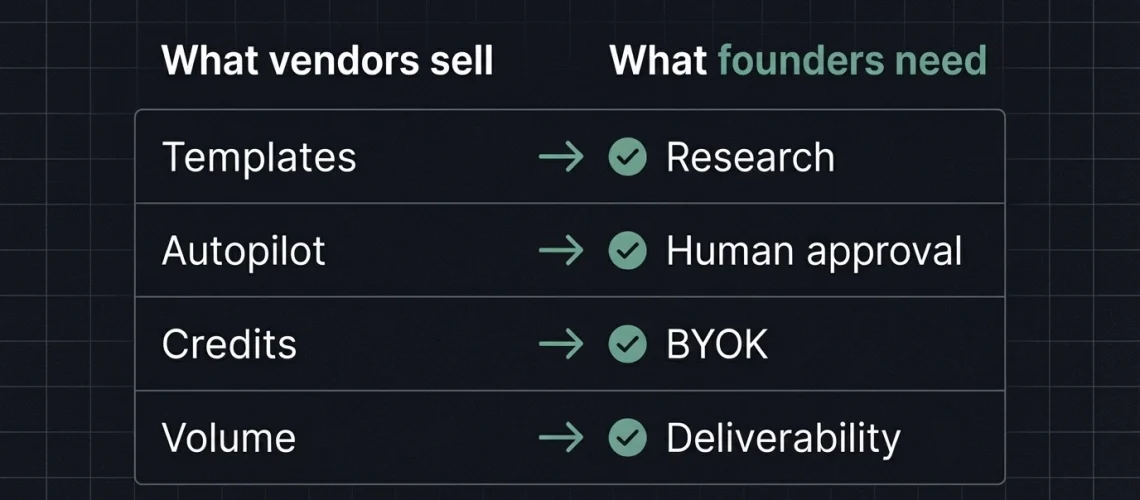
You're building product, chasing intros, and still writing cold emails on Sunday night. You need pipeline to raise, but you can’t afford an $80–120K SDR or another burned domain from a spray-and-pray agency.
Most “best tools” posts won’t help. This page is a practical category guide for AI SDR and AI sales assistant tools—how they work, what to test, and the tradeoffs you’ll actually feel at 3 AM.
Use it as an evaluation framework to compare vendors, map alternatives, and decide what fits your stage and risk tolerance.
AI SDR vs. AI Sales Assistant: Category Overview
- AI SDR: outbound-first agent that researches prospects and drafts/sends outreach across email and LinkedIn, with human approval when needed.
- AI sales assistant: response-first assistant that qualifies replies, books meetings, and routes conversations; often strongest on inbound and post-reply follow-ups.
- Overlap: research, drafting, and follow-ups.
- Key difference: who initiates contact (outbound vs. respond-and-qualify) and how much human oversight you want.
Research Depth: Template Blasting vs. Actual Intelligence
The biggest difference between tools isn't their AI model: it's whether they research before they write.
Template-based systems pull a company name and job title, then fill in Mad Libs-style personalization. "Hi {{firstName}}, I noticed {{company}} is in {{industry}}…" This worked in 2022. It's spam in 2026.
Research-first systems dig into recent company news, funding announcements, job changes, technology stack, and hiring patterns before crafting outreach. They're looking for trigger events and genuine reasons to reach out now versus next quarter.
Ava and Persana AI lead here. Ava researches each prospect through LinkedIn data and builds individualized messaging. Persana's Nia agent pulls from 100+ data sources to identify high-intent prospects and track buying signals. Both systems understand context beyond basic demographics.
Jason AI by Reply.io and AiSDR focus on dynamic personalization based on prospect behavior rather than static company data. They adapt messaging based on engagement patterns, not just whether someone fits your ICP on paper.
The test: ask for examples of the research inputs each tool uses. If they show you company size and industry, keep looking. If they show you recent funding rounds, executive changes, and technology adoptions, you're on the right track.
Human-in-the-Loop: Control Without Micromanagement
The "fully autonomous" versus "AI-assisted" divide matters more than most founders realize. You need approval gates without turning into a bottleneck.
Fully autonomous tools like Ava operate independently after initial setup. They research, write, and send without human intervention. This works if you trust their judgment and can handle occasional misses. The trade-off is speed versus control.
Human-approval systems require sign-off before sending. This prevents disasters but creates a new full-time job if every email needs review. The key is intelligent filtering: showing you only the emails that need human judgment, not every single message.
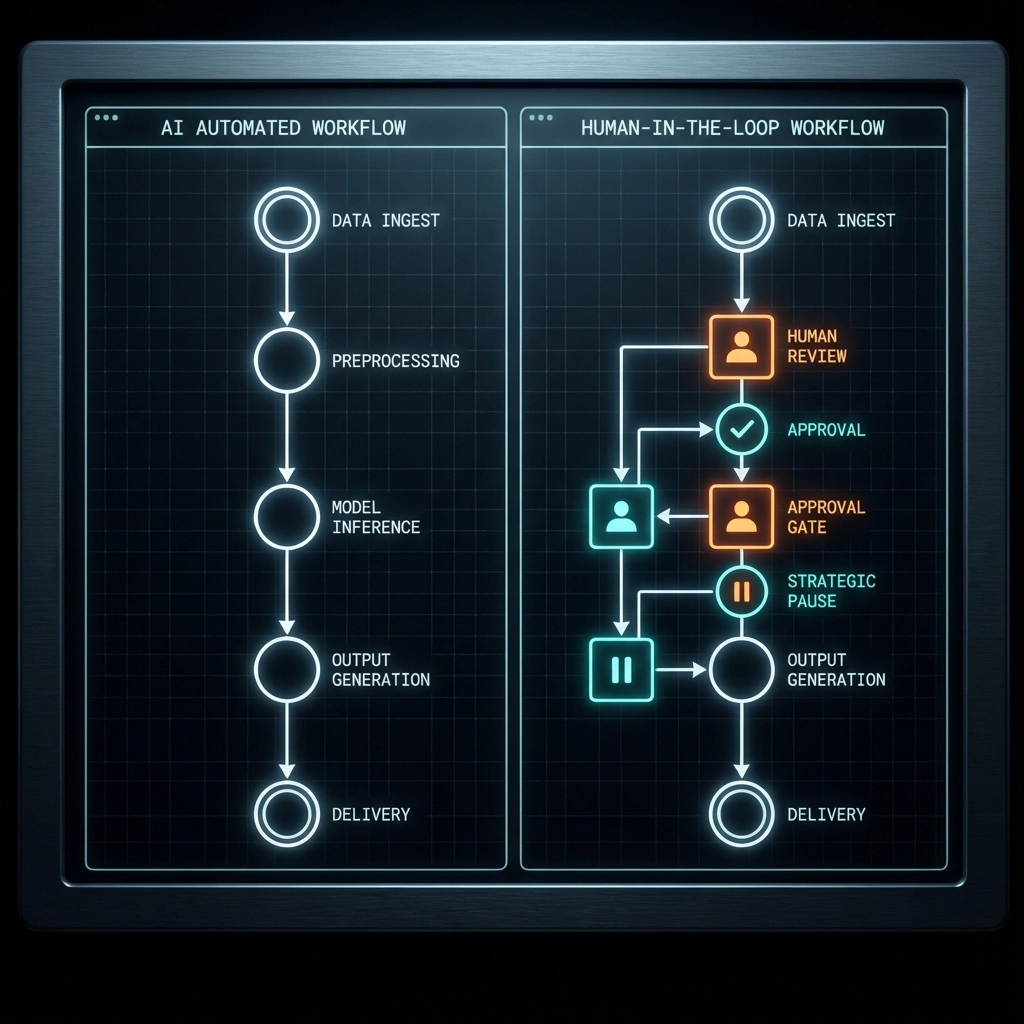
Smart handoff systems bridge this gap. They handle qualification, scoring, and initial engagement autonomously, then trigger human involvement when prospects show genuine interest. Default and Conversica excel here: they engage inbound leads, ask qualifying questions, and only route qualified prospects to your calendar.
The critical feature: escalation rules. You want systems that know when to ask for help rather than guessing. Look for tools that surface unclear responses, competitor mentions, or complex technical questions for human review.
Cost Models: Transparency vs. Markup Games
AI SDR pricing has three models: per-seat subscriptions, per-email credits, and API passthrough. The differences matter more than the sticker price.
Per-seat subscriptions ($200-500/month) work if you need consistent volume and predictable costs. Most established players (Reply.io, Outreach, Salesloft) use this model. You pay the same whether you send 1,000 emails or 10,000.
Credit-based pricing charges per email sent or prospect researched. This scales with usage but can get expensive fast. Ava falls into this category: powerful but costly as you scale.
API passthrough (BYOK – Bring Your Own Keys) lets you connect your own OpenAI, Anthropic, or other API accounts directly. You pay API providers directly plus a platform fee. This is usually 5-10x cheaper than credit-based systems for the actual AI costs.
The markup problem: most tools charge $0.50-1.00 per AI-generated email when the actual OpenAI cost is $0.05-0.10. You're paying 10x markup for convenience. BYOK eliminates this markup but requires managing your own API relationships.
Cost per qualified meeting is the only metric that matters. A tool that sends 1,000 emails and books 5 meetings costs less than a tool that sends 100 emails and books 8 meetings, even if the per-email cost is higher.
Deliverability: Reputation Protection Over Volume
Most AI SDR tools can send emails. Few protect your domain reputation while doing it.
Volume-focused systems prioritize email quantity over deliverability health. They'll send 500 emails per day from a single domain until it gets blacklisted. This kills your email reputation permanently.
Deliverability-conscious systems monitor sender reputation, rotate domains intelligently, and adjust sending patterns based on engagement rates. They understand that 50 emails that reach the inbox beat 200 emails in spam folders.
Key features to evaluate:
- Domain rotation capabilities
- Bounce and complaint monitoring
- Automatic throttling based on deliverability metrics
- SPF/DKIM/DMARC configuration guidance
- Integration with email warm-up services
Persana AI and AiSDR both include deliverability monitoring. Jason AI provides detailed deliverability analytics and domain health tracking. Look for tools that treat deliverability as a core feature, not an afterthought.
Integration Reality: Your Stack vs. Their Requirements
AI SDR tools live in ecosystems. The integration quality determines whether you get a seamless workflow or a daily data entry nightmare.
CRM sync is table stakes. Every tool claims Salesforce and HubSpot integration. The difference is bidirectional sync: updating prospect status, logging activity, and syncing deal stages in real-time versus batch uploads that break when someone manually updates a record.
Data provider integration matters more. Tools that integrate directly with Apollo, ZoomInfo, or Clearbit provide richer prospect data than tools that require manual CSV uploads. This affects research quality and personalization depth.
Multi-channel orchestration separates modern AI SDRs from glorified email tools. The best systems coordinate email, LinkedIn, phone calls, and targeted ads in unified sequences rather than treating each channel separately.
AI SDR Alternatives and When to Use Them
- DIY sequences in HubSpot/Outreach/Salesloft: maximum control and lowest software cost, but you trade time. Good if you’re sending <200 targeted emails/week and want to learn messaging yourself.
- Agency or VA: quick to spin up, but high template risk and domain damage if they chase volume. Works only if you enforce research standards and own the sending domains.
- Hire a human SDR: context and judgment you can’t fake, but expect $80–120K loaded cost and 2–3 months to ramp. Hard to justify pre-seed.
- Hybrid (tool + your review): AI handles research and drafting; you approve before send. Scales faster than DIY without giving up control.
Who it’s for:
- Pre-seed/solo founder: hybrid or DIY until you prove a lane.
- Seed to Series A: configurable AI + human-in-the-loop, with clear escalation rules and CRM sync.
Evaluation Framework: What to Test Before Committing
Skip the demos. Request trial access and run these tests:
Research quality test: Give the tool 20 prospects from your target ICP. Compare the research depth and personalization quality. Count how many emails feel like they could only be sent to that specific person versus generic messages with names swapped.
Approval workflow test: Set up the human-in-the-loop process and run 50 prospects through it. Measure how many emails require your review versus auto-approval. Look for intelligent filtering that surfaces edge cases without overwhelming you.
Cost tracking test: Monitor actual costs versus quoted estimates. Track API usage, email volume, and research costs separately. Many tools underestimate real usage by 2-3x in their estimates.
Deliverability monitoring test: Run a small campaign and track delivery rates, spam folder placement, and domain health metrics. Any tool that doesn't provide this data is treating deliverability as your problem, not theirs.
Making the Decision: Build vs. Buy vs. Hybrid
The reality most founders don't want to hear: no AI SDR tool is perfect out of the box. They all require configuration, testing, and ongoing optimization. The question is which problems you want to solve versus which ones you want the tool to handle.
Full-service platforms like Ava and Persana AI handle everything but cost more and offer less control. Workflow builders like Jason AI and AiSDR provide flexibility but require more setup. Hybrid approaches combine AI assistance with human oversight for qualified handoffs.
The right choice depends on your stage, team size, and risk tolerance. Pre-seed founders with no sales team benefit from full-service automation. Series A teams with dedicated sales ops benefit from configurable workflows with human approval gates.
Glossary: Common terms in this category
- AI SDR: software agent that runs outbound research, drafting, and follow-ups for prospecting. Think “virtual SDR” with approval gates.
- AI sales assistant: assistant that handles responses, qualification, scheduling, and routing in email/chat once a conversation starts.
- Outbound sales automation: systems that coordinate prospect research, sequencing, and multi-channel outreach (email, LinkedIn, phone) with tracking.
- Human-in-the-loop: approval or review step before send or before escalation. Reduces risk without forcing you to read every message.
- BYOK (Bring Your Own Keys): connect your own AI API accounts (OpenAI, Anthropic, etc.) so you pay usage directly instead of per-credit markups.
- Deliverability: your ability to land in the inbox. Driven by domain reputation, list quality, and sending patterns.
- ICP (Ideal Customer Profile): the segment you’re targeting based on company and persona traits.
- Qualified meeting: a booked call where the prospect has budget, problem, and timing that matches your criteria.
FAQ: AI SDR and AI sales assistant
What is an AI SDR vs. an AI sales assistant?
AI SDR tools initiate outbound, research prospects, and draft personalized emails. AI sales assistants focus on replies, qualification, and scheduling. Many platforms claim both—check who initiates and where human approval sits.
Does an AI SDR replace a human SDR?
Not fully. Expect AI to handle research, writing, and follow-ups. Humans set strategy, approve edge cases, and run live calls. The sweet spot is AI + human-in-the-loop.
How much does an AI SDR cost in 2026?
Seat-based tools run ~$200–500/month. Credit-based tools charge per email/research and can spike as you scale. BYOK models route AI usage to your own API accounts and are usually 5–10x cheaper on generation costs.
Will an AI SDR hurt my domain reputation?
It shouldn’t—if the platform manages domain rotation, throttling, bounce/complaint monitoring, and list quality. Volume-first sending is what burns domains.
What data sources matter for research-based personalization?
Recent funding, hiring trends, tech stack, product updates, executive moves, and relevant content. If a tool only shows company size/industry, keep looking.
Is BYOK actually cheaper than credits?
Usually yes. Many tools mark up AI generation 5–10x. With BYOK you pay the provider directly and keep cost visibility.
Can I run AI SDR if I’m pre-seed with a new domain?
Yes, but warm it first, start with low daily volume, and focus on smaller, high-quality lists. Approval gates help keep early sends tight.
What reply rate should I expect?
For targeted outbound with genuine research, 2–5% positive reply is a realistic band. Templates and spray-and-pray typically fall below 1%.
Do I need LinkedIn steps?
It helps for certain personas. The priority is still targeted lists, strong research, and clean email deliverability.
How do I evaluate deliverability health?
Track inbox placement, bounce rate, complaint rate, domain reputation, and engagement. Look for automatic throttling and clear health dashboards.
The Control You Actually Need
The best AI SDR tools give you Sunday nights back without risking your domain reputation or sending emails you'd never approve. They research deeply enough to write emails that sound human, provide approval workflows that don't create bottlenecks, and use transparent cost models that scale with your success rather than your usage.
The evaluation process takes time, but getting it wrong costs months of burned domains, wasted prospect lists, and damaged relationships with your target market.