
You just burned through $15K on a freelance SDR who sent 2,000 emails and booked three demos. Two were tire-kickers. One ghosted after the first call.
Now you're looking at Apollo's "buy 10,000 leads for $999" offer, thinking maybe the problem was the list. Maybe if you just had better data, that contract SDR would've performed. Maybe you need to try one more agency that promises "qualified leads."
Here's the truth nobody wants to tell you: hiring a contract SDR and buying leads aren't solutions to your pipeline problem: they're symptoms of not having a repeatable outbound system.
This post breaks down why the contract SDR model almost always fails early-stage companies, why buying leads makes it worse, and what actually works when you're pre-product-market-fit and can't afford to waste another dollar on pipeline experiments.
Why Contract SDRs Seem Like the Perfect Solution
The pitch is compelling. You can't afford the $80-120K loaded cost of a full-time SDR. You don't have time to do outbound yourself. A freelance SDR or contract recruiter promises to handle it for $3-5K/month with no benefits, no ramp time, and "proven templates."
You get sold on their LinkedIn profile showing 200+ demos booked at their last company. They've got testimonials. They know the tools. They say they can start Monday.
What you don't see: that SDR booked those demos using established brand awareness, a marketing engine feeding them inbound leads, and a CRM full of warm relationships from their account executive. They had enablement, coaching, and clear ICP documentation.
You're giving them none of that. You're handing them a target list you Googled, a Mailshake account, and saying "go book meetings."

The Hidden Math That Kills Contract SDR Deals
Let's run the actual numbers on a typical contract SDR arrangement:
Month 1: Contract SDR spends two weeks "learning your product" and setting up their stack. They send 400 emails using a template they've used at five other companies. Zero replies because the messaging is generic and your product isn't Salesforce.
Month 2: They blame the list. You buy 5,000 "verified" contacts from ZoomInfo for $2K. They send another 800 emails. You get 12 replies, mostly "not interested" or "remove me from your list."
Month 3: They suggest trying LinkedIn outreach. You approve another $500 for Sales Navigator. They send 300 connection requests with a pitch in the first message. 40 people accept and immediately unmatch.
Total investment: $9-15K in SDR fees, $2-3K in tools and data, 90 days of runway burned.
Total qualified pipeline: Maybe one deal if you're lucky. More likely zero.
The freelance SDR moves on to their next client. You're left with burned domains, a trashed sender reputation, and no closer to understanding what messaging actually resonates with your ICP.
Why Buying Leads Compounds the Problem
Here's where founders double down on the wrong solution. The contract SDR didn't work, so clearly the issue must be data quality, right?
You start shopping for leads. Apollo promises 275 million contacts. Instantly.ai offers "unlimited leads" with their sending platform. An agency pitches you on their "proprietary database of decision-makers."
Every single one of these is selling you the same recycled contact lists that 10,000 other startups are already emailing.
When you buy leads in bulk, you're getting:
- Email addresses that have been sold 47 times in the past six months
- Job titles that were accurate in 2022
- "Decision-makers" who've set up filters to auto-archive anything mentioning the words you're about to use
- Generic company data with zero context about what problems they're actually trying to solve
You're not buying leads. You're buying permission to spam people who've already ignored 200 emails exactly like yours.
The contract SDR takes your purchased list and blasts through it using the same templates they ran at their last three clients. Your domain reputation tanks. Your open rates drop to 8%. The few people who do reply are asking to be removed.
You've now paid twice: once for bad data, once for someone to ruin your sending infrastructure with that bad data.
The Long-Term Damage You're Not Calculating
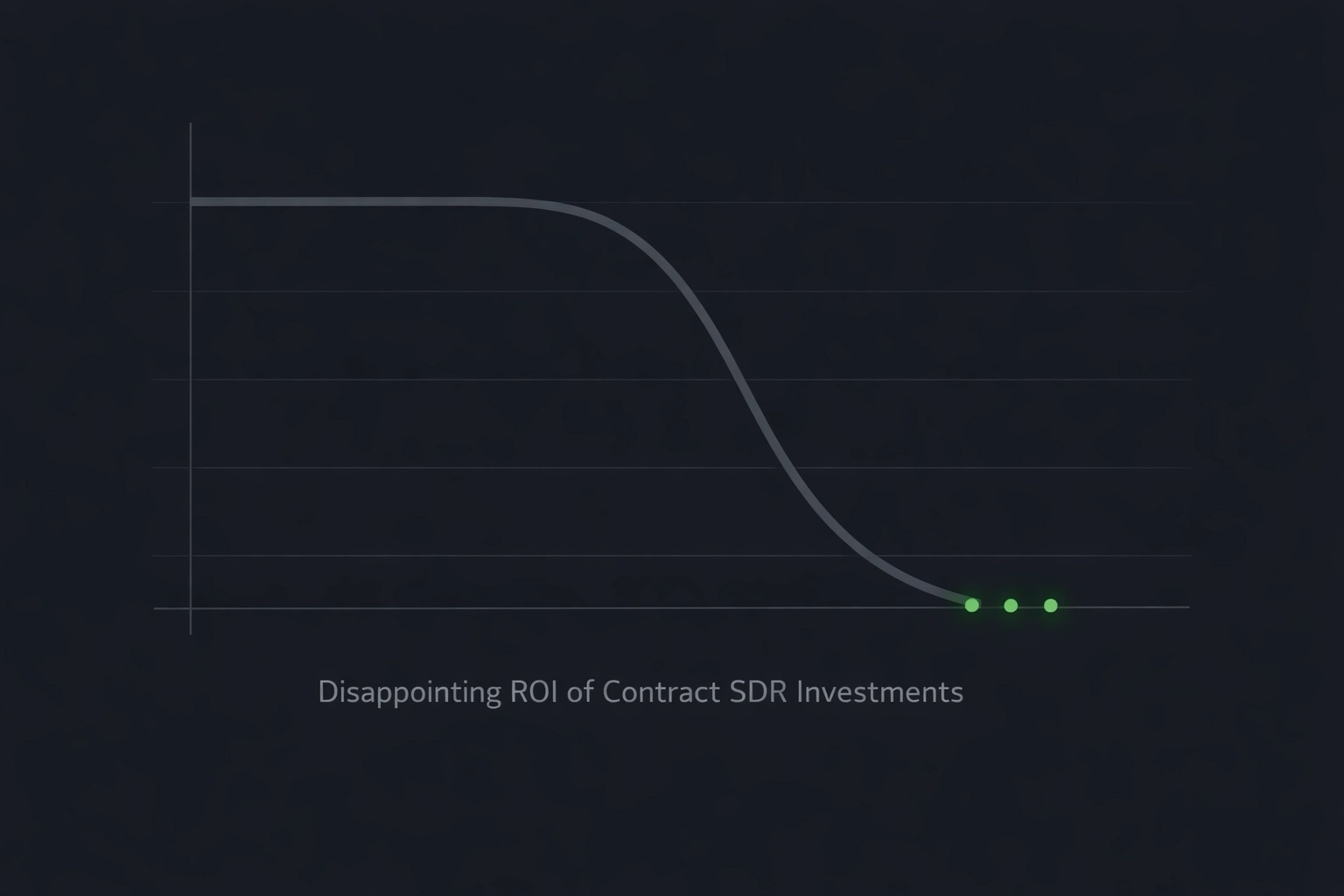
The real cost of the contract SDR plus bought leads approach isn't the $15K you spent. It's what you've destroyed:
Your domain reputation: Once Gmail and Outlook flag your domain as spam, it takes months to rebuild trust. Every future email you send: even good ones: goes to spam or gets blocked entirely.
Your brand in the market: The 3,000 people who got your generic, irrelevant cold email now associate your company with spray-and-pray outbound. When they actually do need what you sell six months from now, they've already mentally filed you under "annoying vendor."
Your understanding of your ICP: You learned nothing from this experiment except "cold email doesn't work." But that's not true: badly targeted, poorly researched, template-blasted cold email doesn't work. You still have no idea what resonates with your actual best-fit customers because you never talked to them as individuals.
Your confidence in outbound as a channel: Now you're gun-shy about email entirely. You pivot to "content marketing" or "community building" even though you need pipeline next quarter, not next year.
What Actually Works When You Can't Afford a Full-Time SDR
The companies that make early-stage outbound work aren't hiring contract SDRs or buying lead lists. They're doing three things differently:
1. They're researching accounts individually, not blasting lists
Instead of sending 100 emails a day to strangers, they're sending 15 emails a day to people they've actually researched. They know what tools the prospect uses, what problems their company is facing, and why their product specifically helps.
2. They're testing messaging themselves before delegating
The founder writes the first 200 emails manually to learn what resonates. Only after you've booked 20 demos yourself do you have enough signal to teach someone else how to do it.
3. They're using tools that force quality over quantity
This is where something like Ramen makes sense: not as a replacement for thinking, but as a system that enforces the research-first approach. You can't blast 10,000 contacts because Ramen is designed to deeply research 50 at a time. You approve every email before it sends, so you're learning what works instead of outsourcing that learning to a freelancer who doesn't care about your company after this month's invoice.
The SDR costs are the same whether you're paying a contract recruiter $4K/month or using an AI tool at $499/month. The difference is whether you're building a repeatable system you understand or just renting someone else's broken playbook.
"But I Don't Have Time to Do Outbound Myself"
This is the objection that drives founders toward contract SDRs in the first place. You're building product. You're trying to fundraise. You've got 11 fires burning and outbound is just one more thing you can't get to.
Here's the hard truth: if you don't have time to write 15 thoughtful emails a day for two weeks, you definitely don't have time to fix the mess a contract SDR will create.
Delegating outbound before you understand it yourself is like hiring a contractor to build your house before you know what rooms you need. You'll spend six months and $30K learning that you optimized for the wrong thing.
The time investment to do research-driven outbound correctly is about 45-60 minutes a day. That's less time than you'll spend on damage control calls with angry prospects who got spammed, or Slack threads with your contract SDR explaining why the demos they booked were all unqualified.
The Alternative: Build the System, Then Scale It
Stop looking for someone to do outbound for you. Start building a system you can eventually hand off.
Spend two weeks sending highly researched emails yourself. Learn what subject lines get opened. Learn what pain points make people reply. Learn which ICPs are actually ready to buy versus which ones are just curious.
Once you've booked 15-20 demos from your own outbound, you have a system. You know what good looks like. You can document the research process, the messaging frameworks, and the qualification criteria.
Then you can hire someone: whether that's a contract SDR, a full-time person, or an AI system: to execute what you've proven works.
The contract SDR who fails on day one succeeds on day 90 when you can show them exactly what to do because you've done it yourself first.
If you're doing outbound as a founder and need a system that forces research over spray-and-pray, Ramen is built for exactly this. Bring your own API keys, approve every email before it sends, and actually learn what works with your ICP instead of burning domains on templates. No contracts, no bought leads, just research-driven outbound that respects your time and your prospects' inboxes.