
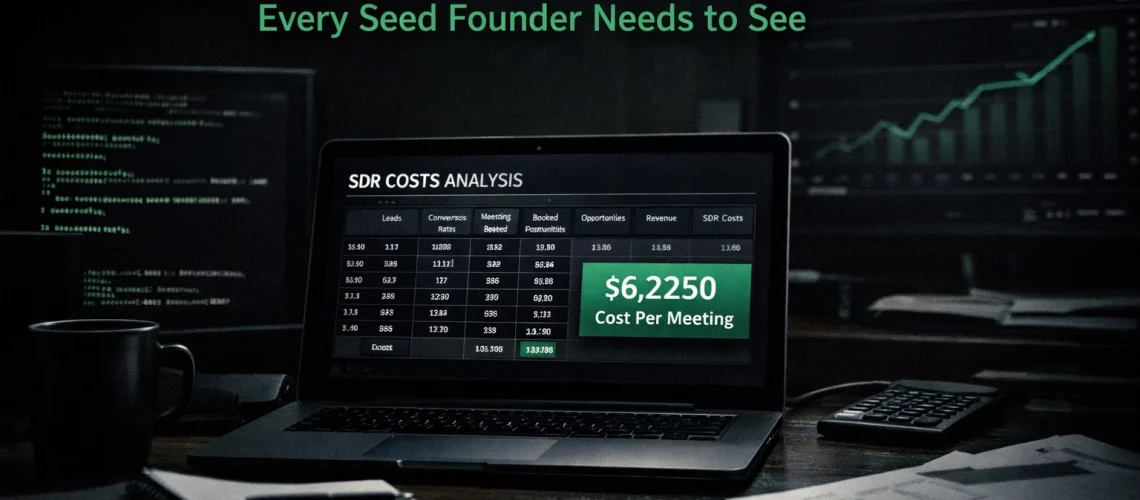
You finally did it. After months of founder-led outbound from your personal email, you convinced yourself it's time to hire an SDR. You post the role at $65K OTE, tell yourself it's an investment in growth, and mentally prepare for the hit to your runway.
Then reality shows up with a bill you didn't see coming.
That $65K becomes $120K when you add payroll taxes, benefits, a laptop, and the recruiter fee. But here's the part that breaks founders: the real SDR costs don't stop at salary. They multiply. Fast.
Here's the spreadsheet most seed founders see too late, and why the unit economics of traditional SDRs haven't worked since 2019.
The OTE Trap
Let's start with the number everyone quotes: $65K OTE for a junior SDR. Sounds reasonable until you realize OTE means "on-target earnings", base plus commission if they hit quota.
Your actual costs look like this:
Base salary: $50K
Payroll taxes + benefits: $12K
Recruiter fee (20%): $13K
Equipment + software: $3K
First-year total: $78K
And that's before they send a single email.

Now add ramp time. A good SDR takes 3 months to hit their stride. That's $19,500 in cash out the door while they learn your ICP, your pitch, and how to handle objections they've never heard before. During those 90 days, your pipeline stays empty and your board deck starts looking thin.
The trap isn't the OTE number itself. It's that everyone optimizes for sticker price while ignoring loaded cost and time-to-productivity. You can't afford to burn three months of runway on training when you're nine months from breakeven.
Why SDR Tools Cost More Than the SDR
Here's where the spreadsheet gets painful.
Your SDR needs tools. Not "nice to have" tools, table stakes tools that make modern outbound possible. Let's build the stack:
Apollo or ZoomInfo: $12K/year for decent contact data
Outreach or SalesLoft: $6K/year for sequencing
LinkedIn Sales Navigator: $1K/year
Email warmup + infrastructure: $1.2K/year
Data enrichment (Clearbit, etc.): $3K/year
CRM seats and automation: $1.5K/year
Annual tool cost: $24,700
Do the math. Your SDR's tools cost 38% of their base salary. And none of these tools run themselves, your SDR spends 40% of their day managing the stack instead of writing emails or researching prospects.
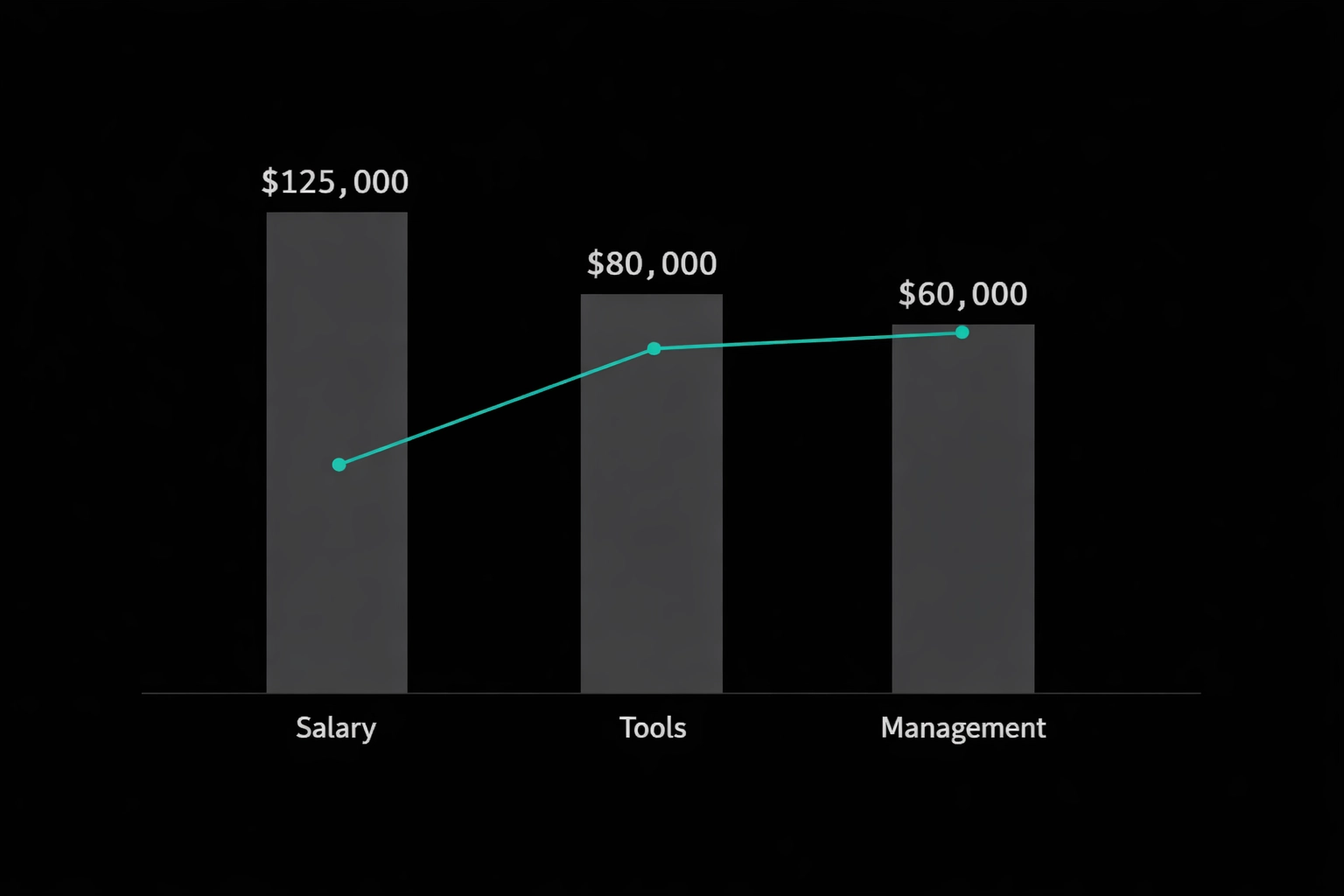
The worst part? These costs scale linearly. Hire two SDRs, double your tool spend. Three SDRs, triple it. There's no leverage, no efficiency gain, no unit economics that improve as you grow.
You're not building a pipeline machine. You're funding a cost center that compounds with every hire.
The Management Tax Nobody Talks About
Your first SDR hire creates a second problem: who manages them?
If you do it yourself, congratulations, you just added 10 hours per week to your calendar. Weekly 1:1s, pipeline reviews, coaching on emails, handling objections, adjusting messaging. That's 520 hours per year of founder time you could've spent on product, fundraising, or closing deals yourself.
Hourly cost of your time as founder (assuming $150K founder salary equivalent): $75/hour
Annual management tax: $39,000
If you hire a sales manager instead, add another $100K in salary, benefits, and recruiter fees. Either way, you're underwater before your SDR books their first meeting.
This is the part of SDR costs that never shows up in budget spreadsheets but eats runway faster than anything else. You can't delegate lead gen without delegating management, and early-stage companies can't afford either.
The AI Unit Economic Revolution
Now let's run the same spreadsheet with AI SDR economics.
AI SDR platform: $500-2K/month ($6K-24K/year)
Your own API keys (OpenAI, etc.): $200-500/month ($2.4K-6K/year)
Email infrastructure: $100/month ($1.2K/year)
Your time (5 hours/week reviewing and approving): $19,500/year
Total annual cost: $29,100 to $50,700
That's 40-60% less than a junior SDR's loaded cost: and you skip the 3-month ramp entirely. More importantly, the unit economics flip. Instead of costs scaling linearly with headcount, your marginal cost per additional email approaches zero.

Want to 10x your outbound volume? With a human SDR, that means 10x your team and 10x your costs. With AI, it means approving more emails. The leverage is absurd.
The objection everyone raises: "But AI emails are generic spam."
Fair. Most AI SDR tools are exactly that: template blasters with a GPT wrapper. But that's a tool problem, not an AI problem. The breakthrough happens when you pair AI research capabilities with human judgment. AI reads the prospect's LinkedIn, their company's recent funding announcement, and their job posting for a sales ops hire. Then you decide if the angle is relevant before anything sends.
That's not spam. That's deeply researched outbound at a scale human SDRs can't touch: because no human can research 50 prospects per day and write custom emails for each one without burning out in two weeks.
The Real Cost: Opportunity Cost
Here's the number that doesn't fit in a spreadsheet: what could you have built with that $120K?
Six months of product development. A year of runway. Your next key hire. Every dollar you spend on SDR costs is a dollar you're not spending on the thing that actually differentiates your company.
Early-stage founders operate in a world of constrained resources and unconstrained problems. You're trying to build product, close early customers, keep investors updated, and somehow generate pipeline: all while your bank account ticks down every month.
The traditional SDR model forces you to make a binary choice: hire an expensive person who might work out, or keep doing founder-led outbound until you burn out. Both options suck.
AI SDRs give you a third option: automate the research and drafting, keep the human judgment and relationship-building. You're not replacing yourself. You're removing the parts of outbound that drain your time without adding strategic value.
What This Means for Your Spreadsheet
If you're a seed founder staring at a hiring decision, run this comparison:
Traditional SDR total cost (year one): $120K-150K
AI SDR total cost (year one): $30K-50K
Savings: $70K-100K
That savings isn't just budget headroom. It's 2-3 extra months of runway. It's the difference between scraping to default alive and having breathing room to find product-market fit.
The spreadsheet isn't about humans vs. AI. It's about unit economics that make sense for early-stage companies. If you had $5M in ARR and predictable pipeline, hire the SDR team. But if you're pre-seed or seed, still figuring out messaging, and burning cash faster than you're comfortable with: the math points one direction.
If you're tired of choosing between expensive SDRs and burning Sundays on outbound, Ramen handles the research and drafting while you keep control of every message. Bring your own API keys, approve what sends, and stop paying for headcount you can't afford yet.