
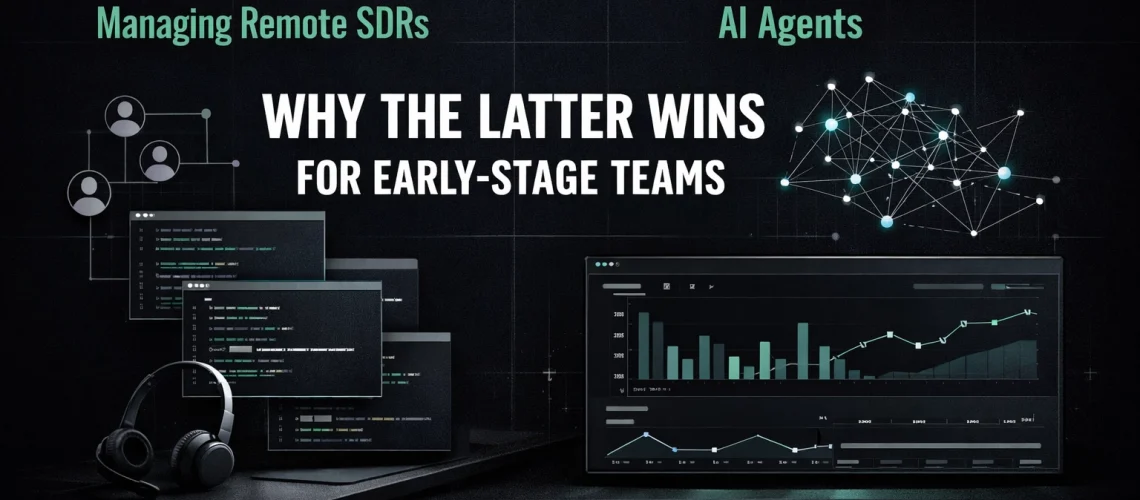
It's 11 PM your time. Your remote SDR in the Philippines just pinged you on Slack asking about territory assignment. Your EMEA hire sent three follow-up questions about the ICP that you already answered twice. And your contractor in South America still hasn't logged activity from yesterday's calls. You're managing three time zones, running async standups, and somehow still writing half the outbound emails yourself because "the messaging needs work."
This is the reality of managing remote SDRs as an early-stage founder. You thought you were hiring leverage. Instead, you hired a part-time management job.
AI agents don't have this problem. They work when you sleep, don't need coaching calls, and scale without adding Slack channels. For most seed-stage teams, that's not a nice-to-have, it's the difference between running outbound or letting it die on your to-do list.
The Management Cost of Remote Teams
When you hire a remote SDR, you're not just paying their salary. You're paying for onboarding, training, weekly 1-on-1s, performance reviews, territory planning, CRM hygiene checks, and the mental overhead of being someone's manager when you're supposed to be building product.
The numbers make this clear: human SDRs take 3-6 months to reach full productivity. During that ramp period, you're burning $6,000-$10,000 per month on salary while getting maybe 30% of the output you actually need. For an early-stage team with $200K in the bank, that's a real problem.
And it's not just the ramp time. Remote SDRs require continuous management. You need to review their emails, coach them on objection handling, help them prioritize accounts, and constantly course-correct when they drift off-message. Every weekly 1-on-1 is an hour you're not spending on product, fundraising, or talking to customers yourself.

Then there's the time zone issue. If you're in Chicago and your SDR is in Manila, you've got maybe 2-3 hours of overlap per day. That means async communication for everything, which sounds efficient until you realize it adds 12-24 hour delays to every decision. A simple question about whether to prioritize enterprise or mid-market can turn into a two-day Slack thread.
The hidden cost? Context switching. Managing a remote SDR means you're pulled into sales operations constantly. You're the sales manager, the enablement team, and the quality control all at once. For a founder who's already wearing six hats, adding "remote team manager" to the list isn't sustainable.
Why AI Doesn't Need a Weekly 1-on-1
AI agents operate in a fundamentally different model. There's no onboarding period. No ramp time. No weekly check-ins to review performance or realign on messaging. You configure the agent once, approve the research and emails it generates, and it runs.
This isn't about replacing human judgment, it's about eliminating management overhead. With tools like Ramen, you're still in the loop. You approve every email before it sends. You review the prospect research. You adjust the ICP or messaging when something's not working. But you do it on your schedule, not in a recurring Zoom call every Thursday at 2 PM.
The productivity gains are immediate. AI SDRs can process hundreds to thousands of prospects simultaneously while a human SDR manages 50-100 contacts at most. And they do it without needing you to explain the value prop for the third time or remind them to log activity in the CRM.
There's no "sorry, I was sick" or "I'm taking PTO next week." AI agents work 24/7 across every time zone without needing coverage. If a prospect in Singapore replies at 3 AM your time, the AI can handle initial qualification and route it to you when you wake up. A remote SDR would leave that lead waiting 12+ hours for a response.
And here's what nobody talks about: the emotional labor of managing people. Giving feedback, handling underperformance, navigating cultural differences in work style: it's exhausting. AI agents remove that entirely. If the output isn't right, you adjust the configuration. No difficult conversations required.
Instant Scalability Without the Hiring Overhead
Scaling outbound with remote SDRs means recruiting, interviewing, onboarding, training, and waiting 3-6 months for them to hit their stride. If you want to go from 100 emails a day to 500, you're looking at hiring 3-4 more people and dealing with all the complexity that comes with it.
AI agents scale instantly. Want to double your outbound volume? Expand your ICP definition and let the system handle it. Need to run three different outbound motions simultaneously: one for enterprise, one for mid-market, one for a specific vertical? Configure it once and let it run. No additional headcount required.

The ROI difference is stark. Companies implementing AI SDRs see a 25% increase in sales-qualified leads and a 30% reduction in sales costs within the first year, with the investment typically paying for itself within six months. Compare that to hiring a $6,000/month remote SDR who takes half a year to ramp and might churn after 12 months: right when they're finally effective.
For early-stage teams, this matters more than it does for established companies. You don't have the runway to wait six months for an SDR to hit quota. You don't have the cash to carry underperformers or burn through multiple hires to find the right fit. AI agents let you move fast without the hiring risk.
And when you do eventually hire a human SDR, they can focus on the high-value work: complex deals, relationship development, closing: while AI handles the top-of-funnel grind. That's a better use of your first sales hire than having them send 100 cold emails a day.
The "But What About Cultural Fit?" Objection
The biggest pushback on AI SDRs comes down to one thing: relationships. "Sales is about people. You need someone who understands the buyer. Cultural fit matters."
All true. Except here's what actually happens with remote SDRs at early-stage companies: you hire someone talented who's great at building relationships, and then you have them send 100 cookie-cutter cold emails a day. That's not relationship-building. That's data entry with a friendly tone.
Human SDRs achieve about 25% conversion rates on qualified conversations compared to AI's 15%: but that's when they're actually in a conversation. The problem is getting to that conversation in the first place. AI agents excel at the high-volume, repetitive top-of-funnel work that doesn't require emotional intelligence. They qualify based on fit, not feelings.
The cultural fit argument assumes you have the luxury of a long sales cycle and warm introductions. Most early-stage teams don't. You're doing cold outbound to strangers who've never heard of you. The first touchpoint isn't about empathy: it's about relevance. Did you do your research? Does your message prove you understand their problem? That's where AI agents shine.
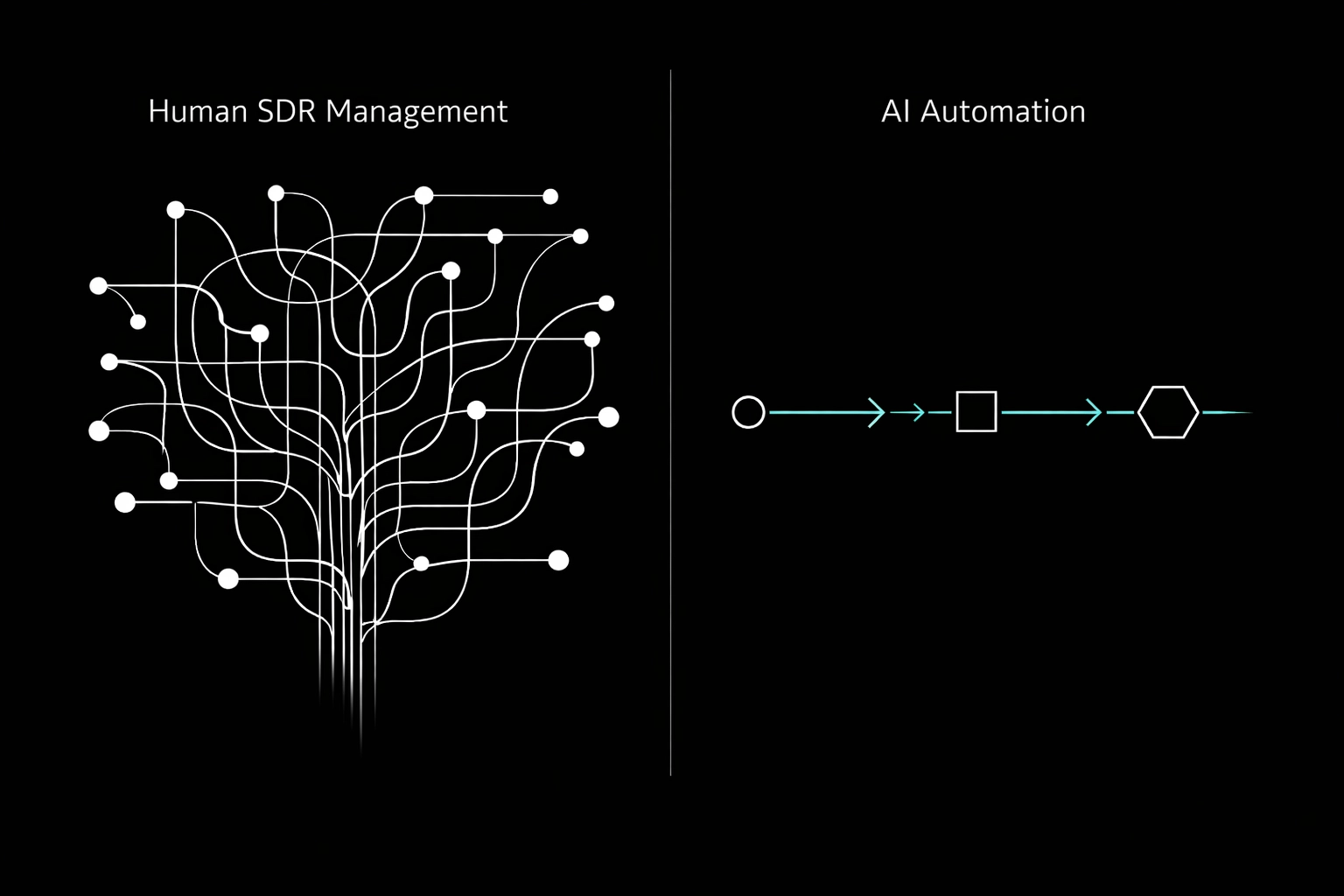
And if you're worried about losing the human touch entirely, don't be. The best approach for most teams is hybrid: AI handles initial research, outreach, and qualification. Humans step in once there's genuine interest. That way your limited founder time or first sales hire focuses on the 10-15% of prospects who actually respond, not the 85% who ghost.
Think about how you actually spend your time right now. If you're a founder doing outbound yourself, you're probably researching companies, writing emails, following up, and tracking activity in a spreadsheet. Maybe 5% of that work is relationship-building. The rest is repetitive execution. That's exactly what AI agents handle.
The Bottom Line for Early-Stage Teams
Managing remote SDRs made sense when the alternative was hiring local at $80-120K loaded cost or doing all the outbound yourself. But that's not the choice anymore.
AI agents give you 24/7 global coverage, instant productivity, and scalability without Slack overhead or management burden. They cost less, ramp faster, and let you focus on the work only you can do: building product, closing deals, talking to customers.
Does that mean you'll never hire a human SDR? No. But it means you can wait until you actually need one for relationship-heavy enterprise deals or complex objection handling. And when you do hire, they'll be focused on high-value work instead of grinding through cold email lists.
If you're spending your Sundays writing outbound emails or managing a remote SDR who still hasn't figured out your ICP, it's worth rethinking the model. Tools like Ramen let you run research-first outbound at scale without the hiring overhead: and you approve every email before it sends, so you stay in control.
The question isn't whether AI can replace every aspect of sales development. It's whether you can afford to keep managing remote teams when there's a faster, cheaper way to fill your pipeline.