
You know you need outbound. Your product has traction, a few design partners are paying, and investors keep asking about your pipeline. So naturally, you think: "We should hire an SDR."
Then you see the numbers. $80-120K loaded cost. Three months to ramp. Another two months to figure out if they're actually good or just sending generic templates to burn through your domain reputation. And you're pre-seed, maybe seed at best, trying to stretch 18 months of runway into 24.
Here's the truth about hiring an SDR in 2026: it's harder, more expensive, and riskier than ever before. But if you're going to do it, you need to understand what's changed, and what actually matters when you can't afford to get it wrong.
The 2026 SDR Market Reality
The SDR role has fundamentally shifted. In 2024, an SDR who could write decent cold emails and make 50 calls a day was solid. In 2026, that same person is replaceable by AI tools that cost $200/month.
What separates good SDRs from AI-replaceable ones now:
They understand your ICP at a systems level, not just "VP of Sales at Series A companies." They can explain why your product matters to a procurement team versus an end user. They know which objections are real blockers versus polite deflections.
They're fluent with AI tools but don't rely on them blindly. They can spot when ChatGPT hallucinates a prospect's pain point or when an AI-generated email sounds like every other AI-generated email hitting that inbox. They use AI to do research faster, not to spam faster.
They think in sequences, not one-off messages. They understand why message three in a cold sequence needs to change based on whether the prospect opened message one. They can articulate why a 7-touch sequence converts better than a 3-touch for your specific buyer.
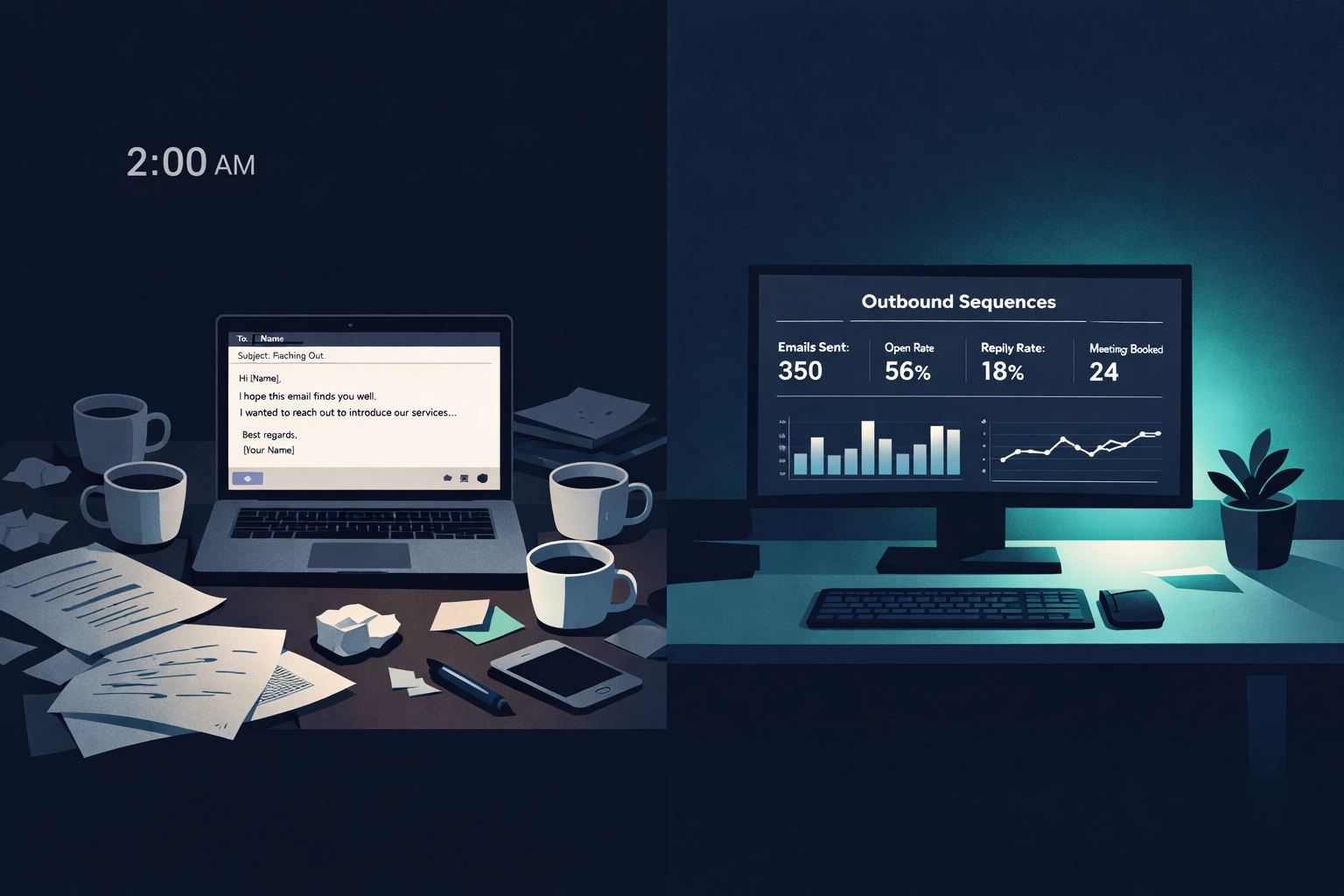
The problem? SDRs who actually have these skills cost $90-130K in major markets, and they know they're valuable. The junior SDRs at $65-75K often lack the experience to navigate 2026's complexity, AI tools, deliverability challenges, and buyers who've seen every cold email template already.
The Hidden Costs You're Not Calculating
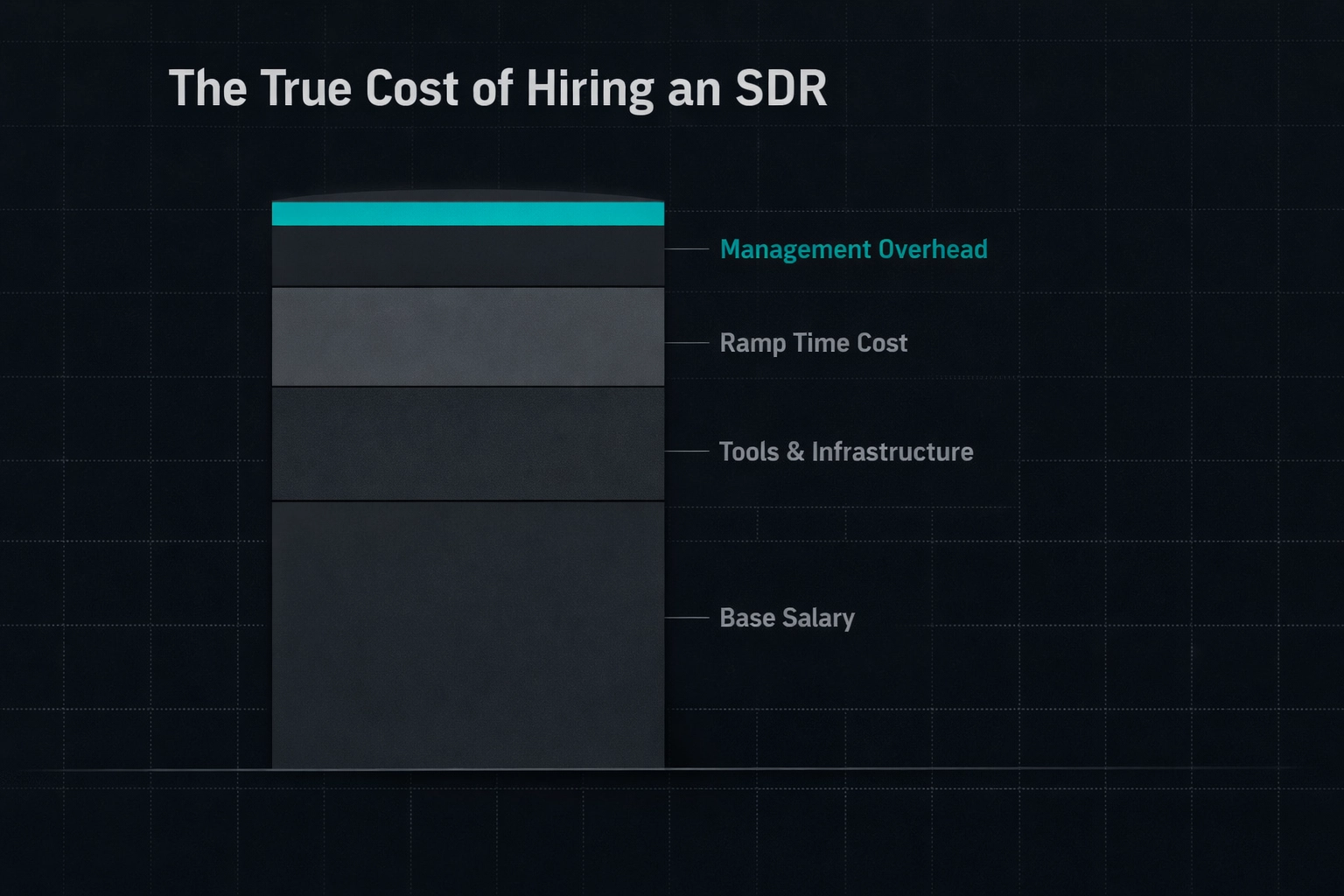
Most founders budget for salary and maybe tools. They miss the real costs of hiring an SDR in 2026:
Ramp time: Three months minimum before they book their first qualified meeting. You're paying full salary while they learn your ICP, test messaging, burn through domains figuring out deliverability, and refine their qualification criteria. That's $20-30K before any pipeline contribution.
Infrastructure: Salesforce or HubSpot ($1,200-3,000/year per seat), Apollo or ZoomInfo ($10-15K/year), Outreach or SalesLoft ($4-6K/year), domain infrastructure and email warmup tools ($500-1,000/year). Add another $15-20K annually in tooling.
Management overhead: An SDR without direction becomes an expensive spam machine. Someone needs to review their sequences, check their qualification criteria, analyze their metrics weekly, and course-correct when reply rates tank. If that's you, calculate 5-8 hours per week of your time. If you hire a sales manager to do it, add another $100K+ to the budget.
Churn risk: Average SDR tenure is 12-18 months. Just when they're finally good at their job, they get promoted to AE elsewhere or leave for more money. Now you're back to square one with ramp time and training costs.
If You're Going to Hire: What Actually Matters
Skip the "top performer" LinkedIn profiles with polished bullet points. Here's what to screen for when you hire an SDR in 2026:
Ask them to critique their own cold email. Send them a cold email they wrote at their last job (you can find these on their LinkedIn or ask for samples). Then ask: "What would you change about this today?" Weak candidates defend it. Strong candidates immediately spot the generic opener, lack of specific research, or vague value prop. They can articulate why it probably got 2-3% reply rates and what they'd do differently.
Test their research depth. Give them three target accounts from your ICP. Ask them to come back in 48 hours with outreach angles. You're not looking for perfect emails, you're looking for whether they found the actual pain points (recent funding rounds, product launches, hiring surges, tech stack changes) or just surface-level company descriptions.
Evaluate their AI literacy. Ask: "How would you use AI to scale personalization without making every email sound like AI wrote it?" Good answers involve using AI for research and first drafts, but human editing for voice and specificity. Bad answers are either "I don't use AI" (they're behind the curve) or "AI does everything" (they'll spam your prospects into oblivion).
Qualification framework clarity. Ask: "Walk me through your last discovery call." They should articulate their qualification criteria clearly, not just BANT, but the specific questions they ask to uncover budget timing, decision-making process, technical requirements, and competitive landscape. If they can't explain this systematically, they're just booking meetings, not qualifying pipeline.
The Questions No One Asks (But Should)
"How do you know when to disqualify a prospect?" Most SDRs are incentivized to book meetings, period. You need someone who can recognize when a prospect is too small, too early-stage, or fundamentally misaligned with your product, and say no. Bad pipeline is worse than no pipeline because it wastes your AE's time (or your time if you're closing deals yourself).
"What's your email deliverability strategy?" In 2026, this question separates professionals from amateurs. They should mention domain rotation, email warmup protocols, SPF/DKIM/DMARC setup, avoiding spam triggers, and monitoring sender reputation. If they look confused, they're going to burn your domains in month one.
"How do you handle a 1% reply rate after two weeks?" Strong candidates talk about testing subject lines, changing the research angle, adjusting the value prop, or pivoting the entire sequence. Weak candidates blame the list or say they need more volume (which just means more spam).
The Objection You're Already Thinking
"Can't I just use an AI SDR tool instead?"
Yes. And for most pre-seed/seed founders, you probably should.
The economics don't lie. A good SDR costs $100K+ fully loaded for 12-18 months of tenure. An AI SDR platform costs $2-5K annually and doesn't quit or need ramp time. The question isn't whether AI can replace humans: it's whether you need a human at this stage.
Here's when you actually need to hire an SDR:
- You're closing $50K+ ACV deals that require multi-threading and complex qualification
- You have 5+ AEs who need pipeline fed to them consistently
- You've validated your ICP and messaging through founder-led outbound already
Here's when you don't:
- You're pre-product-market fit and still figuring out who to sell to
- You're a solo founder or have a tiny team with no sales leadership
- You need 10-15 qualified meetings per month, not 50+
- You can't afford 3-6 months of experimentation while someone ramps
If you're in the second category, you're not avoiding hiring because you're cheap: you're being strategic about where to deploy limited capital and time.

The Alternative Path
Most founders hiring their first SDR aren't actually trying to build a sales team: they're trying to solve a pipeline problem. They need 10-20 qualified meetings per month without burning through their domain reputation or wasting hours doing manual research on Sunday nights.
The smarter play for early-stage founders: start with an AI-augmented approach that gives you SDR-level output without the SDR-level cost and risk. Tools that do deep research on every prospect, generate personalized outreach, and let you approve everything before it sends. You maintain control, avoid the spam problem, and get 80% of the results for 5% of the cost.
Then, when you're ready: when you've validated your messaging, proven you can generate pipeline consistently, and actually need someone to own the entire function: hire the SDR. But now you're hiring from a position of strength. You know what good looks like. You have benchmarks to evaluate against. You're not outsourcing the entire problem to an unproven hire.
What Actually Works Right Now
If you decide to hire an SDR in 2026, structure the role as a hybrid: part researcher, part strategist, part executor. Give them AI tools to handle the repetitive work (list building, first-pass research, initial drafts). Have them focus on the high-value activities AI still can't do well: understanding nuanced buyer psychology, crafting sequence strategies, qualifying at depth.
And if you're not ready to hire, don't force it. The best AI SDR doesn't replace the human entirely: it handles the 80% of work that doesn't require human judgment, so you can focus on the 20% that does. Which means you stay in control of your outbound motion, keep costs manageable, and preserve runway for the things that actually matter at your stage.
Because here's the final truth: hiring an SDR won't solve your pipeline problem if you don't understand your ICP, your value prop, or your buyer's actual pain points. Do that work first, whether with AI tools, founder-led outbound, or both. Then hire when you need scale, not when you need a solution.
Ramen helps pre-seed and seed founders generate pipeline without hiring an SDR: deep research on every prospect, human-approved emails, your own API keys so you control costs. It's how you get SDR-level output while staying focused on building product instead of managing salespeople. See how it works.