
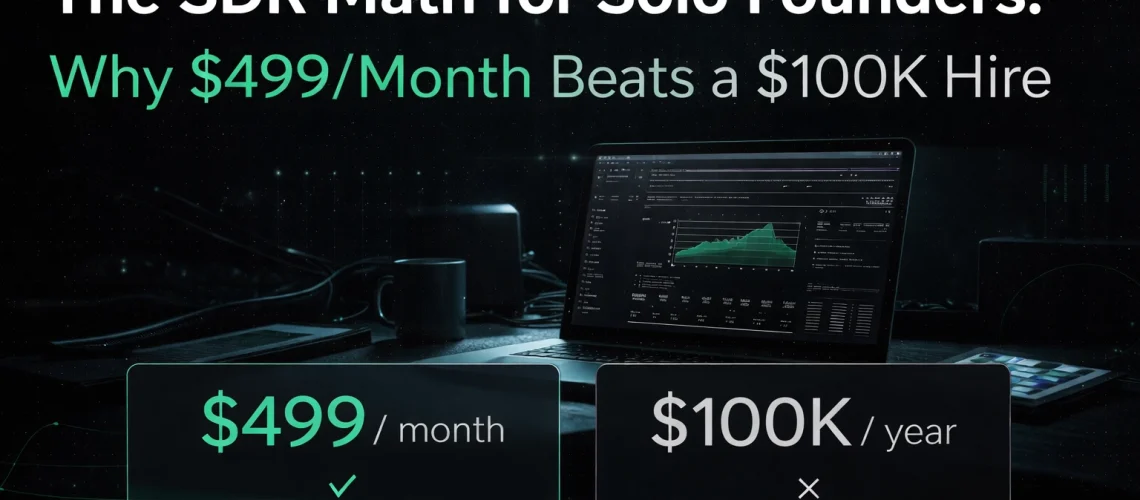
You need pipeline to raise. You need money to hire someone to build pipeline. You're stuck writing cold emails at 11 PM on Sunday because the alternative, shelling out six figures to hire an SDR, isn't an option when you're burning $30K/month and have 14 months of runway.
This post is the math you actually need. Not recruiting platitudes. Not "invest in your team" advice from founders who raised a $10M Series A. Real SDR costs, real alternatives, and a framework for deciding what makes sense at your stage.
What It Actually Costs to Hire an SDR
When founders talk about SDR costs, they usually think salary. Maybe $50-60K for someone junior in a tier-2 city. That number is a fantasy.
The fully loaded cost of an SDR, including benefits, payroll taxes, tools, management overhead, enablement, and the inevitable churn, runs $119,000 to $143,500 per year. That's $10,000-$12,000 per month walking out the door before they book a single meeting.
Here's where it gets worse: SDRs take 2-3 months to ramp. During that window, you're paying full price for someone who's learning your ICP, fumbling through your value prop, and sending emails that make you cringe. If they quit at month four (and the median SDR tenure is 14 months), you get to start over.
For a seed-stage company, that math is brutal. You're not just paying for an SDR, you're paying for:
- Base salary: $50-70K
- Benefits and taxes: Add 20-30%
- Tech stack: Sales engagement platform, CRM seats, data tools ($500-1,000/month)
- Management time: Who's coaching them? That's your time or a fractional sales leader's
- Ramp period: 2-3 months of below-target output
- Churn risk: 50% chance they leave within 18 months
When you add it up, you're looking at $100K+ in year one for a bet that might not pay off.
The Hidden Cost Nobody Talks About
There's another number that matters more than SDR costs: your time.
If you're a solo founder doing your own outbound, you're probably spending 15-25 hours per week on prospecting, research, and writing emails. At even a conservative $200/hour implied CEO value, that's $150,000-$250,000 in annual opportunity cost.
One analysis found that a founder at $4M ARR who was still doing their own sales was losing nearly one-third of annual revenue to hidden costs, burnout, missed product decisions, slower fundraising.
The real question isn't "can I afford to hire an SDR?" It's "can I afford to keep doing this myself, and what's the cheapest way to stop?"

The $499/Month Math
Here's where the comparison gets interesting.
At $499/month, an AI SDR tool costs $5,988 per year. That's roughly:
- 5% of a fully loaded SDR hire
- Less than one month of a junior SDR's salary
- About what you'd spend on a half-decent sales engagement platform alone
But cost savings mean nothing if the output is garbage. So let's talk about what $499/month actually gets you.
A modern AI SDR platform (like Ramen) handles:
- Prospect research: Deep dives on each contact, not just name and title
- Personalized email generation: Based on actual signals, not mail-merge templates
- Send sequencing: Multi-touch campaigns timed for deliverability
- Reply handling: Routing positive responses to your inbox
The catch, and this is important, is that you still need to approve what goes out. More on that in a minute.
Running the Real ROI Comparison
Let's do the math that actually matters: cost per qualified meeting.
Scenario: Hire an SDR
- Annual cost: $120,000 (conservative fully loaded)
- Ramp time: 3 months of reduced output
- Monthly meetings booked (post-ramp): 8-12
- Annual meetings: ~80-100 (assuming some ramp drag)
- Cost per meeting: $1,200-$1,500
Scenario: AI SDR at $499/month
- Annual cost: $5,988
- No ramp time (you're already live)
- Monthly meetings booked: 4-8 (conservative, you're approving everything)
- Annual meetings: ~50-80
- Cost per meeting: $75-$120
Even if an AI SDR books half the meetings of a human rep, the cost-per-meeting ratio is 10-15x better. For a founder trying to build pipeline on a shoestring, that math matters.
The breakeven point where hiring makes sense is roughly when you need 15+ qualified meetings per month and have the revenue to support a $120K annual investment. For most pre-seed and seed founders, that's not the reality.
"But AI Emails Are Spam"
Let's address this directly, because it's the objection that matters.
Yes, most AI-generated outbound is garbage. The tool farms blasting 10,000 identical emails with [FIRST_NAME] tokens have poisoned the well. Prospects can smell automation from three sentences away, and reply rates have cratered across the industry.
Here's what's different about a human-in-the-loop approach:
You approve every email before it sends. This isn't fully autonomous blasting: it's AI doing the research and drafting, while you maintain quality control. Think of it as a research assistant who writes first drafts, not a robot running your outbound on autopilot.
The emails that actually work in 2025 aren't personalized at the "I saw you went to Duke" level. They're relevant at the problem level: showing you understand the prospect's context, their likely pain points, and why a conversation might be worth their time.
An AI that does deep research on each prospect: company news, tech stack, recent hires, funding signals: can write that kind of email. A junior SDR working through a list of 50 accounts per day cannot.
What About Domain Risk?
This is the other fear, and it's legitimate. Burn your domain with spammy outbound and you've created a problem that takes months to fix.
Three things matter here:
-
Volume: Blasting 500 emails/day from a fresh domain will torch your reputation. A human-in-the-loop system naturally throttles volume because you're reviewing everything.
-
Quality: Emails that get marked as spam or ignored kill your sender reputation. Emails that get replies (even negative ones) help it. Research-backed personalization improves reply rates and protects your domain.
-
Infrastructure: Separate your outbound domain from your main domain. Use proper warmup. Monitor deliverability. This isn't AI-specific advice: it's outbound hygiene that applies to any approach.
If you're worried about domain health, the AI SDR approach that emphasizes research-first outbound is actually safer than a junior SDR trying to hit activity quotas.
When This Math Doesn't Work
Let's be honest about the limitations.
AI SDR tools don't make sense if:
- You're selling to 50 enterprise accounts where every touchpoint needs to be handcrafted
- Your ACV is $500K+ and the sales cycle is relationship-driven over 12+ months
- You have zero idea who your ICP is: AI can't fix positioning problems
They work best when:
- You're selling to SMB or mid-market
- Your deal size is $10K-$100K ACV
- You have a reasonably defined ICP
- You need pipeline but can't justify a $100K+ hire
For most seed-stage B2B founders, that's the situation.
The Decision Framework
Here's how to think about this:
If you're pre-revenue to $500K ARR: Do founder-led outbound with AI assistance. You can't afford the SDR costs, and you shouldn't outsource learning about your market anyway. But you also shouldn't be spending 20 hours a week writing emails.
If you're $500K-$2M ARR: AI SDR makes the most sense here. You have some revenue to invest, you need more pipeline than you can generate alone, but you're not ready for a $120K bet on a hire.
If you're $2M+ ARR: Start thinking about hiring, but consider keeping AI in the stack even then. A human SDR with AI research support can outperform either approach alone.
If you're stuck in the founder-led sales grind and the SDR costs don't make sense yet, Ramen might be worth a look. It's built for exactly this stage: deep prospect research, emails you approve before they send, and a price point that doesn't require a board conversation. Book a demo and see if the math works for you.